

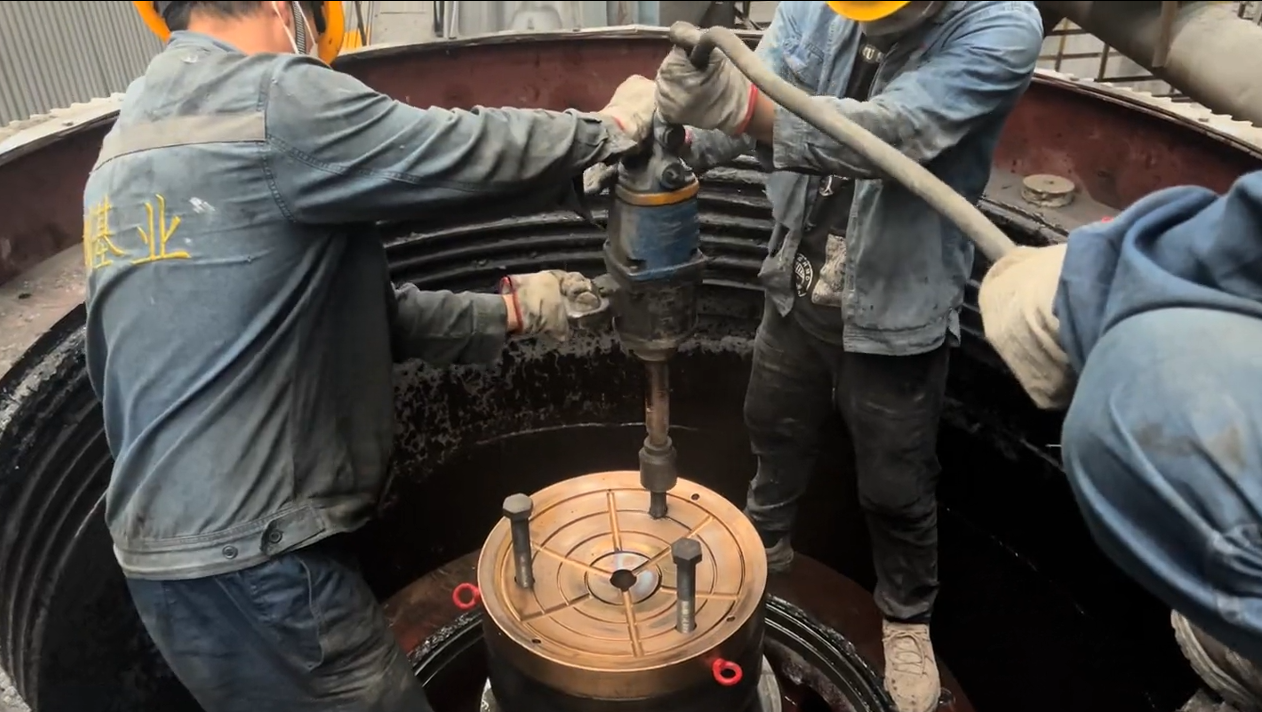
The socket liner (often referred to as the spherical bearing or step bearing) supports the entire vertical load of the mantle assembly and crushing force. Unlike the eccentric bushing which handles radial loads, the socket liner must maintain the geometric pivot point of the main shaft. For maintenance managers operating Symons or HP series crushers, replacing this bronze component is a precision task. A worn socket liner drops the head assembly, reducing the closed-side setting (CSS) clearance, altering the nip angle, and risking metal-to-metal contact between the mantle and head center.
This technical guide defines the quantitative wear limits, failure signatures, and replacement protocols to prevent catastrophic head spin or socket failure.
Diagnostic Criteria: Measurable Wear Limits
Visual inspection is insufficient. Replacement decisions must be based on dimensional measurements taken during liner changes or major inspections.
| Parameter | Standard Condition | Warning Threshold | Critical Replacement Limit |
|---|---|---|---|
| Liner Thickness | Varies by model (e.g., 25mm) | -15% of original thickness | -25% or <3mm oil groove depth remaining |
| Shaft “Sinking” | Baseline height measurement | Head has dropped >3mm | Head drop >5mm (Risk of head ball contacting socket casting) |
| Oil Groove Depth | Typically 6-8mm | < 3mm remaining | < 1mm (Hydrodynamic lift failure imminent) |
| Surface Profile | Smooth, uniform bronze | Galling / Scuffing (>10% area) | Step wear >0.5mm at load zone edge |
Failure Modes and Root Causes
- “Step” Wear: A ridge forms at the edge of the ball contact area. This indicates a consistent short-stroke operation or undersized feed preventing full gyration. Risk: The ridge acts as a stress riser, cracking the liner.
- Lead Sweat / Smearing: Silvery streaks or melted patches on the bronze. Caused by lubrication failure (Temp > 120°C) or overload. Risk: Loss of bearing geometry leading to head spin.
- Fretting Corrosion: Red dust on the backside of the liner. Indicates the liner is loose in the socket. Risk: The liner will spin and destroy the expensive socket casting.
SOP: Replacement and Installation Protocol
Replacing a socket liner is not a “drop-in” job. It requires precision fitting to ensure the load is distributed evenly across the spherical surface.
1. Preparation and Removal
- Cooling: If the liner is interference-fitted, use dry ice to shrink it for removal. Avoid heating the socket casting, which can warp the precision bore.
- Inspection: Clean the socket seating surface thoroughly. Check for burrs or high spots. A 0.1mm debris particle under the liner will cause a high spot on the bearing surface, leading to rapid failure.
2. Installation and Blue Fitting (The Critical Step)
You cannot simply install the liner and run. You must verify the contact pattern between the new liner and the head ball.
- Bluing: Apply Prussian Blue paste to the head ball.
- Test Fit: Lower the head onto the new socket liner. Rotate the head 30-45 degrees back and forth. Lift the head.
- Verify Pattern:
- Target: >80% contact area distributed evenly.
- Outer Edge Contact: Good. Ensures stability.
- Inner Edge Only: BAD. Creates an unstable “wobble” and will lead to rapid failure. Scrape the liner to correct.
3. Break-In Procedure
New bronze needs time to conform to the steel head ball.
- Run-In: Operate unloaded for 4 hours. Monitor oil return temperature. A spike >5°C above normal indicates binding.
- First Load: Introduce feed gradually (50% capacity) for the first shift.
Preventive Maintenance: Lubrication is Key
The socket liner operates in a mixed lubrication regime—boundary lubrication during crushing impacts and hydrodynamic during idling.
- Oil ISO Code: Maintain 18/16/13. Bronze is soft; particles embed and become cutting tools against the steel head ball.
- Oil Pressure: Ensure the socket lube line is not clogged. This line is often the highest point in the lube circuit and prone to air locks.
Engineer’s Note: When replacing the socket liner, always inspect the head ball condition. Installing a new liner under a scored or out-of-round head ball is a waste of money. The rough steel will machine the new bronze liner in less than 200 hours. If the head ball is damaged, it must be re-machined or polished before assembly.


 English
 French
 German
 Spanish
 Russian
 Arabic
 Portuguese
 Turkish