
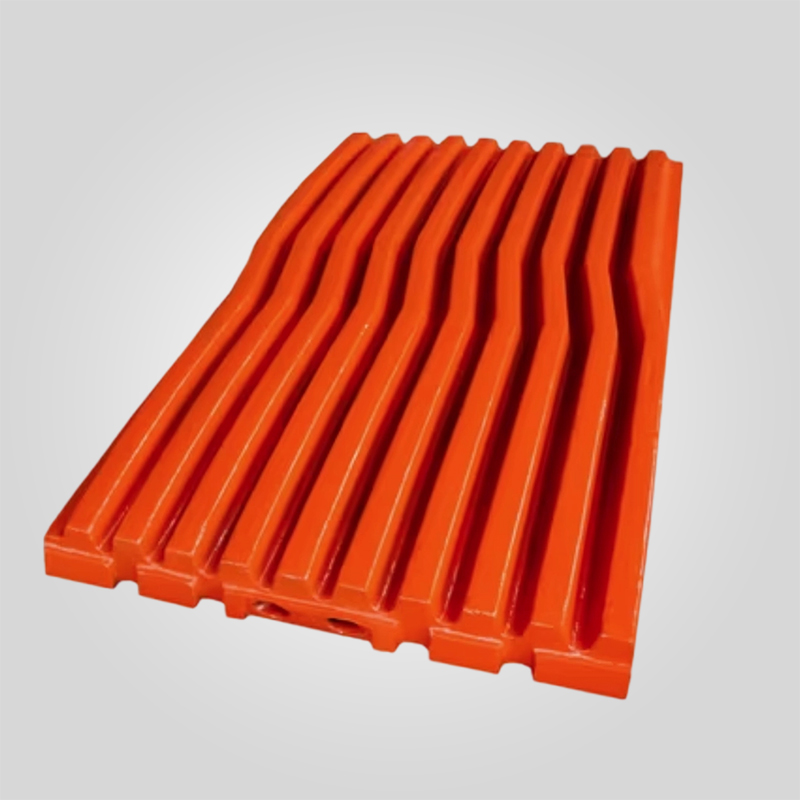
Mn18Cr2 Swing Jaw Plate: Heavy-Duty Moving Jaw Die
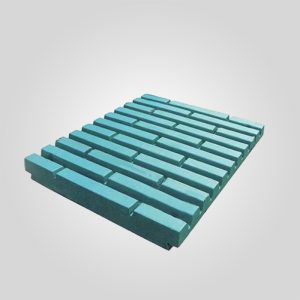
The Swing Jaw Plate (or Moving Jaw Die) is the dynamic component of the crushing chamber. Mounted directly onto the reciprocating Pitman (Jaw Stock), it delivers the crushing stroke against the stationary plate. This component faces the most severe operating conditions: cyclic impact loading combined with intense sliding abrasion as material is forced downward.
We manufacture our swing jaw plates using ASTM A128 Grade C (Mn18Cr2) High Manganese Steel. This alloy is specifically chosen for its work-hardening characteristics. While the initial hardness is ~220 HBW (to prevent cracking under shock), the surface quickly hardens to >500 HBW upon impact, forming a wear-resistant skin that outlasts standard Mn13 steel by 30%.
Technical Specifications
| Parameter | Data / Standard |
|---|---|
| Part Type | Swing Jaw Plate (Moving Die) |
| Material Grade | Mn18Cr2 (ASTM A128 Grade C) |
| Initial Hardness | 220 – 250 HBW (Austenitic) |
| Work-Hardened Hardness | 550 – 600 HBW (In-Service) |
| Tooth Profile | Standard Wave / Super Tooth / Corrugated |
| Mounting Surface | Machined Flat (Ra 6.3) for Pitman Contact |
| Heat Treatment | Water Quenching (Toughening Treatment) |
Performance Analysis: Dynamic Crushing Optimization
- Inertia Balance: Our plates are cast with a precise weight tolerance (±2%) to ensure the Pitman assembly remains balanced. An unbalanced swing jaw causes excessive vibration, destroying the main bearings.
- Anti-Slip Profile: The “Wave-Profile” ridges are designed with a calculated nip angle. This geometry grips smooth river gravel or slabby rock, preventing it from popping out of the chamber (Pop-Corn Effect).
Field Diagnosis & Maintenance: Preventing Pitman Damage
[Pro-Tip] A loose Swing Jaw Plate will destroy the Pitman face ($20k+ repair).
1. The “Clicking” Sound: If you hear a metallic clicking or knocking sound during crushing, the jaw die is loose. Stop immediately and tighten the wedge bolts.
2. Backing Condition: Unlike the fixed jaw, the swing jaw moves. If the backing material (epoxy or zinc) crumbles, the plate will flex and crack. Inspect the backing during every liner change.
3. Reversible Wear: Just like the fixed plate, the swing jaw wears most at the bottom (discharge) end. Flip it 180 degrees when the bottom teeth are 50% worn to double its life.
Installation Best Practices
- Surface Prep: The face of the Pitman must be perfectly clean. Remove all old backing compound. Any high spots will cause the new plate to crack under load.
- Tightening Sequence: Tighten the wedge bolts in a star pattern. Re-torque them after 4 hours and 24 hours of operation, as the liner will “settle” against the pitman.
- Cheek Plate Gap: Ensure there is a small gap (3-5mm) between the side of the jaw plate and the Cheek Plates to allow for thermal expansion.
Technical Parameters of Applicable Jaw Crusher

Workshops And Warehouses

Cross-Brand Compatibility Disclaimer
Our aftermarket crusher spares are engineered to be fully interchangeable with OEM components (e.g., Metso C Series, Sandvik CJ Series). All manufacturer names, part numbers, and descriptions are used for reference purposes only. NEWREG supplies independently manufactured replacement parts and is not affiliated with the OEM.

 English
 French
 German
 Spanish
 Russian
 Arabic
 Portuguese
 Turkish