

Mn18Cr2 Fixed Jaw Plate: Heavy-Duty Stationary Jaw Die
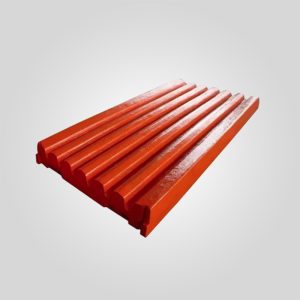
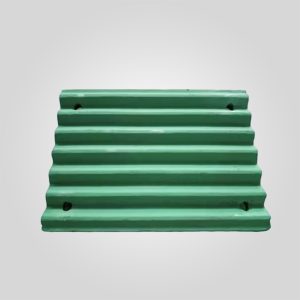
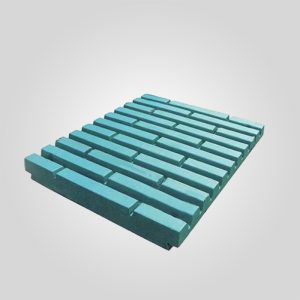
The Fixed Jaw Plate is the stationary crushing surface in a single-toggle jaw crusher. It endures the brunt of the crushing force as the Swing Jaw compresses material against it. Unlike the movable jaw, the fixed plate is bolted rigidly to the front frame. Its performance is defined by two factors: the ability to grip the rock (Nip Angle) and the ability to withstand extreme compressive impact without cracking.
We manufacture our jaw plates using ASTM A128 Grade C (Mn18Cr2) High Manganese Steel. This alloy offers the optimal balance between initial hardness and work-hardening capability. Under the impact of hard rock (granite/basalt), the surface layer transforms from an austenitic structure (~220 HBW) to a hard martensitic skin (>500 HBW), providing a self-renewing wear surface.
Technical Specifications
| Parameter | Data / Standard |
|---|---|
| Part Type | Fixed Jaw Plate (Stationary Die) |
| Material Grade | Mn18Cr2 (ASTM A128 Grade C) |
| Initial Hardness | 200 – 240 HBW |
| Work-Hardened Hardness | 500 – 550 HBW (In-Service) |
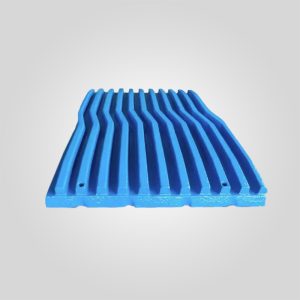
| Tooth Profile | Standard Wave / Super Tooth / Quarry Tooth |
| Mounting Face | Machined Flat (Ra 6.3) for Frame Contact |
Performance Analysis: The “Wave” Advantage
- Nip Efficiency: Our Precision Wave-Grooves are cast with a sharp profile radius. This maximizes the point-loading on the rock, initiating fractures with 25% less force than worn, rounded teeth.
- Slippage Reduction: The optimized tooth pitch (35-50mm depending on size) prevents flat or slabby material from sliding up the chamber, reducing “belching” and increasing throughput by ~15%.
Field Diagnosis & Maintenance: Get 2x Life
[Pro-Tip] Stationary Jaw Plates wear unevenly.
1. The “Toe” Wear: 80% of crushing happens at the bottom (Closed Side Setting zone). The top of the fixed plate sees very little wear.
2. Flip It: Our plates are designed symmetrically. When the bottom teeth are worn flat (approx. 50% wear), flip the plate 180 degrees. This moves the unworn top section to the crushing zone, effectively doubling the service life. Do not wait until the plate is worn through to the backing, or you will damage the crusher frame.
Installation Best Practices
- Backing Integrity: The back of the jaw plate must sit flush against the frame. Any gap will cause the plate to flex and crack. We recommend checking the frame wear plate for straightness.
- Tightening Wedges: The cheek plates and upper wedges hold the jaw die in place. Re-torque the wedge bolts after the first 8 hours of operation, as the liner will “seat” into position.
- Jaw Dies Must Match: Always replace the Fixed and Swing jaw plates together, or verify that the tooth profiles mesh (Peak-to-Valley). Mismatched profiles (Peak-to-Peak) will reduce capacity by 30% and cause extreme vibration.
Workshops And Warehouses

Cross-Brand Compatibility Disclaimer
Our aftermarket crusher spares are engineered to be fully interchangeable with OEM components (e.g., Metso C Series, Sandvik CJ Series). All manufacturer names, part numbers, and descriptions are used for reference purposes only. NEWREG supplies independently manufactured replacement parts and is not affiliated with the OEM.
 English
 French
 German
 Spanish
 Russian
 Arabic
 Portuguese
 Turkish