

Mn18Cr2 Fixed Jaw Plate: Stationary Crushing Surface Engineering, Work-Hardening Kinetics, and Stress Distribution Analysis
In the primary comminution circuit, the fixed jaw plate (stationary jaw die) serves as the anvil against which the movable jaw exerts compressive forces often exceeding 350 MPa. Unlike the moving jaw which benefits from the inertial momentum of the pitman, the fixed jaw plate must endure static rigidity while absorbing high-frequency cyclic shock loads. The structural integrity of this component is defined not by marketing claims, but by its ability to maintain a stable nipping angle (typically 18-22 degrees) while resisting surface gouging and fatigue cracking under high-stress abrasion.
A standard jaw crusher operating at a closed side setting (CSS) of 100mm processing granite with a Bond Work Index of 16 kWh/t will subject the fixed jaw to localized point loading that creates extreme plastic deformation. If the metallurgy is insufficient, this leads to rapid “mushrooming” of the metal, closing the gaps between plates and stressing the frame. This technical dossier outlines the engineering specifications of our Fixed Jaw Plates, manufactured from solution-annealed Mn18Cr2 austenitic manganese steel, designed to maximize fracture toughness and wear life through controlled work-hardening mechanisms.
Metallurgical Composition and Strain Hardening Mechanics
The performance of a jaw plate is dictated by its microstructural response to impact. We utilize a modified Mn18Cr2 (ASTM A128 Grade C) alloy chemistry, distinct from the generic Mn13 grades often found in lower-cost aftermarket parts.
- Austenitic Matrix Stability: The casting process involves water quenching from 1050°C to suppress carbide precipitation. This results in a fully austenitic structure with high ductility (elongation > 30%) in the as-supplied state (220 HBW). This ductility is critical; it ensures the plate does not crack under the initial tensile stresses of installation and startup.
- The Work-Hardening Phenomenon: Upon impact with feed material, the surface lattice structure undergoes a phase transformation. Slip planes and twinning deformation occur within the austenite grains, effectively increasing the surface hardness from the initial 220 HBW to over 550 HBW (approx. 52-54 HRC). This creates a hard, wear-resistant “skin” that constantly renews itself as it wears down, while the core remains ductile to arrest crack propagation.
- Chromium Reinforcement: The addition of 2% Chromium creates hard chromium carbides dispersed within the matrix, providing initial resistance to gouging abrasion before the work-hardening layer is fully established. This is particularly vital when crushing abrasive materials with Mohs hardness > 6.0, such as quartzite or river gravel.
Tooth Profile Geometry and Crushing Efficiency
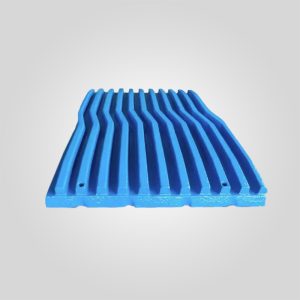
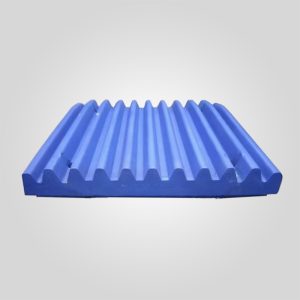
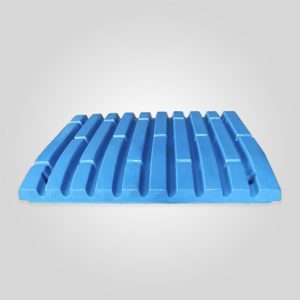
The visual signature of the parallel vertical ridges is not merely aesthetic; it is a calculated geometric optimization for force distribution.
Point Loading vs. Distributed Load:
Flat plates distribute the crushing force over a large area, which is inefficient for initiating fracture in hard rock. Our engineered tooth profile reduces the contact surface area, thereby increasing the localized pressure (Pressure = Force / Area) to exceed the compressive strength of the rock (typically 150-300 MPa). The 12-16 uniform ridges function as stress concentrators, initiating cracks in the feed material more rapidly.
Material Flow and Nipping Angle:
The valley depth (10-14mm) and tooth pitch are optimized to grip the rock during the compression stroke, preventing “pop-outs” where rock slippage ejects material upwards. A maintained sharp tooth profile ensures the effective nipping angle remains below the critical friction limit (approx. 24 degrees). Worn, rounded teeth increase this angle, reducing throughput by up to 15% and increasing liner wear due to slippage friction.
Manufacturing Precision and Back Surface Integrity
A critical, often overlooked specification is the flatness of the non-crushing side (the back) of the plate.
Machined Mounting Surfaces:
Castings naturally warp during cooling. While low-tier manufacturers leave the back surface “as-cast,” we perform precision machining on the mounting pads to achieve a flatness tolerance of 0.3mm per linear meter.
Why this matters: If the back of the jaw plate is not flat, it creates unsupported spans when bolted to the front end frame. Under crushing loads, these unsupported sections act as cantilever beams, leading to catastrophic flexural fatigue failure (snapping the plate in half) regardless of material quality. The machined surface ensures 100% contact area with the frame or backing plate, transmitting loads directly into the crusher structure as intended.
Technical Specifications Data
| Parameter | Specification Value | Standard / Test Method |
|---|---|---|
| Material Grade | Mn18Cr2 (High Manganese) | ASTM A128 Grade C / GB/T 5680 |
| Chemical Composition | C: 1.15-1.25%, Mn: 17.5-19.0%, Cr: 1.8-2.2% | Spectrometer Analysis |
| Initial Hardness | 210 – 240 HBW | Brinell Hardness Test |
| Work-Hardened Capability | ≥ 550 HBW (Surface) | Field Hardening Potential |
| Tensile Strength | ≥ 800 MPa | ISO 6892-1 |
| Impact Toughness | ≥ 145 J/cm² @ -25°C | Charpy U-Notch (AKU) |
| Dimensional Tolerance | CT11 – CT12 | ISO 8062-3 (Casting) |
| Machining Tolerance | ± 0.3 mm | Mounting Surfaces |
Installation Dynamics and Frame Protection
The interaction between the fixed jaw plate and the crusher frame is the single most common source of structural damage. The fixed jaw does not move, but micro-vibrations are inevitable.
The Importance of Tight Fitment:
The jaw plate is secured by a wedge system. If the torque on the wedge bolts is insufficient, or if the casting dimensions are undersized, the plate will shift vertically during the return stroke. This movement acts like a hammer against the toe of the crusher frame and the wedge faces. Over time, this fretting wear destroys the precision machined surfaces of the crusher frame, necessitating expensive weld repairs and line boring. Our plates are cast with a +1mm/-0mm length tolerance to ensure a tight interference fit with the wedge system.
Failure Mode Analysis: Avoiding “Mushrooming”
A common failure mode in manganese steel is plastic flow or “mushrooming.” If the jaw plate material is too soft (e.g., Mn13) or the impact energy is too low to work-harden the surface but high enough to deform it, the metal flows laterally. This expansion can permanently lock the jaw plate into the frame, making removal impossible without thermal lancing (cutting with a torch). By utilizing Mn18Cr2 with controlled Carbon/Manganese ratios, we increase the initial yield strength, significantly reducing the risk of lateral plastic flow while maintaining the work-hardening benefits.
Total Cost of Ownership (TCO) Analysis
When evaluating jaw crusher wear parts, the purchase price is a minor component of the TCO.
Scenario: A generic Mn13 plate costs $800 and lasts 400 hours. Our Mn18Cr2 plate costs $1,100 and lasts 650 hours.
Direct Cost: The generic plate costs $2.00/hour. The Mn18Cr2 plate costs $1.69/hour.
Indirect Cost (Downtime): Replacing jaw plates takes approximately 4-6 hours. If the crusher produces 300 tons/hour at $10/ton margin, one downtime event costs $12,000 to $18,000 in lost opportunity. By extending the changeout interval from 400 to 650 hours, the operational savings far outweigh the initial component cost difference.
Engineer’s Advice: Field Operations & Maintenance
[Option B: Pro-Tip] – The 50% Wear Rotation Rule:
Even though the fixed jaw doesn’t move, the wear profile is rarely uniform. Typically, the lower 30% of the plate (the crushing zone) wears fastest due to the higher density of material and smaller reduction ratio at the discharge. Do not wait for the bottom to wear through. When the tooth profile at the bottom is worn to 50% of its original height, flip the plate 180 degrees (top to bottom). This brings the fresh tooth profile from the top into the high-wear crushing zone, effectively extending the total service life of the casting by 30-40%.
[Option C: Field Case Snippet] – The “Shim” Solution:
In a recent audit of a basalt quarry, we found the fixed jaw plate was cracking vertically down the centerline. The cause was not the material, but the frame face—it had worn concave over years of use (a 2mm gap in the center). When the flat jaw plate was bolted down, it bridged this gap. Under load, it flexed and snapped. Advice: Always check the frame flatness with a straight edge during liner changes. If a gap exists, use a minimal amount of backing compound (crusher epoxy) or precise steel shims behind the jaw plate to support the void. Never bolt a flat plate to a curved frame.
Quality Assurance and Traceability
Every fixed jaw plate we manufacture is serialized and traceable to its specific heat batch.
- Phase 1: Raw material spectral analysis before pouring.
- Phase 2: Ultrasonic testing (UT) per ASTM A609 Level 2 to detect internal shrinkage or porosity.
- Phase 3: Dimensional verification of the wedge locking angles and back flatness.
This ensures that the part you receive fits correctly the first time and performs predictably throughout its campaign.
Technical Parameters of Applicable Jaw Crusher

Workshops And Warehouses

Cross-Brand Compatible
Our aftermarket parts are reverse-engineered using coordinate measuring machines (CMM) to ensure dimensional interchangeability with the following OEM standards. We guarantee fitment tolerances within ISO 2768-mK.
| Brand | Series | Crusher Model |
|---|---|---|
| Mettso | Nordberg Jaw C series | C3054,C3055,C63,C80,C96,C105,C106,C110,C116,C120,C125,C130,C140,C145,C150,C160,C200 |
| Nordberg Bergeaud VB Series | VB46 , VB57 , VB67 , VB83 , VB93 , VB105 , VB108 , VB0907 , VB1008 , VB1311 | |
| Sandvick | Jaw Crusher CJ series | CJ815, CJ615, CJ613, CJ612, CJ412, CJ411, CJ409, CJ211 |
| Kleemann | Mobicat Jaws series | MC100R EVO,MC110R EVO , MC110Z EVO ,MC120Z PRO,MC125Z , MC140Z,MC160PRR |
| SSTR Jaws series | SSTR1000,SSTR1100, SSTR1200, SSTR1250,SSTR1400, SSTR1600 | |
| Shanbao | Jaw Crusher PE series | PE150x250, PE250x400, PE400x600, PE500x750, PE600x900, PE750x1050, PE900x1200, PE100X1200, PE1200x1500, PE1500x1800. |
| Jaw Crusher PEX series | PEX250x750, PEX250x1000, PEX250x1200, PEX300x1300 | |
| Trio | CT Jaw Series | CT1030,CT1040,CT1048,CT1252,CT2036,CT2436,CT3042,CT3648,CT4073,CT4254,CT4763,CT6080,APS40 |
| Extec | QJ Mobile Crushers | C10 ,C12,QJ241,QJ341 |
| Allis Chalmers / Svedala | Allis Chalmers Superior Jaw Series | 36 x 48 Superior, 60 x 84 Superior |
| Allis Chalmers STD Jaws | 10x 24 ,15 x 24 , 18 x 30 Model B , 18 x 36, 24 x 36, 25 x 36 “A-1 New, 42 x 40 A1 , 36 x 48 New , 42 x 48 A1 ,48×60 , 66 x 84 A1 | |
| Svedala CJ Series | CJ208,CJ209,CJ211,CJ408,CJ409,CJ411,CJ412,CJ612 ,CJ613,CJ615, CJ815 | |
| Svedala RT Series | RT6090 (24X36) , RT75105 ( 30 x 42 ) , RT60-120 (24 x 48 ) , RT 80-120 (32 x 48) , RT105-120 (42×48) , R10580 (1050×800) | |
| Svedala Jawmaster Series | 1108HD (32 x 42) , 1206HD (24 x 48) , 1208HD (32×48) , 1211HD (44 x 48 ) , 1312HD (46×52) , 1513HD (52×60) | |
| Terex | Jaques JW Range | JW40, JW42 , JW45, JW55 |
| Jaques ST Range | ST36, ST42, ST47,ST48, ST54,ST60 | |
| Cedarapids JC Range | JC2236,JC3660,JC5460,JS3750,JS4552,JC5460 | |
| Cedarapids Old Range | 10×16,12×16,10×20,10×24,15×24,18×24,20x25A , 18×30 ,10×36 ,12×36,15×36 ,18×36,20×36, 24×36,25×40,32×40,12×42,16×42,27×42,42×42,36×48, | |
| 12×48,16×48,22×48,42×48,57×48,35×54,36×60,54×60,10×72 | ||
| Finlay Mobile Jaw Series | J-960,J-1160,J-1170,J-1175,J-1480 | |
| Powerscreen Premiertrak | XA300, XA400 , XR400 , XA400S, XR400S, Premiertrak 600 ,XA750 | |
| BL-Pegson Premiertrack | 1100×650 , 1100x650HA , 1100x650HR , 1100×800 | |
| BL-Pegson Premierplant | 900×600 , 1100×650 , 1100×800 | |
| BL-Pegson Stationary Jaws | 24×14 ,32×18 , 32×22, 32×06 , 36×20 , 36×22 , 36×24 , 36×25 ,42x30B , 42x30D , 44×26 ,44×32 , 48×42 | |
| Telsmith | Telsmith Old Jaw Range | 10×21,14×24,24×5,30×42,42×48 |
| Hydraulic Jaw Range | 2038, 2550, 3042, 3055, 3648, 3258, 3858, 4448, 5060 | |
| Hydra & Iron Jaw Range | H2238, H2550, H3244, H3450, H4448, H5060, H3042, H3055, H3648, H3258, H3858, ,4448IG ,5060IG, | |
| Komatsu | BR Jaw Series | BR100JG,BR200,BR210,BR300,BR350,BR380,BR500,BR550JG,BR580 |
| Chyi Meang | PJS Series | PJS800, PJS900,PJS1050,PJS100,PJS1100,PJR1350, PJS1260, PJS1400,PJS1500,CMNJS4836 |
| Comec Primary Jaw Crusher | P90.65, P900 ,P105.75 , P1100 ,P1300 ,P1600 | |
| Comec Secondary Jaw Crusher | S800 ,S900 ,S1000 ,S1450 | |
| Goowin Barsby | Series 5 Jaws | 30″x18″,42″x24″ ,42″x30″ ,36″x6″ Granulator |
| Krupp | Jaw Range | ERC18-14 ,EB12-10 ,EB14-11 ,EB16-12,EB20-15 |
| Kawasaki | KS Series Jaws | KS-3624,KS-3018, KS-4230G,KS-4840,KS-6048, KD-4232G,KD-4842G |
| Hewitt-Robins | Jaw Range | 10×24, 18×30 ,10×36 ,12×36 ,15×36 ,20×36 ,24×36 ,30×36 ,30×42 ,12×48 ,22×48,30×48 ,36×48,42×48, 36×50 ,12×60,30×60,, 18×30 ,10×36 ,12×36 ,15×36 ,20×36 ,24×36 ,30×36 ,30×42 ,12×48 ,22×48,30×48 ,36×48,42×48, 36×50 ,12×60,30×60,48×60,30×62 |
| Lippmann | Jaw series | 2248, 2436, 3042, 3048, 3055, 3062, 3650, 3862, 4248, 5062 |
| Parker | Jaw series | Parker40x32 , Parker 36×10 , Parker 38×12 Stonesizer , Parker 20×12 , Parker16x10 , Parker16x5 |
| Brown Lenox Kue-Ken | Jaw Series | Model 22(3 x 12) , Model 24 (5 x 12), Model 25 (7×12) ,Model 34 (6 x 16) , Model 35(9 x 16), Model 54( 8 x 24), Model 55(10 x 24) ,Model 56 (12 x 24)Model 68 (9 x 30) , |
| Model 69(12×39) , Model 70 (15 x 30) , Model 75S (20 x 30) , Model 79 (8 x 36), Model 80(10 x 36) Model 81(12 x 36), Model 89 (16 x 36) , Model 90(20 x 36) , Model 95 (24 x 36) , | ||
| Model 95S( 29 x 36) , Model 104( 8 x 42) , Model 105(10 x 42), Model 106 (12 x 42), Model 106S (14 x 42) , Mode ,107 (17 x 42) ,Model 108 (20 x 42) , Model 110(25 x 42) , | ||
| Model 120 (30 x 42) , Model 126(36 x 42) ,Model 145 (24 x 48) , Model 150(36 x 48) , Model 150A (40 x 48) , Model 150s (42 x 48), Model 160 (42 x 48) , | ||
| Model 188 (26 x 60) Model 32 x 60 , Model 200 (48 x 60) | ||
| Hitachi-Nakayama | Nakayama Primary Range | AC1410,AC2415,AC3219,AC3219B,AC4219,AC4220,AC4220B, AC482,AC6030 |
| Nakayama RC Range | SK3624,RC3624,RC4224,RC4228,RC4832,RC5042,RC6048,RS4032,RS4230 | |
| Hitachi Mobile Jaw | HR240,HR420G | |
| Fintec | Mobile Jaw crushers | 1107RJ ,1108 ,542, 570 ,640 |
| McColskey | Mobile Jaw Series | J35 ,J40, J44, J45, J50, J40V2, J45V2 ,C50 |
| Minyu | MS Jaw Series | MS2416 , MS3020 , MS3624 , MS4226 , MS4230 , MS4832 , MS4840 , MS5432 , MS6040 , MS6048 |
| MSH Jaw Series | MSH3624 , MSH4230 , MSH5434 | |
| Russia | CMD/SMD Jaw Series | СМД-741 ,СМД-108,СМД-109,СМД-110,СМД 118,СМД 111,СМД 117 |
| Keestrack | Mobile Jaw Series | B3, B4 , B5 , B7 |
| Astec | Pioneer Standard Jaw Series | 10×16,10×20,10×24,15×24,10×30,18×30,8×36,9×36,10×36,13×36,15×36,18×36,20×36,24×36,26×40,30×42,36×42,31×44,35×46,10×47,21×48,42×48,24×49, |
| 33×50,28×54,30×55 | ||
| KPI-JCI Jaw Series | 2742 ,2650,3055,3365,4448IG,5060IG,2238H,3244H,3450H | |
| Tesab | Mobile Jaw Range | 10570, 10580, 700i, 800i, 800ie |
| Liming SBM | Liming /Vipeak PE Range | PE 400×600 ,PE 500×750 ,PE 600×900 ,PE750x1060,PE 900×1200,PE 1000×1200 |
| Shanghai Shibang /Zenith PEW Range | PEW250x1000,PEW250x1200,PEW400x600,PEW760,PEW860,PEW1100,PEW200x1300 | |
| CX Range | C6X80,C6X100,C6X110,C6X145,C6X160,C6X200,HJ98,HJ110,HJ145 | |
| Jaw Plate Corrugated | CJ Series | CJ208,CJ209,CJ211,CJ408,CJ409,CJ411,CJ412,CJ612 ,CJ613,CJ615, CJ815 |
| Universal Engineering | Universal Jaw Crusher Range | 24×36,25x40WRB,30×42,32x42WRB,12×48,22×48,32×48,36×48,44x48WRB ,32×54 ,42×50,12×60 ,50x60WRB |
*All manufacturer names, part numbers and descriptions are used for reference only. They belong to their respective OEMs. NEWREG supplies aftermarket replacement parts – independently manufactured and warranted, not OEM-originated. No affiliation with OEMs is claimed or implied.
 English
 French
 German
 Spanish
 Russian
 Arabic
 Portuguese
 Turkish