

400.0483-002 Movable Jaw Plate for Sandvik CJ409 JM907 | M2 Mn18Cr2 Wear Parts
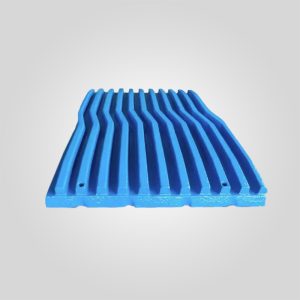
Advanced Design: Parallel wave-pattern surface enhances material engagement
Premium Material: Manufactured from high-grade manganese steel (Mn13/Mn18)
Durable Construction: Reinforced structure withstands heavy impact loads
0artname: cone crusher oart
Distinctive Blue Coating: Protective anti-corrosion finish for easy identification
库存 182 件
PRODUCT
Description
Technical Specification Overview
| Specification Parameter | Technical Detail |
|---|---|
| Part Number | 400.0483-002 |
| Part Description | Jaw Plate Movable WT (Z) M2 |
| Compatible Models | Sandvik CJ409 / JM907 Series |
| Material Grade | M2 High Manganese Steel (ASTM A128 Grade C / Mn18Cr2 Equivalent) |
| Weight | 967.05 kg (Approx. 2,132 lbs) |
| Tooth Profile | Wide Tooth (WT) – Z Profile |
| Hardness (As Cast) | 200 – 220 HB |
| Work Hardened Capability | 450 – 550 HB |
| Manufacturing Process | V-Process Casting with CNC Precision Machining |
Core Advantages: Engineered for Sandvik CJ409 / JM907
The 400.0483-002 Movable Jaw Plate is a critical component designed specifically for the rigorous demands of the Sandvik CJ409 (formerly JM907) jaw crusher. Unlike generic crusher spares, this component is manufactured to meet precise OEM dimensional tolerances, ensuring seamless installation and optimal crushing chamber geometry.
Constructed from M2 grade High Manganese Steel, this wear part balances high impact toughness with exceptional abrasion resistance. The “WT” (Wide Tooth) configuration maximizes the wear life in abrasive applications by providing more material in the high-wear zones while maintaining an efficient nip angle for consistent throughput.
Material Science and Metallurgy
Our foundry utilizes a refined austenitic manganese steel matrix. While standard parts often use Mn13, our M2 specification aligns with ASTM A128 Grade C (Mn18Cr2). This alloy provides a superior work-hardening rate:
- Initial State: The plate is supplied with a ductility-focused hardness of approx. 220 HB, preventing cracking under shock loads.
- In-Service Transformation: Under compressive impact, the surface layer rapidly hardens to excess of 500 HB.
- Substrate Integrity: The core remains ductile, arresting crack propagation during the processing of uncrushable materials (tramp iron).
Performance Optimization and Wear Analysis
Field data from aggregate and mining operations demonstrates the efficiency of the M2 Wide Tooth profile compared to standard corrugated plates. Operators can expect tangible improvements in operational efficiency:
| Performance Metric | Standard Mn13 Plate | M2 (Mn18Cr2) WT Plate | Benefit Analysis |
|---|---|---|---|
| Wear Life | 100% (Baseline) | 125% – 135% | Reduced change-out frequency by ~30% |
| Work Hardening Rate | Moderate | High (Rapid) | Faster protection against abrasive feed |
| Production Stability | Variable | Consistent | Z-Profile maintains cubicity longer |
Expert Maintenance Diagnosis: When to Replace?
As a crusher part suppliers expert, diagnosing the condition of your 400.0483-002 jaw plate is vital for protecting the main frame. Look for these signs during your routine inspection:
- The “Cupping” Effect: Check the vertical profile of the jaw plate. If the center is worn concave significantly more than the ends, capacity will drop, and power consumption will spike due to poor crushing angles.
- Thickness Limit: Once the tooth profile is worn flat and the plate thickness reduces by approximately 50% of the original tooth depth, structural integrity is compromised. Continued use risks plate cracking and damage to the wedge system.
- Wedge Looseness: Excessive movement of the jaw plate (indicated by shiny spots on the back of the plate) suggests the wear parts have stretched or the clamping wedges need tightening.
Manufacturing and Quality Assurance
To ensure reliability comparable to OEM standards, we implement a strict quality control protocol for every 967.05kg casting:
- Simulation: CAE solidification simulation is used to design the gating system, eliminating shrinkage porosity.
- Heat Treatment: A precise water-quenching process at 1050°C ensures a fully austenitic structure without carbide precipitation.
- Machining: The back seating surface is CNC machined to ensure 100% contact with the moving jaw frame, preventing stress risers and cracking.
FAQ: Common Questions About 400.0483-002
1. Is the M2 material grade compatible with hard abrasive rock?
Yes. The M2 grade (Mn18Cr2) is specifically formulated for high-impact and abrasive applications such as granite, basalt, and river stone. It offers a better lifespan than standard Mn13 parts in these environments due to its superior work-hardening capabilities.
2. Can this plate be used on both the Fixed and Moving sides?
No. The part number 400.0483-002 specifically refers to the Movable Jaw Plate. The stationary (fixed) jaw plate for the CJ409/JM907 has a different part number and back-face geometry. Always verify the part number against your manual before ordering crusher spares.
3. How does the Wide Tooth (WT) profile affect product shape?
The Wide Tooth profile is designed to hold the CSS (Closed Side Setting) longer than sharper tooth profiles. While it provides excellent durability, it generally produces a slightly coarser product initially but maintains a consistent gradation curve throughout its lifespan compared to standard corrugated plates.
Expert Note on Installation
Engineer’s Advice: When installing your new 400.0483-002 jaw plate, ensure the seating surfaces on the jaw frame are completely clean and flat. We strongly recommend using a fresh backing plate or cheek plates if significant wear is present on the frame side. Additionally, re-tighten the wedge bolts after the first 4 hours of crushing, as manganese steel will “settle” and flow slightly under initial load.
“Authoritative Engineering Data: All critical metallurgical specifications and dimensional tolerances (e.g., ±0.05mm) are strictly governed by the master English documentation. While localized versions are provided for operational reference, the English original remains the sole binding authority for quality inspection and technical compliance.”

 English
 French
 German
 Spanish
 Russian
 Arabic
 Portuguese
 Turkish