
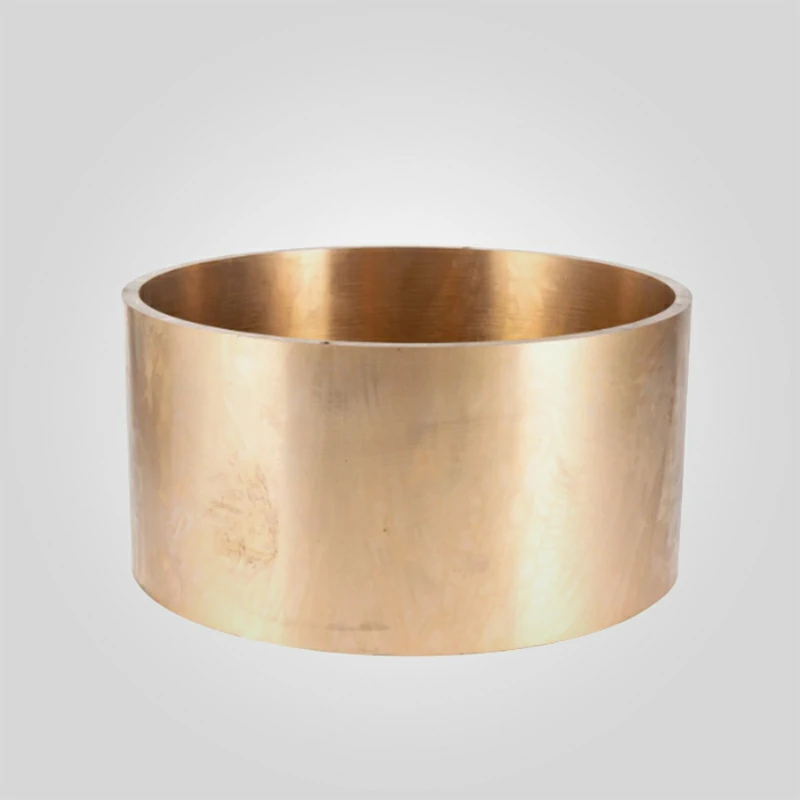
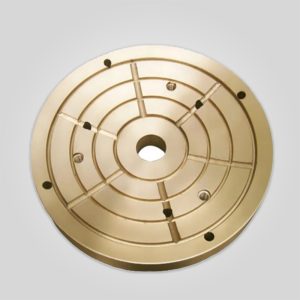
Cone Crusher Head Lower Bushing: Durable Bronze Wear Part for Crusher Maintenance
Material Grade : CuSn8 Tin Bronze (ASTM B271)
Dimensions (ID × OD × Height) : Φ180mm × Φ240mm × 120mm
Hardness (HB) : 80–100
Max Load Capacity : 1,200 kN
Operating Temperature : -40°C to +200°C
Typical Service Life : 8,000–12,000 hours
库存 334 件
PRODUCT
Description
Cone Crusher Head Lower Bushing – OEM Specification 1022147350 (109.2kg)
The 1022147350 Head Bushing (Lower) serves as the primary radial journal bearing within the eccentric assembly of the cone crusher. Weighing 109.2kg, this component mediates the dynamic compressive forces between the gyrating cone head and the eccentric sleeve. It functions under conditions of mixed-film and hydrodynamic lubrication, requiring precise metallurgical properties to prevent adhesive wear (galling) during high-load crushing cycles.
Unlike static structural components, this bushing acts as a sacrificial wear interface designed to protect the more expensive main shaft and crusher head. Its performance is governed strictly by the tribological relationship between the bronze alloy and the mating steel surface, the oil wedge stability, and the geometric concentricity relative to the machine’s centerline.
Metallurgical Composition and Centrifugal Casting integrity
The operational longevity of a lower head bushing is dictated by its microstructure. We utilize a centrifugal casting process rather than sand casting. This technique exerts high G-forces during solidification, driving impurities and lighter oxides to the inner diameter (which is subsequently machined away) and ensuring a dense, non-porous grain structure. This is critical for preventing fatigue spalling under cyclic loading.
Standard Metallurgy: CuSn8 / C93800 High-Leaded Tin Bronze
For standard applications (Symons/Nordberg equivalents), we utilize a high-leaded tin bronze matrix. The lead content (typically 13-16%) exists as discrete globules within the copper-tin matrix. Under emergency conditions—such as localized oil film rupture or “hot spots”—this lead smears across the journal surface, providing temporary solid lubrication to prevent catastrophic shaft seizure.
Heavy-Duty Metallurgy: CuAl10Fe3 / C95400 Aluminum Bronze
For high-stress applications involving harder ores (Basalt/Granite >300 MPa compressive strength), we employ Aluminum Bronze. This alloy relies on a martensitic-like structure achieved through quenching and tempering. It offers significantly higher tensile strength and resistance to impact fatigue, though it requires stricter oil filtration protocols as it lacks the embeddability of high-leaded alloys.
Precision Machining and Geometric Tolerances
A bushing is only as effective as its geometric fit. The 1022147350 unit is machined using CNC vertical turning centers to achieve the following metrological standards:
- Dimensional Tolerance (ID/OD): We adhere to ISO 286 tolerance classes H7/s6 or H7/r6 depending on the interference fit requirements of the specific crusher model. This ensures the bushing remains static within the head bore while maintaining the correct running clearance with the eccentric.
- Surface Roughness (Ra): The inner running surface is finished to Ra 0.8μm or better. This low roughness average is essential for establishing a stable hydrodynamic oil wedge at startup, minimizing the duration of boundary lubrication where metal-to-metal contact occurs.
- Concentricity & Perpendicularity: The operational axis is controlled to within 0.03mm TIR (Total Indicator Reading). Deviations here lead to “head spin” (where the head rotates at eccentric speed) or uneven loading, which accelerates edge loading and premature failure.
- Oil Groove Profiling: The geometry of the oil distribution grooves is not arbitrary. We machine radiused edges on all oil pockets to preventing oil film shearing. Sharp edges in lesser-quality bushings act as scrapers, removing the protective oil film and leading to rapid overheating.
Technical Specifications and Operating Parameters
| Technical Parameter | Standard Specification (Symons/Metso Eq.) | Severe Duty Specification (Sandvik/Terex Eq.) |
| Material Grade | UNS C93700 / CuSn10Pb10 (High Leaded) | UNS C95400 / CuAl10Fe3 (Aluminum Bronze) |
| Hardness (Brinell) | 70 – 85 HBW (Soft for embeddability) | 170 – 190 HBW (Hard for load bearing) |
| Tensile Strength | ≥ 240 MPa | ≥ 600 MPa |
| Yield Strength (0.2% Offset) | ≥ 110 MPa | ≥ 250 MPa |
| Max PV Value (Pressure x Velocity) | 3.5 MPa·m/s | 5.2 MPa·m/s |
| Machining Tolerance | ISO IT6 / IT7 | ISO IT6 |
| Operating Temperature limit | 180°C (Flash point concern) | 220°C (Thermal expansion concern) |
| Lubrication Regime | Hydrodynamic / Elastohydrodynamic | Hydrodynamic |
Compatibility and Interchangeability Analysis
This cone crusher lower bushing is engineered for direct interchangeability with the following OEM specifications. Validation is performed via coordinate measuring machines (CMM) against original OEM archival drawings.
| System Platform | Model Compatibility | Engineering Validation |
| Symons / Norberg | 5.5ft, 7ft Standard & Short Head | Matches the specific 1:50 taper ratio (where applicable) and interference fit allowances for the head bore. |
| HP Series (Metso) | HP300, HP400, HP500 | Correct porting alignment for the hydraulic anti-spin mechanism. Groove depth calculated for ISO VG 150/220 oil flow rates. |
| Sandvik Hydrocone | CH430, CH440, CH660 | High-strength CuAl10Fe3 variant available to withstand the higher crushing forces associated with Hydrocone “constant liner performance” settings. |
| Terex / Cedarapids | MVP Series, TC Series | Maintains strict wall thickness uniformity to prevent thermal distortion during high-temp operation cycles. |
Quality Assurance: Non-Destructive Testing (NDT)
We do not rely on batch sampling for critical rotating components. Every 1022147350 bushing undergoes the following inspection protocols before dispatch:
- Ultrasonic Testing (UT): Performed to ASTM B548 standards to detect subsurface discontinuities, voids, or inclusions within the bronze matrix that could lead to crack propagation.
- Dye Penetrant Inspection (PT): Applied to the machined surfaces to identify surface-breaking defects or porosity that would disrupt the oil film.
- Dimensional Verification: 100% inspection of Inner Diameter (ID), Outer Diameter (OD), and concentricity using calibrated micrometers and bore gauges. Reports are available upon request.
Engineer’s Advice: Maintenance and Installation Protocols
1. Installation: Cryogenic Fitting is Mandatory
Do not attempt to press fit this bushing using brute force or hydraulic rams alone. The risk of galling the steel head bore or distorting the bronze bushing is high.
Protocol: Use dry ice (solid CO2) and alcohol bath or liquid nitrogen to shrink the bushing. Bronze has a coefficient of thermal expansion roughly 50% higher than steel. Freezing the bushing to -78°C (dry ice) will shrink the 240mm+ OD sufficiently to allow a drop-in fit. Ensure the alignment of the oil holes/grooves marks on the head matches the bushing before the temperature equalizes. You have a window of approximately 30-60 seconds.
2. The “Burn-In” Cycle: Avoid Early Failure
A common failure mode is seizure within the first 24 hours of operation. This is rarely a part defect and usually an operational error. New bronze bushings require a “burn-in” period to conform to the minor irregularities of the eccentric.
Protocol: Upon installation, run the crusher empty for 2-4 hours while monitoring the return oil temperature. Once stable, introduce feed at 50% capacity for 4 hours. Only ramp up to 100% choke feed if the return oil temperature remains within 5°C of the baseline. If you see a temperature spike, stop immediately, let it cool, and restart. This allows the high spots on the bronze to smooth out (plastic deformation) rather than weld to the shaft.
Thermal Dynamics and Clearance Management
Understanding the thermal expansion characteristics of this bushing is vital for troubleshooting. During operation, the bronze bushing expands inward (reducing the running clearance) and outward (increasing the interference fit pressure).
If the crusher is operated beyond the recommended temperature (typically >60°C return oil temp), the running clearance may vanish, leading to clamping. The 1022147350 is machined with a specific clearance calculation based on the assumption of a ΔT (temperature differential) between the bronze and the steel shaft.
Operators must ensure their oil coolers are functioning correctly. If you are crushing extremely hard abrasive material that generates excess heat, consider switching to the Aluminum Bronze variant, which has a slightly lower coefficient of thermal expansion compared to Tin Bronze, providing more stable clearance at elevated temperatures.
Procurement and Supply Chain Logic
In the mining sector, OEE (Overall Equipment Effectiveness) is the only metric that matters. Waiting for an OEM part with a 12-week lead time is often not an option. We stock the 1022147350 in semi-finished states.
- Stock Status: Castings are held in stock. Final machining to specific tolerance classes (e.g., specific undersize IDs to compensate for worn eccentric shafts) can be completed within 48-72 hours.
- Traceability: All shipments include material certificates (Mill Test Reports) verifying chemical composition (spectrographic analysis) and mechanical properties.
This component is not merely a spare part; it is a calculated mechanical element designed to restore your crusher’s geometric integrity.
“Authoritative Engineering Data: All critical metallurgical specifications and dimensional tolerances (e.g., ±0.05mm) are strictly governed by the master English documentation. While localized versions are provided for operational reference, the English original remains the sole binding authority for quality inspection and technical compliance.”

 English
 French
 German
 Spanish
 Russian
 Arabic
 Portuguese
 Turkish