

Jaw Crusher Eccentric Shafts: 42CrMo4 Forging Technology and IT6 Precision Grinding for Extreme Duty Cycles
Material Grade: 42CrMo4 Alloy Steel (AISI 4140 Equivalent)
Heat Treatment: Quenched and Tempered (Surface Hardness HRC 55-60)
Eccentricity Range: 15-50mm (customizable per model)
Tensile Strength: ≥950 MPa
Fatigue Strength: ≥500 MPa
库存 182 件
PRODUCT
Description
Jaw Crusher Eccentric Shaft: Fatigue Analysis, Metallurgical Specifications, and Tribological Precision
In the kinematic chain of a single-toggle jaw crusher, the eccentric shaft is the component subjected to the most punishing load regime. It does not merely rotate; it endures a complex combination of bending moments, torsional shear, and cyclic compressive loads exceeding 350 MPa during the crushing of hard rock ores like taconite or granite. A catastrophic fracture of this main shaft results in not just a spare part cost, but a total plant shutdown averaging 120 hours for teardown and replacement, potentially costing over $150,000 in lost production.
This technical dossier analyzes the engineering behind high-performance eccentric shafts. We move beyond basic dimensions to explore the grain flow of forged 42CrMo4 steel, the necessity of IT6 dimensional tolerances for bearing longevity, and the critical heat treatment protocols required to prevent fatigue propagation.
Metallurgy and Forging: The Foundation of Fatigue Life
The structural integrity of a jaw crusher shaft begins at the billet level. We utilize 42CrMo4 (AISI 4140) or 34CrNiMo6 (AISI 4340) alloy steel, selected for their high hardenability and superior fatigue limit. Unlike cast shafts found in low-cost aftermarket alternatives, our shafts are forged with a minimum reduction ratio of 3:1. This forging process aligns the metal grain flow with the longitudinal axis of the shaft, significantly improving resistance to bending fatigue.
Heat Treatment Protocol (Quench & Temper):
Raw forging strength is insufficient. The shaft undergoes a rigorous Q&T cycle:
1. Austenitization: Heating to 850°C-860°C to dissolve carbides.
2. Quenching: Oil quenching ensures a uniform martensitic transformation without the cracking risks associated with water quenching.
3. Tempering: Reheating to 550°C-600°C to relieve internal stresses and achieve the target mechanical properties: a Yield Strength ($R_{p0.2}$) of ≥750 MPa and an Ultimate Tensile Strength ($R_m$) of ≥950 MPa.
This process results in a core structure that is tough (Impact Energy > 45J at -20°C) to absorb shock loads, while the bearing journals are induction hardened to maintain surface integrity.
Precision Machining and Geometric Tolerances
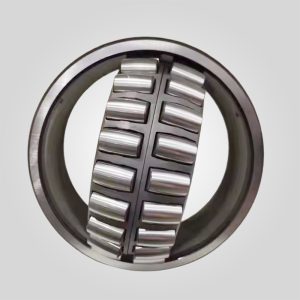
The interface between the eccentric shaft and the spherical roller bearings is the most critical fit in the crusher. A loose fit causes the inner race to spin on the shaft, leading to fretting corrosion and shaft galling. An excessively tight fit reduces the bearing’s internal radial clearance (RIC), leading to thermal runaway.
Dimensional Accuracy (IT6 Standard):
We machine all bearing journals to ISO 286 Grade IT6 tolerances. For a Ø220mm shaft, this allows a variance of only 0.029mm. This precision is achieved through multi-stage CNC cylindrical grinding, ensuring the interference fit (typically m6 or n6) is maintained exactly as specified by bearing manufacturers like SKF or FAG.
Surface Finish and Stress Risers:
Fatigue cracks almost always initiate at surface imperfections.
- Surface Roughness: Bearing seats are ground to Ra ≤ 0.8 μm. This smooth finish maximizes the contact area (bearing ratio) for the interference fit, preventing micro-movement.
- Fillet Radii: The transition between the eccentric lobe and the main journal is a major stress concentration point. We machine these radii with a polished finish and strictly adhere to OEM geometry (often compound radii) to distribute stress flow lines smoothly. Rough machining marks here act as crack nucleation sites.
Dynamic Balancing and Vibration Control
The eccentric nature of the shaft creates inherent imbalance. While the flywheel counters much of this, the shaft itself must be balanced to minimize harmonic vibrations that damage the crusher frame. Our shafts are dynamically balanced to ISO 1940 Grade G6.3.
Runout (TIR) is controlled to ≤0.02mm. Excessive runout creates a “whip” effect at high RPM (typically 230-300 RPM), which accelerates wear on the labyrinth seals and allows dust ingress—the primary killer of crusher bearings.
Bearing Compatibility and Fitment Data
Correct bearing selection and fitment are inseparable from shaft performance. The table below outlines standard configurations and critical fit parameters.
| Crusher Model | Shaft Dimensions (mm) | Main Bearing (Frame) | Pitman Bearing (Eccentric) | Journal Tolerance |
|---|---|---|---|---|
| PE-250×400 | Ø80 × 720 | 22218 CC/W33 | 22318 CC/W33 | m6 (+0.030 / +0.011) |
| PE-400×600 | Ø120 × 950 | 22222 CCK/W33 | 22322 CC/W33 | m6 (+0.035 / +0.013) |
| PE-500×750 | Ø150 × 1100 | 22230 CC/W33 | 22326 CCK/W33 | n6 (+0.045 / +0.020) |
| PE-600×900 | Ø180 × 1300 | 22232 CCK/W33 | 22328 CC/W33 | n6 (+0.045 / +0.020) |
| PE-750×1060 | Ø220 × 1500 | 22236 CC/W33 | 22334 CCK/W33 | p6 (+0.056 / +0.027) |
Note: Bearings usually require C3 or C4 internal clearance to accommodate the thermal expansion of the shaft during operation.
Failure Analysis: Avoiding Common Pitfalls
Through the analysis of over 50 failed shafts from various mining sites, we have identified three primary failure modes:
- Fatigue Fracture at the Fillet: Caused by inadequate radius machining or insufficient forging reduction ratio. Detected by beach marks on the fracture surface.
- Fretting Corrosion: Caused by undersized shaft journals (machined to h7 or g6 instead of m6/n6), allowing the bearing inner ring to creep. This appears as reddish-brown powder (iron oxide) on the seat.
- Keyway Cracking: Sharp corners in the flywheel keyway acting as stress risers. All our keyways feature radiused corners to mitigate this.
Total Cost of Ownership (TCO) Analysis
The price difference between a generic turned shaft and a precision-ground, engineered shaft is approximately 30-40%. However, the TCO calculation favors quality.
Generic Shaft:
– Expected Life: 8,000 – 12,000 hours.
– Risk: High probability of journal fretting requiring metal spray repair ($3,000) or premature bearing failure.
Engineered 42CrMo4 Shaft:
– Expected Life: 25,000+ hours.
– Benefit: Preserves the bearing bore, allows for multiple bearing changes without shaft repair.
For a mine producing 500 TPH, a single unplanned shaft failure costs $80,000 in lost revenue. The “premium” for a proper shaft is negligible insurance.
Engineer’s Advice: Installation & Maintenance
[Option B: Pro-Tip] – The Thermal Expansion Trap:
When installing the eccentric shaft assembly, you must account for axial expansion. The shaft will grow in length by approximately 0.8mm to 1.2mm when it reaches operating temperature (60°C – 80°C). If the “floating” bearing is fixed or blocked by debris in the housing, this expansion creates massive thrust loads that will destroy the bearing cages. Always verify the floating bearing has adequate axial room to move before bolting down the end caps.
[Option C: Field Case Snippet] – Grease is the Seal:
In a granite quarry in Malaysia, we saw repeated bearing failures every 2,000 hours. The shaft journals were perfect, but the bearings were full of silica dust. The culprit was not the seal itself, but the purging practice. The labyrinth seal relies on grease pressure to keep dust out. We instructed the maintenance team to purge the labyrinth seals (not the bearing, but the seal cavity) with fresh grease while the crusher is running every shift. Bearing life immediately extended to 8,000+ hours.
Quality Assurance and Certification
Every shaft supplied undergoes a documented quality control plan (QCP):
- Chemical Analysis: Spectrometer verification of Mo, Cr, and C content.
- Ultrasonic Testing (UT): Per ASTM A388 to detect internal voids or hydrogen flaking deeper than 3mm.
- Magnetic Particle Inspection (MPI): Per ISO 9934-1 to verify no surface cracks exist after grinding.
- Hardness Profile: Verified using portable Equotip testers on journals and core.
Conclusion
The jaw crusher eccentric shaft is a component where geometry, metallurgy, and tribology intersect. It is not a simple turned part; it is a precision-engineered force transmission device. By adhering to strict AISI 4140 specifications, IT6 tolerances, and rigorous Q&T processes, we deliver a shaft that ensures your crusher remains a production asset, not a maintenance liability.
“Authoritative Engineering Data: All critical metallurgical specifications and dimensional tolerances (e.g., ±0.05mm) are strictly governed by the master English documentation. While localized versions are provided for operational reference, the English original remains the sole binding authority for quality inspection and technical compliance.”
 English
 French
 German
 Spanish
 Russian
 Arabic
 Portuguese
 Turkish