
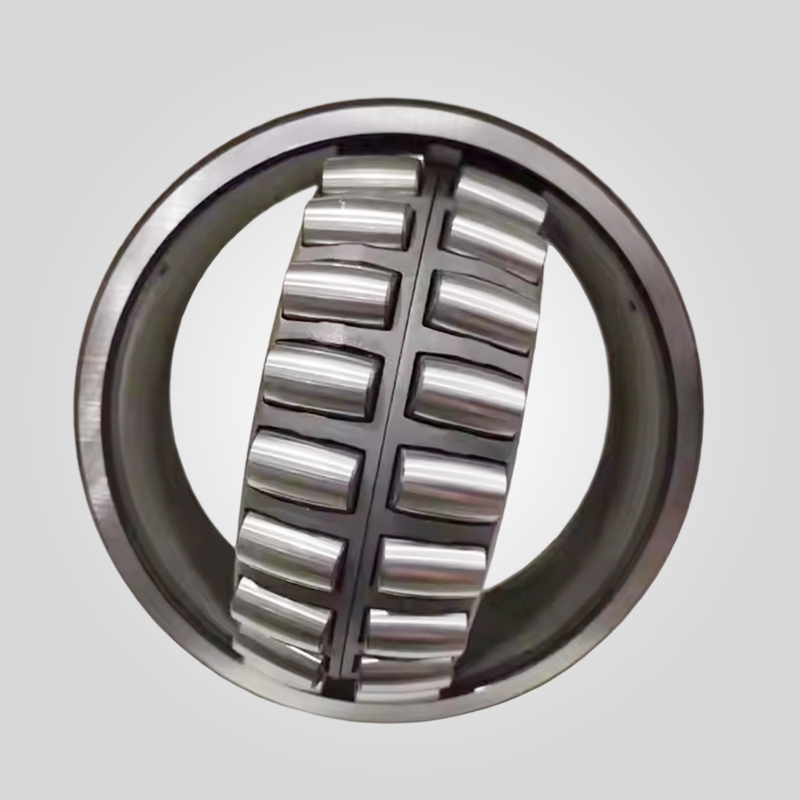
Jaw Crusher Bearing Dynamics: Engineering 223-Series Spherical Rollers for High-Shock Mining Loads
PE-250×400: 22308 CC/W33
PE-400×600: 22309 CCK/W33, 22238 CCK/W33
PE-500×750: 22311 CC/W33, 23038 CCK/W33
PE-600×900: 22312 CC/W33, 23140 CCK/W33
PE-750×1060: 22240 CCK/W33, 23244 CCK/W33
PE-900×1200: 22318 CC/W33, 22252 CCK/W33
CJ Series: Custom bearings for CJ411, CJ612 models
PEV Series: PEV8013, PEV1007 heavy-duty variants
库存 182 件
PRODUCT
Description
Jaw Crusher Spherical Roller Bearings: Tribological Analysis, Load Ratings, and Operational Reliability in High-Vibration Environments
The bearing assembly in a single-toggle jaw crusher represents the single most critical point of failure in the kinetic chain. Unlike standard rotating machinery, jaw crusher bearings—specifically the eccentric shaft (pitman) bearings and main frame bearings—operate under a regime of severe oscillating loads, extreme impact shocks exceeding 50g, and constant misalignment due to shaft deflection. A bearing failure here is not a minor maintenance event; it requires a complete teardown of the pitman assembly, often necessitating craneage, thermal lancing of seized races, and downtime costs averaging $2,000 per hour in lost aggregate production.
This technical analysis dissects the engineering requirements of heavy-duty Spherical Roller Bearings (SRB) used in crushing applications. While generic cylindrical bearings are mentioned in lower-tier specifications, the industry standard for high-performance crushers (Metso C-Series, Sandvik CJ, etc.) relies on the 222xx and 223xx series spherical roller bearings due to their self-aligning capabilities. We will examine the metallurgy of 100Cr6 steel, the necessity of C3/C4 internal clearances, and the critical installation metrics required to prevent premature spalling.
Structural Dynamics and Load Compensation
The defining characteristic of a jaw crusher application is the misalignment of the eccentric shaft under crushing load. As the pitman compresses rock, the shaft flexes. Rigid bearings (like deep groove ball or standard cylindrical rollers) cannot accommodate this deflection, leading to edge loading—a phenomenon where stress concentrates at the roller edges, causing rapid fatigue flaking.
Our engineered spherical roller bearings feature two rows of symmetrical rollers running in a common sphered outer ring raceway. This geometry allows for angular misalignment of up to 1.5 degrees without compromising load distribution. The rollers are guided by a floating guide ring between the two rows, which minimizes friction and heat generation during the unloaded phase of the rotation cycle.
Cage Design Matters:
For high-vibration crushing applications, standard stamped steel cages (suffix CC or J) are often insufficient. They suffer from fatigue cracking at the bridge points under shock loads. We recommend and supply bearings with Machined Brass Cages (Suffix CA, MA, or MB). Brass provides superior damping characteristics and sliding properties against the steel rollers, significantly reducing the risk of cage fracture during tramp iron events.
Metallurgical Specification: 100Cr6 and Vacuum Degassing
The longevity of a bearing is dictated by the cleanliness of the steel. Inclusions act as stress risers that nucleate sub-surface fatigue cracks.
- Material Grade: High-Carbon Chromium Steel GCr15 (AISI 52100 / DIN 100Cr6).
- Purity Standard: Vacuum Degassed Steel is mandatory to reduce oxygen content to < 10 ppm. This process eliminates oxide inclusions, extending the calculated fatigue life ($L_{10}$) by a factor of 1.5x compared to standard air-melted steel.
- Heat Treatment:
- Through-Hardening: For rings up to 100mm wall thickness, achieving uniform hardness of 58-62 HRC.
- Dimensional Stabilization: Rings are heat-stabilized for operation up to 200°C (S1 specification) to prevent permanent dimensional changes (ring growth) that could lead to loss of interference fit during high-temperature operation.
Internal Radial Clearance (RIC): The C3/C4 Necessity
A common error in aftermarket procurement is selecting bearings with “Normal” (CN) clearance. In a jaw crusher, the friction heat generated at the bearing/shaft interface flows outward, expanding the inner ring faster than the outer ring (which is cooled by the massive frame). Additionally, the interference fit on the shaft expands the inner ring.
To prevent the bearing from seizing (loss of running clearance), jaw crusher bearings must be specified with C3 (Greater than Normal) or C4 (Greater than C3) radial internal clearance.
Example: For a 22332 bearing (160mm bore), a C3 clearance provides 170-220 μm of initial gap. Upon installation and thermal expansion, this reduces to the optimal operating clearance of 50-80 μm. Using a CN bearing here would result in negative clearance and catastrophic thermal runaway within 4 hours of operation.
Technical Specifications and Load Ratings
| ISO Designation | Bore (d) mm | OD (D) mm | Width (B) mm | Basic Dynamic Load (C) kN | Fatigue Load Limit (Pu) kN | Limiting Speed (Grease) RPM | Mass (kg) |
|---|---|---|---|---|---|---|---|
| 22308 E/C3 | 40 | 90 | 33 | 165 | 18.5 | 4800 | 1.05 |
| 22312 E/C3 | 60 | 130 | 46 | 315 | 35.5 | 3400 | 3.20 |
| 22232 CCK/W33 | 160 | 290 | 80 | 1060 | 118 | 1400 | 22.5 |
| 22334 CCK/W33 | 170 | 360 | 120 | 1860 | 180 | 1100 | 61.0 |
| 22252 CCK/W33 | 260 | 480 | 130 | 2240 | 230 | 850 | 98.0 |
Note: “K” denotes a 1:12 tapered bore, critical for hydraulic mounting. “W33” indicates a lubrication groove and three holes in the outer ring for efficient regreasing.
Crusher Model Compatibility Matrix
Correct bearing selection requires matching the static and dynamic load capacities to the specific crusher geometry. Below is a validated compatibility list for common PE and CJ series crushers.
PE Series (Traditional Toggle)
- PE-250×400: Pitman: 22308 CC/W33 | Frame: 22209 CC/W33
- PE-400×600: Pitman: 22314 CC/W33 | Frame: 22216 CC/W33
- PE-600×900: Pitman: 22324 CC/W33 | Frame: 22228 CCK/W33
- PE-900×1200: Pitman: 22338 CC/W33 | Frame: 22244 CCK/W33
CJ / JM Series (High Performance)
- CJ409 / JM907: Pitman: 22320 CAM/W33 (Brass Cage)
- CJ411 / JM1108: Pitman: 22326 CAM/W33 (Brass Cage)
- CJ612 / JM1211: Pitman: 23244 CAM/W33 (Wide Series)
Surface Finish and Tribology
The interaction between the roller and the raceway is governed by Elastohydrodynamic Lubrication (EHL). To ensure a sufficient oil film (Kappa value > 1.5) under heavy loads, the surface finish of our rollers is super-finished to Ra ≤ 0.2 μm. This mirror-like finish reduces asperity contact, lowering friction and operating temperature.
The bearing housing seats must also meet strict tolerances.
- Housing Tolerance: ISO H7 or J7.
- Shaft Tolerance: ISO m6 or n6 for cylindrical bores; tapered journals rely on drive-up distance.
Rough machining on housing bores (Ra > 3.2 μm) will lead to fretting corrosion on the bearing outer diameter, eventually causing the race to spin in the housing.
Lubrication Strategy for Contaminated Environments
Bearing failure in crushers is rarely due to fatigue; it is almost always due to contamination. Silica dust is harder (Mohs 7) than bearing steel (Mohs 5-6). If dust enters the grease, it creates a lapping paste that destroys the cage and rollers.
- Grease Selection: Use Lithium Complex EP (Extreme Pressure) grease with a base oil viscosity of ISO VG 220 or 320. The thickener must withstand vibration without separating.
- Fill Quantity: Do not overfill. Fill the bearing 100%, but the housing only 40-50%. Overfilling causes churning, excess heat, and seal blowout.
- W33 Feature: Utilizing the annular groove and holes in the outer ring allows fresh grease to be pumped directly into the load zone, purging old grease and contaminants out through the labyrinth seals.
Total Cost of Ownership (TCO) Analysis
Consider a primary crusher in a granite quarry producing 800 TPH.
Option A: Economy Bearing (Standard Steel Cage, Air-melted Steel)
Cost: $1,200. Lifespan: 1,800 hours.
Option B: Premium Bearing (Vacuum Degassed, Brass Cage, C3 Clearance)
Cost: $2,800. Lifespan: 6,500 hours.
The Reality:
Replacing Option A three times requires 3 shutdowns, 3 crane rentals, and 36 hours of lost production (@ $16,000 revenue/hour). The “cheap” bearing ends up costing the operation over $500,000 in lost opportunity and maintenance labor annually. The premium bearing is not an expense; it is a yield protection device.
Engineer’s Advice: Field Installation & Maintenance
[Option B: Pro-Tip] – The Drive-Up Method:
For tapered bore bearings (suffix K), never rely on torque values to tighten the lock nut. Torque is useless due to friction variables. You must measure the reduction of radial internal clearance (RIC) using feeler gauges.
Procedure: Measure the unmounted clearance (e.g., 0.15mm). Drive the bearing up the tapered sleeve until the clearance is reduced by the manufacturer’s specified amount (typically 0.06-0.08mm reduction for this size). This ensures the correct interference fit without crushing the internal geometry.
[Option C: Field Case Snippet] – The “New Grease” Fallacy:
I once diagnosed a persistent overheating issue on a CJ412. The site was greasing the bearings daily with high-quality Mobilgrease XHP 222. However, they were storing the grease drums outside, unsealed. Analysis showed the “new” grease contained 2000 ppm of silicate dust. They were pumping grinding compound directly into the bearing. Advice: Keep grease drums indoors, sealed, and use a dedicated pump filter. Contamination kills bearings faster than overload.
Quality Assurance and Testing
Our manufacturing process adheres to rigid quality protocols to ensure ISO P6 / ABEC-3 precision:
- Ultrasonic Testing (UT): 100% inspection of rings to detect subsurface voids.
- Magnetic Particle Inspection (MPI): Checks for surface micro-cracks on rollers and raceways.
- Vibration Testing: Each bearing is run-tested to ensure vibration levels meet Class ZV2 or ZV3 limits.
- Dimensional Audit: CMM measurement of bore, OD, and width to ±0.015mm tolerance.
Conclusion
Selecting the correct bearing for a jaw crusher involves balancing load capacity, internal clearance, and cage robustness. By utilizing vacuum-degassed GCr15 steel, machined brass cages, and C3/C4 clearances, our Spherical Roller Bearings are engineered to survive the “stone-breaking” environment. Do not compromise the heart of your crusher with standard-duty components.
“Authoritative Engineering Data: All critical metallurgical specifications and dimensional tolerances (e.g., ±0.05mm) are strictly governed by the master English documentation. While localized versions are provided for operational reference, the English original remains the sole binding authority for quality inspection and technical compliance.”
 English
 French
 German
 Spanish
 Russian
 Arabic
 Portuguese
 Turkish