
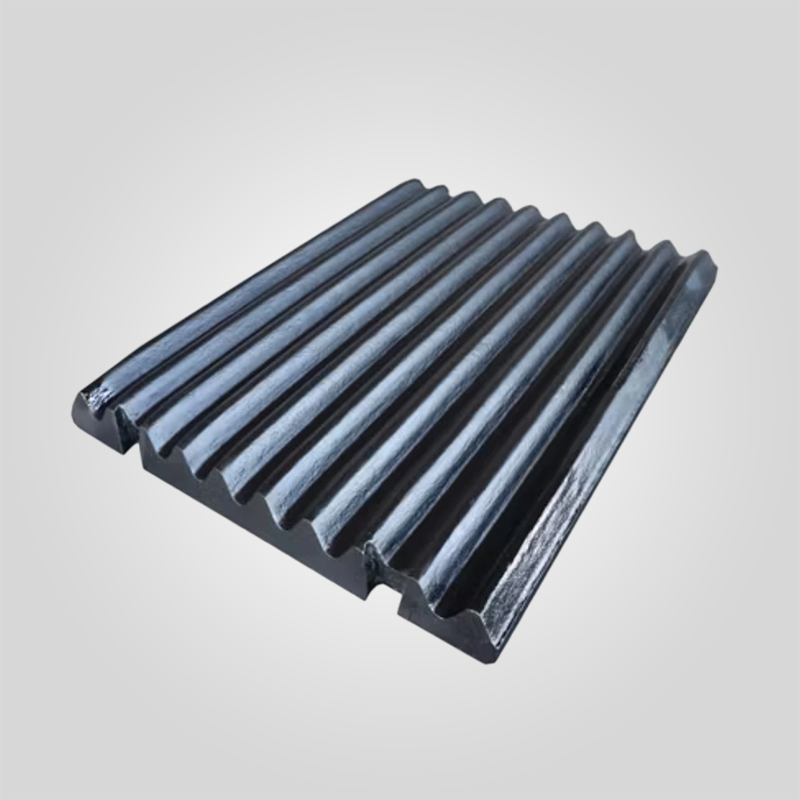
Technical Specifications: Wave-Profile Jaw Crusher Plates
| Specification Attribute | Engineering Standard |
|---|---|
| Component Type | Swing Jaw Plate (Movable) & Fixed Jaw Plate |
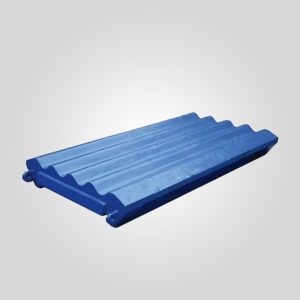
| Tooth Profile | Wave / Corrugated (High Grip) |
| Material Grade | Mn18Cr2 (ASTM A128 Grade C) / Mn22Cr2 |
| Heat Treatment | Water Toughening (Solution Annealing) |
| Initial Hardness | 210 – 240 HB (Austenitic State) |
| Work Hardened Limit | >550 HB (Under compressive load) |
| Impact Toughness | ≥ 150 J/cm² (Charpy V-Notch) |
| Compatible Series | Metso C-Series, Sandvik CJ/JM, Terex JW, Telsmith |
The efficiency of a jaw crusher is defined by the grip of its liners. As specialized crusher part suppliers, we engineered this Wave-Profile Jaw Plate to solve the common issue of “rock slippage” in primary crushing. Manufactured from heavy-duty Mn18Cr2 steel, these plates are designed to fracture hard river pebbles and granite where standard flat-tooth plates fail.
Core Advantages: Tooth Geometry & Metallurgy
Standard jaw dies often allow flat rocks to slide up the chamber, reducing throughput. Our Spare parts utilize an aggressive geometry:
- Wave-Profile Ridges: The varying tooth height creates high-pressure points on the rock surface. This initiates fractures with less force and prevents flat material from “surfing” up the jaw, increasing capacity by up to 20%.
- Mn18Cr2 Metallurgy: We strictly adhere to ASTM A128 standards. By alloying 18% Manganese with 2% Chromium, we ensure the plate has a ductile core to withstand shock loads, while the surface work-hardens rapidly to resist gouging from abrasive silica.
- Machined Back Surface: Unlike rough cast plates, the back of our Crusher spares is precision machined. This ensures full contact with the crusher frame, preventing the plate from flexing and cracking under load.
Performance Comparison: Why Profile Matters
Choosing the right tooth profile for your Wear parts is critical for tonnage. See the difference:
| Performance Metric | Standard Coarse Tooth | Our Wave/Corrugated Profile |
|---|---|---|
| Slabby Material Grip | Poor (Slippage likely) | Excellent (3-Point Bending) |
| Product Cubicity | Average (Flaky) | Improved (Better inter-particle crushing) |
| Wear Distribution | Concentrated at toe | More Even (Due to better flow) |
Field Diagnosis: When to Flip or Replace?
Jaw plates are designed to be reversible. Monitor your Jaw Dies closely:
- The “One-Third” Rule: Jaw plates wear fastest at the bottom (the “Toe”). When the tooth profile at the bottom 30% is worn flat, you must flip the plate (turn it 180 degrees).
- Cupping (Concave Wear): If the plate wears excessively in the center, check your feed distribution. You may be feeding too many fines, which causes abrasive scouring rather than impact crushing.
- Cracking: If the plate cracks horizontally, the backing plate is uneven, or the toggle plate setting is incorrect (excessive stroke).
Expert Tip: Installation & Rotation
Maximize your investment: Don’t wait until the teeth are completely gone to rotate.
Best Practice: Rotate the Fixed and Swing Jaw plates when 50% of the tooth height at the bottom is worn.
Warning: Always clean the seating surface on the frame before installing new plates. Even a small layer of dust or old packing material can create a stress point that will snap a brand new Mn18 casting in half.
Frequently Asked Questions (FAQ)
Q1: Can I use Mn22Cr2 instead of Mn18Cr2?
A1: Yes, for extremely abrasive rock (like Quartzite). Mn22 offers harder wear resistance but is slightly more brittle. For general granite or limestone, Mn18Cr2 is the safer, more durable choice.
Q2: Do I need to replace the Cheek Plates (Side Liners) at the same time?
A2: Not always, but check them. Worn Cheek Plates create a gap where rocks can get stuck, causing side-wear on your new Jaw Plates. It is good practice to replace the lower cheek plates when changing the main jaws.
Q3: Why did my new jaw plate crack immediately?
A3: This is usually an installation error. If the jaw plate does not sit perfectly flat against the frame (due to debris or a warped frame), it acts like a bridge. The first heavy rock will snap it. Always check the seating surface.
Technical Parameters of Applicable Jaw Crusher

 English
 French
 German
 Spanish
 Russian
 Arabic
 Portuguese
 Turkish