
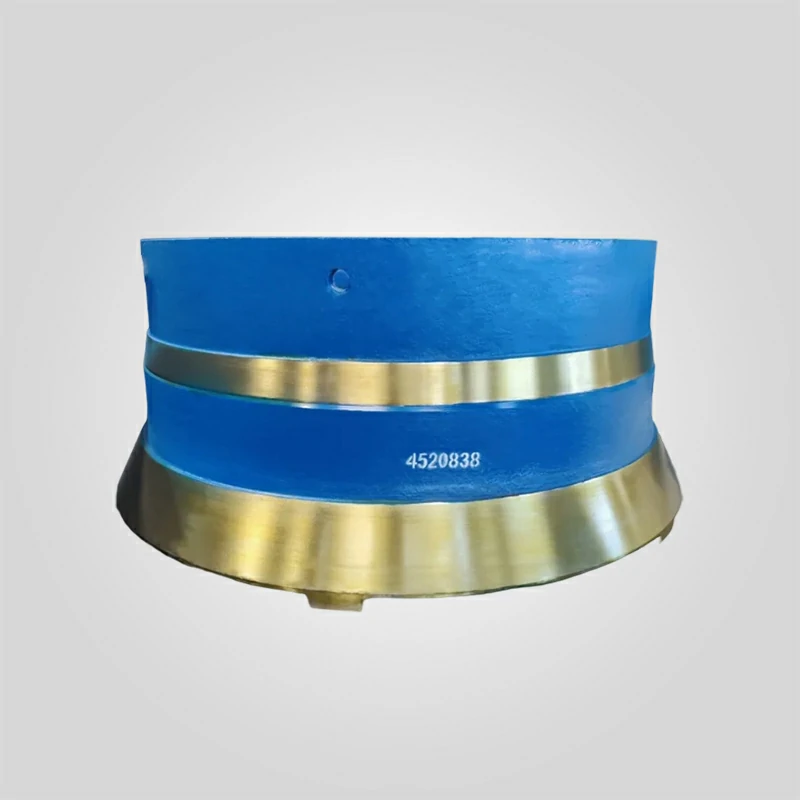
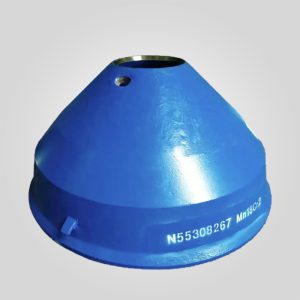
CH870 452.0838-02 Concave -Cone Crusher Parts Bowl liner
Compatible Model : Sandvik CH870 Cone Crusher
Original Part Number: 452.0838-02
Part Type: Concave, Bowl Liner
Material Composition: High Manganese Steel (Mn18Cr2/Mn22Cr2)
Hardness Range: HB200-240 (as cast), Work-hardened up to HB500+
Chamber Type :Compatible with various chamber configurations (EC, C, MC, M, F)
库存 23 件
PRODUCT
Description
| Technical Parameter | Specification Value | Engineering Standard |
|---|---|---|
| OEM Part Number | 452.0838-02 | Verify Chamber ID (e.g., C, MC, M) |
| Component Name | Concave / Bowl Liner | Stationary Crushing Element |
| Compatible Equipment | Sandvik CH870 (H7800) / CH880 | Heavy-Duty Hydrocone Series |
| Material Grade | Mn18Cr2 (ASTM A128 Grade C) | Premium High Manganese Steel |
| Initial Hardness | 210 – 230 HBW | Solution Annealed Condition |
| Max Work Hardness | 500 – 550 HBW | Surface transformation under load |
| Tensile Strength | ≥ 800 MPa | Resistance to bursting pressure |
| Installation Method | Bolted + Backing Compound | Requires Epoxy Resin Support |
| Weight | ~ 2,800 kg – 3,200 kg | Dependent on exact profile |
Sandvik CH870 Concave 452.0838-02 | Mn18Cr2 | OEM Compatible Cone Crusher Liner
The Concave 452.0838-02 is the stationary heavy-duty wear component specifically engineered for the Top Shell assembly of the Sandvik CH870 (formerly H7800) cone crusher. Acting as the fixed anvil against which the Mantle compresses the rock, this liner defines the crusher’s chamber geometry, capacity, and final product gradation.
Unlike generic aftermarket castings that claim “universal fit,” our cone crusher parts are precision-manufactured to replicate the exact chamber profile (Nip Angle and Choke Point) defined by the Sandvik OEM specification. Manufactured from solution-annealed Mn18Cr2 (ASTM A128 Grade C), this concave is designed to withstand the extreme hydrostatic crushing forces (up to 6 MPa) generated by the CH870’s main hydraulic cylinder.
Metallurgical Engineering: Why Mn18Cr2?
For high-throughput crushers like the CH870, standard Mn13 (Hadfield Steel) is insufficient. We utilize a modified austenitic manganese steel alloy.
- The Twinning Induced Plasticity (TWIP) Effect: The 452.0838-02 liner is supplied with an initial hardness of ~220 HBW. Under the impact of rock, the surface crystal lattice deforms and instantly hardens to >500 HBW. This creates a wear-resistant “skin” while the core remains ductile (tough) to absorb shock loads without cracking.
- Chromium Stabilization: The addition of 2% Chromium reinforces the yield strength. This is critical for preventing the concave from “growing” or warping under compression, which is a leading cause of liner loosening and Top Shell damage.
Deep Dive: Chamber Geometry and Performance
The specific profile of part number 452.0838-02 dictates the performance of your crusher. It is not interchangeable with other profiles.
1. The Importance of “Nip Angle”
The angle formed between the Concave and the Mantle is the Nip Angle.
- Correct Geometry: Our liners are machined to ensure the Nip Angle is between 18° and 22°. This ensures the rock is gripped and crushed.
- The Risk of Generic Parts: If a supplier provides a concave with an incorrect angle (>24°), the rock will slip upwards (“Boiling”). This reduces capacity by up to 30% and causes extreme localized wear at the intake, destroying the cone crusher bowl and mantle set prematurely.
2. The “Choke Point” Definition
The Choke Point is the zone of minimum capacity in the chamber.
- Wear Balance: The 452.0838-02 is designed to align its wear zone with the crushing stroke of the CH870. This ensures that the liner wears evenly from top to bottom, maximizing the utilization of the manganese steel (typically achieving 50-60% metal utilization).
Performance Comparison: Mn18Cr2 vs. Standard Alloys
Choosing the right alloy for your crusher spares impacts your bottom line. Below is a comparison based on processing abrasive Granite (Wi > 18 kWh/t).
| Material Property | Mn13Cr2 (Standard) | Our Mn18Cr2 (452.0838-02) | Customer Benefit |
|---|---|---|---|
| Initial Yield Strength | 300 – 320 MPa | 350 – 380 MPa | Prevents liner stretching/loosening |
| Work Hardening Rate | Moderate | Aggressive | Faster protection in hard rock |
| Wear Life (Hours) | Baseline (100%) | 120% – 140% | Reduced shutdown frequency |
Engineer’s Guide: Installation and Maintenance (Information Gain)
As experienced crusher part suppliers, we see more failures caused by poor installation than by material defects. Follow these protocols for Part 452.0838-02.
Protocol 1: The Backing Compound Criticality
The CH870 Top Shell is machined, but the back of the cast manganese concave is rough.
- The Void: There is always a gap (3-10mm) between the steel concave and the iron Top Shell.
- The Filler: You MUST use a high-compressive-strength epoxy Backing Compound.
- The Failure Mode: If the backing is missing or contains air bubbles, the concave will flex under the 500-ton crushing load. This flexing leads to vertical cracking. Once cracked, the concave loses its arch support and can fall into the crusher, causing catastrophic damage.
Protocol 2: Checking the “Mounting Lugs”
The 452.0838-02 concave hangs on the Top Shell using cast lugs or a mounting ring.
- Inspection: Before installation, inspect the mounting lugs on the casting. They must be free of casting burrs and perfectly flat.
- Load Transfer: The weight of the liner is held by these lugs, but the crushing force is transferred through the backing. Do not rely on the lugs to take the crushing load.
Protocol 3: The “25mm” Wear Limit
When should you change the Cone Crusher Liner?
- Do not wait for holes: Manganese steel requires a certain thickness to maintain its structural integrity.
- The Rule: When the liner thickness at the thinnest point reaches approx. 20-25mm, replace it. Below this thickness, the steel acts like a foil and can crack instantly, damaging the Top Shell seating surface.
Common Failure Analysis
Understanding why parts fail helps you optimize your Wear parts strategy.
1. “Coring” or Pocket Wear
Symptom: Deep localized holes in the middle of the concave.
Cause: Feed material is too fine (trickle feeding). The rock is abrading the liner rather than crushing against other rocks.
Solution: Increase feed rate to maintain a “Choke Feed” level.
2. Vertical Cracking
Symptom: A straight crack running from top to bottom.
Cause: Insufficient backing compound or a warped Top Shell.
Solution: Check the Top Shell for roundness and ensure proper backing pouring procedures.
3. “Peening” or Flowing
Symptom: The bottom edge of the concave curls inward.
Cause: The liner material is too soft for the crushing pressure, or the chamber is packed with tramp iron.
Solution: Upgrade to our Mn18Cr2 or Mn22Cr2 alloy.
Quality Assurance Process
We ensure every 452.0838-02 liner meets the rigorous standards of modern mining.
- Laser Scanning: We use 3D laser scanners to verify the internal profile against OEM drawings. This guarantees the chamber volume is correct.
- Ultrasonic Testing (UT): Per ASTM A609 Level 2, we scan the casting to ensure there are no internal shrinkages or voids that could lead to early failure.
- Hardness Verification: Every casting is Brinell tested (3000kg load) to ensure the heat treatment was successful (Range 210-230 HBW).
Why Partner With Us?
In the world of crusher spares, reliability is currency.
- Inventory: We stock 452.0838-02 liners to ensure you don’t wait 12 weeks for a casting.
- Traceability: Full material certification provided with every shipment.
- Support: Our engineers can help you simulate chamber wear and optimize liner selection.
Don’t let worn liners strangle your production. Restore your CH870 to factory capacity.
“Authoritative Engineering Data: All critical metallurgical specifications and dimensional tolerances (e.g., ±0.05mm) are strictly governed by the master English documentation. While localized versions are provided for operational reference, the English original remains the sole binding authority for quality inspection and technical compliance.”

 English
 French
 German
 Spanish
 Russian
 Arabic
 Portuguese
 Turkish