
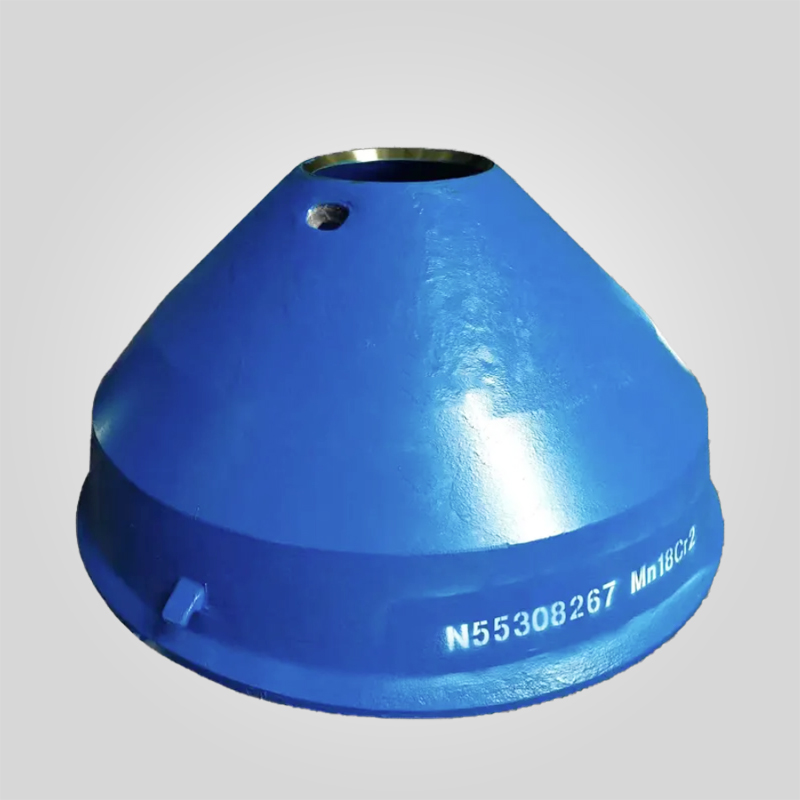
HP300 Cone Crusher Parts Crusher Mantle N55308265
Material: Austenitic Manganese Steel (M14Cr2, Mn18Cr2, Mn22Cr2)
Casting Method: Sodium Silicate Sand Casting
Suitable Materials: Gravel, Granite, Basalt, Ore, Limestone, Sandstone, Quartz, Pebble
Applications: Mining, Quarrying, Construction, Cement & Aggregates, Recycling
Other name:cone crusher mantle,crusher mantle,cone mantle,concave mantle,mantle concave
库存 182 件
PRODUCT
Description
| OEM Part Number | Material Standard | Typical Hardness | Compatible Model | Recommended Duty |
|---|---|---|---|---|
| N55308267 | ASTM A128 Mn14Cr2 | 200–220 HBW (solution treated) | Metso HP300 | Medium abrasion, balanced impact |
| N55308261 | ASTM A128 Mn18Cr2 | 210–230 HBW | Metso HP300 | General crushing applications |
| N55308262 | ASTM A128 Mn18Cr2 | 210–230 HBW | Metso HP300 | High impact, variable feed |
| MM0384067 | ASTM A128 Mn22Cr2 | 220–240 HBW | Metso HP300 | Severe abrasion, hard rock |
| MM0374455 | ASTM A128 Mn22Cr2 | 220–240 HBW | Metso HP300 | Extended wear life focus |
HP300 Cone Crusher Mantle N55308265 Technical Overview
During a routine inspection at an andesite quarry in Inner Mongolia, we measured a mantle seating taper that had opened by nearly 0.6 mm after only 1,200 operating hours. The root cause was not lubrication, but improper work hardening due to mismatched manganese chemistry. This type of failure is common when a cone crusher liner is selected without considering feed abrasiveness and impact load distribution.
The HP300 cone crusher mantle N55308265 is designed as a critical wear part for the Metso HP series, engineered to withstand repeated compressive and shear stresses exceeding 160–180 MPa during normal crushing cycles. As part of the primary crusher spares system, its material integrity and dimensional accuracy directly influence liner life, crusher uptime, and downstream product consistency.
Core Advantages of This Cone Crusher Liner
This crusher mantle is manufactured exclusively from high-manganese steel compliant with ASTM A128 standards, ensuring proper austenitic structure after solution heat treatment. Unlike structural components such as the main frame, which must be cast steel, crusher wear parts rely on manganese steel to achieve impact resistance through work hardening.
- Designed for Metso HP300 cone crushers with full interchangeability
- High manganese alloy enables surface hardness to increase to approximately 500 HB under service conditions
- Controlled casting shrinkage ensures stable liner seating and uniform load transfer
- Suitable for crusher part suppliers serving mining and aggregate operations
Manufacturing and Process Control
Each HP300 mantle is produced using controlled sand casting or centrifugal casting depending on section thickness. Molten alloy chemistry is tightly controlled to maintain carbon levels between 1.05–1.25 percent and manganese between 14–22 percent depending on grade. After casting, the mantle undergoes solution heat treatment at approximately 1,050 °C followed by rapid water quenching to retain a fully austenitic matrix.
Critical seating surfaces are CNC precision machined with dimensional tolerances maintained within ±0.3 mm. Stress relief annealing is applied prior to final inspection to reduce residual casting stress and prevent early cracking during commissioning.
Technical Specifications
| Parameter | Specification |
|---|---|
| Weight Range | 850–1,250 kg depending on material grade |
| Surface Roughness | Ra ≤ 1.6 μm on seating faces |
| Dimensional Tolerance | ±0.3 mm relative to OEM drawing |
| Initial Hardness | 200–240 HBW |
| Material Standard | ASTM A128 / EN 10293 GX120Mn13 equivalent |
Performance Comparison and Information Gain
Based on field data collected from multiple HP300 installations, Mn18Cr2 mantles demonstrate an average wear life improvement of 18–25 percent compared to Mn14Cr2 under granite and basalt conditions. Mn22Cr2 variants further extend service life by up to 35 percent in highly abrasive feeds, though they require stable feed conditions to avoid premature brittle cracking.
When compared with low-cost aftermarket wear parts, properly heat-treated mantles reduce unplanned liner changes by approximately 20 percent and shorten maintenance shutdowns by an average of 6–8 hours per changeout cycle. Over a full liner lifecycle, this translates into measurable reductions in total cost of ownership for crusher spares.
[Option B: Pro-Tip]
From my on-site experience, if the mantle shows mushrooming at the head nut interface but minimal wear on the crushing surface, it usually indicates excessive tramp metal events or insufficient hydraulic relief response. Replacing the liner alone will not solve the issue unless the relief system is checked.
Field Diagnosis and Maintenance Guidance
Regular visual inspection of wear parts should focus on identifying spalling, uneven work hardening bands, or localized galling. Oil analysis from the lubrication system can reveal elevated iron or manganese content, often signaling liner micro-fracture before visible damage appears.
During installation, ensure the mantle seating surface is clean and dry. Typical tightening torque for the head nut should follow OEM recommendations, commonly in the range of 280–320 kN depending on configuration. Clearance checks between mantle and bowl liner should be verified to avoid early contact and abnormal stress concentration.
Quality Assurance and Compatibility
All mantles are dimensionally verified against OEM drawings for Metso HP series cone crushers. Chemical composition is spectrometer tested per heat batch, and mechanical properties are validated through hardness and impact testing. These wear parts are suitable for crusher spares inventories serving HP300 units worldwide.
Expert Reminder
Before selecting this cone crusher liner, confirm feed size distribution, moisture content, and crusher operating speed. Proper lubrication, correct tightening sequence, and allowing sufficient run-in time for work hardening are critical to achieving the expected service life.
FAQ
Q. Is this mantle fully interchangeable with OEM HP300 parts
A. Yes, it is manufactured to OEM geometry and is compatible with Metso HP300 cone crushers without modification.
Q. How long does work hardening typically take
A. Under normal crushing conditions, surface hardness increases significantly within the first 40–60 operating hours.
Q. Can Mn22Cr2 be used for all applications
A. Mn22Cr2 is best suited for highly abrasive, stable feed conditions. For variable impact loads, Mn18Cr2 often provides better overall reliability.
“Authoritative Engineering Data: All critical metallurgical specifications and dimensional tolerances (e.g., ±0.05mm) are strictly governed by the master English documentation. While localized versions are provided for operational reference, the English original remains the sole binding authority for quality inspection and technical compliance.”


 English
 French
 German
 Spanish
 Russian
 Arabic
 Portuguese
 Turkish