


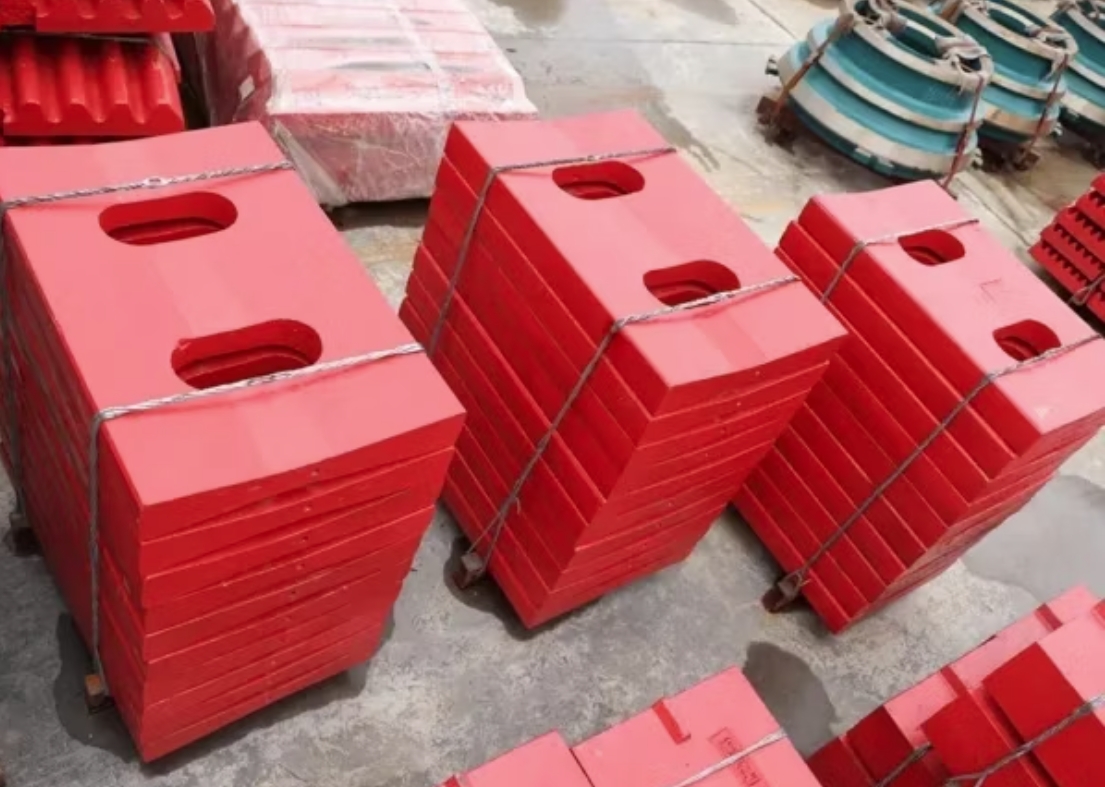
Jaw Crusher Toggle Plates: Engineering the Perfect Structural Fuse with 46MnSiB Alloy Steel
- Material: 46MnSiB Alloy Steel
- Surface Hardness: HRC 48-52 (case-hardened)
- Tensile Strength: ≥ 1200 MPa
- Impact Resistance: 50J at -20°C
- Dimensional Tolerance: ±0.5mm
库存 182 件
PRODUCT
Description
Jaw Crusher Toggle Plate: Structural Fuse Mechanics, Metallurgy of 46MnSiB, and Load Transmission Dynamics
In the kinematics of a single-toggle jaw crusher, the toggle plate performs a dual function that presents a complex engineering paradox: it must be rigid enough to transmit up to 4,000 kN of crushing force from the eccentric pitman to the reaction block, yet brittle enough to snap instantaneously when the crushing chamber encounters uncrushable material (tramp iron). It is, by definition, a calibrated structural fuse. A failure to fracture at the precise calculated load results in catastrophic plastic deformation of the eccentric shaft, shattered bearings, or cracks in the main frame assembly—repairs that can cost 20 times the price of the toggle plate itself.
This technical dossier analyzes the engineering behind high-performance toggle plates manufactured from 46MnSiB alloy steel. We will move beyond superficial descriptions to explore the tribology of the toggle seats, the heat treatment profiles required for controlled failure, and the dimensional precision necessary to maintain accurate Closed Side Settings (CSS).
The Mechanics of the “Structural Fuse”
The toggle plate operates under a regime of high-cycle compressive fatigue combined with rolling friction at its ends. During normal operation, the plate serves as a lever, converting the rotary motion of the eccentric shaft into the reciprocating linear motion of the swing jaw. However, its safety function relies on the principle of Euler Buckling or pure shear stress limits.
Unlike cast iron plates used in legacy machinery which fail via brittle fracture often too early or too late, modern 46MnSiB alloy steel plates offer a predictable yield point. The geometry is engineered using Finite Element Analysis (FEA) to identify a specific stress concentration zone. When the compressive load exceeds the “Safe Operating Limit” (typically set at 120% of the crusher’s maximum rated crushing force), the material yields and the plate buckles or shears. This disconnects the drive system from the jaw instantaneously, dissipating the kinetic energy and protecting the expensive capital components.
The reliability of this function depends entirely on metallurgical consistency. A variation in material hardness of just 5 HRC can shift the failure point by hundreds of kilonewtons, rendering the safety function useless.
Material Science: Why 46MnSiB Alloy Steel?
The selection of 46MnSiB (Boron-Manganese Steel) over standard carbon steels (like Q235 or A36) or grey cast iron is driven by the need for high tensile strength and hardenability.
- Boron Enhancement: The addition of minute quantities of Boron (0.0005-0.003%) significantly increases the hardenability of the steel without requiring expensive alloying elements like Molybdenum. This allows for a uniform martensitic structure after quenching.
- Manganese/Silicon Synergy: Manganese (approx. 1.0-1.3%) acts as a solid solution strengthener, while Silicon improves the yield strength and elastic limit. This combination ensures the plate does not plastically deform (bend) under normal crushing loads, maintaining the CSS.
- Heat Treatment Profile: The raw plate undergoes a Quench and Temper (Q&T) process to achieve a core tensile strength of ≥ 1200 MPa. However, the tips (the rolling ends) undergo secondary High-Frequency Induction Hardening. This creates a surface hardness case of HRC 52-56 at the contact points to resist galling and abrasive wear against the toggle seats, while the core remains slightly more ductile (HRC 48-52) to prevent fatigue cracking under normal vibration.
Manufacturing Precision and Surface Integrity
The dimensional accuracy of the toggle plate directly dictates the crusher’s discharge setting and mechanical efficiency. A variance in length of 2mm translates to a significant shift in the CSS and the reduction ratio.
Flame Cutting vs. Machining:
Low-cost plates are often flame-cut with no post-processing. This leaves a Heat Affected Zone (HAZ) at the edges where the metal is brittle and prone to micro-cracking. Our manufacturing protocol involves computer-controlled flame cutting followed by CNC milling to remove the HAZ entirely. This ensures the edge geometry is free of thermal stress risers.
The Toggle Seat Interface:
The ends of the toggle plate roll against the toggle seats (pillows). This is a non-lubricated or semi-lubricated rolling contact zone. The surface finish of the toggle plate ends must be controlled to Ra 1.6 μm or better. A rougher surface acts as a file, rapidly wearing down the bronze or steel toggle seats. Furthermore, the radius of the toggle plate end is machined to a strict tolerance (typically -0.1mm to -0.3mm relative to the seat radius) to ensure line contact rather than point contact, distributing the load evenly across the width of the crusher.
Surface Treatment and Fatigue Resistance
To combat the initiation of fatigue cracks, the plates undergo Shot Peening after heat treatment. By bombarding the surface with steel shot, we induce residual compressive stress in the surface layer. This compressive layer impedes the opening of micro-cracks under tensile loads (which occur on the underside of the plate during the rebound stroke).
The “Rust-Brown” coating visible in product imagery is a specialized oxide primer. While the rolling ends are polished to bare metal for installation, the body of the plate is coated to prevent corrosion pitting during storage and operation. Deep corrosion pits can act as stress concentrators, potentially lowering the overload breaking point unpredictably.
Technical Specifications Data
| Parameter | Value / Specification | Engineering Standard / Note |
|---|---|---|
| Material Designation | 46MnSiB (Boron Steel) | DIN 1.5531 Equivalent |
| Tensile Strength ($R_m$) | ≥ 1200 MPa | Tested per ISO 6892-1 |
| Yield Strength ($R_{p0.2}$) | ≥ 1050 MPa | Ensures elastic recovery after load cycles |
| Surface Hardness (Ends) | HRC 52 – 56 | Induction Hardened Depth 3-5mm |
| Core Hardness | HRC 48 – 52 | Through-hardened structure |
| Impact Energy | 50J @ -20°C | Charpy V-Notch (Preventing cold brittle fracture) |
| Length Tolerance | ±0.5 mm | Critical for consistent CSS |
| Fatigue Cycle Rating | > 100,000 cycles | At 80% rated load |
| Surface Finish (Ends) | Ra 1.6 μm | Ground finish for rolling contact |
Compatibility and Customization
The toggle plate design is universal in principle but highly specific in geometry. We manufacture to OEM specifications for major crusher brands, but also offer “Shim-Compensation” lengths.
- Standard Lengths: Matches the OEM part number exactly for factory settings.
- Minus/Plus Lengths: We provide plates in ±5mm or ±10mm increments. As the toggle seats and jaw dies wear, the CSS opens up. Installing a slightly longer toggle plate allows operators to return to the original discharge setting without maxing out the wedge adjustment system.
- Model Coverage: Compatible with Metso C-Series (C100, C120, C160), Sandvik CJ Series, and Terex/Pegson units.
Root Cause Analysis: Why Cheap Plates Fail
A metallurgical audit of failed aftermarket plates often reveals “Band Segregation”—layers of varying hardness caused by improper rolling of the steel slab. Under the high-frequency vibration of a crusher (approx. 250-300 RPM), these bands delaminate. Another common issue is Hydrogen Embrittlement. If the plating or pickling process is not followed by a de-embrittlement bake, hydrogen atoms trapped in the lattice structure cause the plate to snap under loads as low as 50% of the rated capacity, causing unnecessary downtime.
Engineer’s Advice: Field Operations & Maintenance
[Option B: Pro-Tip] – The “Seat” Criticality:
I cannot stress this enough: Never install a new toggle plate into worn or damaged toggle seats. I have seen operators replace a snapped plate but ignore the gouged seat. The damaged seat creates high-friction “catch points” instead of a smooth rolling surface. This forces the toggle plate to bend rather than roll, introducing bending moments it was not designed for. The result? The new plate snaps within 48 hours. Always inspect the seats; if there are ridges or flat spots, replace them with the plate.
[Option C: Field Case Snippet] – The Noise Indicator:
In a recent troubleshooting visit to a recycling yard, the crusher was making a loud “clacking” sound on the return stroke. The operator assumed it was the tension rod spring. It wasn’t. The toggle plate had worn down by 4mm in length, and the geometry had shifted, causing the toggle end to lose contact with the seat momentarily and then slam back into place. This impact shock sends stress waves back into the pitman. We replaced the plate and the seats, and the vibration levels on the main frame dropped by 40%. Measure your toggle plate length during liner changes; if it’s worn more than 3-5mm, scrap it.
Conclusion
The toggle plate is the guardian of your crusher’s structural integrity. It requires a manufacturing process that respects the fine line between strength and sacrifice. By utilizing 46MnSiB alloy, precision CNC machining, and rigorous heat treatment protocols, we ensure that this component performs its duty: transmitting power efficiently every day, and failing predictably only when absolutely necessary to save your machine.
“Authoritative Engineering Data: All critical metallurgical specifications and dimensional tolerances (e.g., ±0.05mm) are strictly governed by the master English documentation. While localized versions are provided for operational reference, the English original remains the sole binding authority for quality inspection and technical compliance.”
 English
 French
 German
 Spanish
 Russian
 Arabic
 Portuguese
 Turkish