

replacement crusher parts cone crusher Bowl Liner
Sandvik CH/CS Series
Metso HP/MP Series
FLSmidth Raptor
Symons 2-7ft
Terex Cedarapids
库存 12 件
PRODUCT
Description
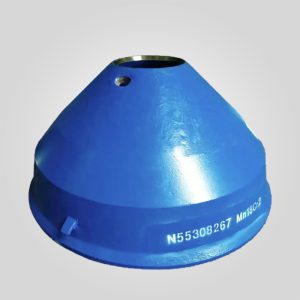
Cone Crusher Bowl Liner: Premium Manganese Wear Parts
The Cone Crusher Bowl Liner (also known as the Concave) is the stationary counterpart to the moving Mantle. Together, they form the crushing chamber where rock reduction occurs. As a critical Wear part, the Bowl Liner must endure massive compressive forces while resisting the gouging abrasion of granite, basalt, and iron ore.
We supply high-performance replacement crusher parts engineered to match or exceed OEM specifications. Our foundry utilizes advanced metallurgy to produce liners that offer the optimal balance between hardness (wear resistance) and toughness (crack resistance).
Technical Specifications & Material Grades
We offer two distinct material grades to suit different crushing stages and feed materials. The following specifications outline our capabilities.
| Parameter | Standard Grade (Mn14) | Premium Grade (Mn18/Mn22) |
|---|---|---|
| Material Code | Mn14Cr2 (ASTM A128 Grade A) | Mn18Cr2 (Grade C) / Mn22Cr2 (Grade E) |
| Application | Soft Rock (Limestone), Primary Crushing | Hard Rock (Granite), Secondary/Tertiary |
| Initial Hardness | 200 – 220 HBW (Ductile Base) | 210 – 230 HBW (Ductile Base) |
| Work-Hardened Hardness | 450 – 500 HBW | > 550 HBW (High Work Hardening) |
| Impact Toughness | ≥ 100 J/cm² | ≥ 140 J/cm² (Resists tramp iron) |
| Service Life Estimate | Baseline | +20% to +40% vs Standard |
Universal Compatibility
Our engineering team has reverse-engineered liners for the most popular global brands. We guarantee fitment for:
- Metso: Nordberg HP, GP, MP Series
- Sandvik: Hydrocone (CH/CS), Superior (S/H) Series
- Symons: 2ft, 3ft, 4ft, 4.25ft, 5.5ft, 7ft (Std & Short Head)
- Terex: Cedarapids MVP, TC Series
- FLSmidth: Raptor Series
Performance Engineering: Why Metallurgy Matters
As dedicated crusher part suppliers, we control the heat treatment process strictly:
- Water Quenching: All liners undergo Solution Annealing at 1050°C followed by rapid water quenching. This ensures a fully Austenitic structure, which is crucial for the “self-hardening” property of manganese steel.
- Precision Machining: The seating surfaces (hooks and lands) are CNC machined to OEM tolerances (+/- 0.2mm). A perfect fit prevents the liner from “spinning” or “rocking” in the top shell, which can destroy the adjustment threads.
- Optimized Profiles: We offer modified cavity profiles (e.g., changing the parallel zone length) to solve specific production issues like “bell-mouthing” or poor product shape.
Field Diagnosis: The “Concave Ringing” Test
Ensure your installation is solid.
The Test: After the epoxy backing has cured (approx. 24 hours), tap the liner with a metal hammer at various points around the circumference.
The Sound: A solid, dull “thud” indicates good backing coverage. A hollow, high-pitched “ring” means there is a void (air pocket) behind the liner.
The Risk: Voids lead to localized stress concentration, which will cause the liner to crack vertically under load. If you hear a ring, you may need to re-pour or inject backing.
Installation & Maintenance Best Practices
- Surface Prep: Thoroughly clean the bowl seating surface. Remove all old backing and rust. Apply a release agent (wax/grease) to the steel bowl, but NOT to the liner (the backing needs to stick to the liner).
- Epoxy Backing: Always use a high-compressive strength epoxy compound. Pour continuously to prevent air entrapment.
- Break-In: Run the crusher idle for 2 hours, then at 50% load for 4 hours. This allows the manganese to stress-relieve and seat properly before hitting full production.
Expert Engineer’s Note: Wear Monitoring
Replacement Rule: Don’t wait until the liner wears through to the backing! Replace the Bowl Liner when the wall thickness at the wear zone reaches approx. 20-25mm (or about 60-70% wear by weight). Running it thinner risks the liner collapsing or cracking, which can jam the crusher and bend the main shaft.
“Authoritative Engineering Data: All critical metallurgical specifications and dimensional tolerances (e.g., ±0.05mm) are strictly governed by the master English documentation. While localized versions are provided for operational reference, the English original remains the sole binding authority for quality inspection and technical compliance.”

 English
 French
 German
 Spanish
 Russian
 Arabic
 Portuguese
 Turkish