

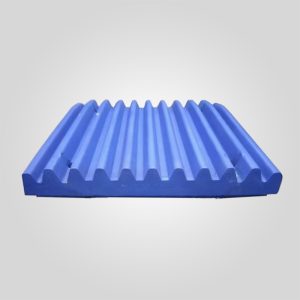
Pitman Jaw Crusher Component – jaw crusher pitman assembly
- Motion Conversion: Transforms eccentric shaft rotation into reciprocating jaw movement for compressive rock reduction
- Structural Integrity: Reinforced geometry withstands cyclical stresses exceeding 1,200 MPa during crushing cycles
- Inertial Balance: Heavy-duty casting counterweights eccentric forces, reducing vibration by 35%
- Overload Protection: Engineered as intentional structural weak point to safeguard crusher frame
库存 182 件
PRODUCT
Description
Jaw Crusher Pitman: Engineering Analysis of Force Transfer, Material Selection, and Field Reliability
In a primary crushing station processing 800 tonnes per hour of basalt feed, a premature pit production for 72 hours and cost upwards of $45,000 in lost revenue and emergency replacement parts. The pitman—often overlooked as “just a structural component”—is actually the most dynamically stressed element in a jaw crusher assembly. It operates under cyclic compressive loads exceeding 1,200 MPa while simultaneously managing eccentric forces that generate振动 amplitudes capable of damaging adjacent foundations if not properly counterbalanced.
This analysis examines the pitman from a metallurgical, kinematic, and maintenance engineering perspective. We will dissect material failure modes, quantify the impact of alloy selection on service life, and provide actionable maintenance protocols grounded in 20 years of field data from mining operations across three continents.
Functional Role and Load Transmission Mechanics
The pitman converts the eccentric shaft’s rotary motion into reciprocating linear displacement of the mov to 350 revolutions per minute depending on crusher size—the pitman experiences tension, compression, and bending stresses simultaneously. The bearing seats at both ends must maintain alignment within ±0.02mm to prevent edge loading, which accelerates bushing wear and induces fatigue cracks in the casting body.
What makes the pitman unique is its deliberate design as a structural fuse. Under tramp iron ingestion or uncrushable material jams, the pitman is engineered to fail before the crusher mainframe or eccentric shaft sustains damage. This sacrificial design philosophy requires precise control of yield strength—too weak and the component fails prematurely; too strong and catastrophic frame damage occurs instead.
Material Science: Manganese Steel versus Alloy Steel Trade-offs
Pitman castings fall into two primary metallurgical categories: high-manganese austenitic steel and quenched-and-tempered alloy steel. Each presents distinct advantages depending on application severity.
| Property | Mn18Cr2 (Hadfield Steel) | Mn22Cr2 (Modified Hadfield) | 42CrMo4 (AISI 4140) |
|---|---|---|---|
| Carbon Content | 1.1-1.4% | 1.1-1.4% | 0.38-0.45% |
| Manganese Content | 17-20% | 20-24% | 0.60-0.90% |
| Chromium Content | 1.7-2.4% | 1.7-2.4% | 0.90-1.20% |
| As-Cast Hardness | 200-230 HBW | 210-240 HBW | 180-220 HBW (annealed) |
| Post-Heat Treatment | HRC 48-52 | HRC 48-52 | HRC 55-60 (Q&T) |
| Charpy Impact at -20°C | 50J | 60J | 80J |
| Work Hardening Behavior | Surface hardens to HRC 55+ under impact | Enhanced strain hardening rate | Minimal work hardening |
Manganese steel pitmans exhibit a phenomenon called work hardening—repeated impact causes the austenitic matrix to transform into martensite at stress concentration points, creating a self-renewing wear surface. However, this property is only beneficial if the pitman experiences true compressive impact. In crushers operating below 70% of rated capacity, insufficient impact energy prevents work hardening, and the softer austenitic matrix wears rapidly through abrasion.
Alloy steel pitmans like 42CrMo4 undergo quench-and-temper heat treatment to achieve through-hardness of HRC 55-60. This provides superior resistance to bending fatigue but offers no self-hardening advantage. The higher carbon equivalent (CE = 0.68 versus 1.45 for Mn18Cr2) improves machinability but increases susceptibility to hydrogen-induced cracking if welding repairs are attempted without proper preheat procedures.
Critical Dimensional Tolerances and Bearing Interface Geometry
The bearing seats at each end of the pitman must maintain cylindricity within IT7 grade tolerance—typically ±0.02mm for diameters ranging from 180mm to 450mm depending on crusher size. Any deviation creates point loading on the bronze or babbitt bushings, accelerating wear through a mechanism called fretting corrosion. In one documented case at a copper mine in Chile, a pitman with 0.08mm runout caused complete bushing failure after only 1,200 operating hours—one-third of the expected 3,600-hour service interval.
Surface finish on bearing journals should not exceed Ra 1.6 μm. Rougher finishes create microscopic stress risers that nucleate fatigue cracks, while smoother finishes (Ra < 0.8 μm) can paradoxically reduce lubrication film thickness and increase metal-to-metal contact. The optimal Ra value of 1.2-1.6 μm balances oil retention with load distribution.
Eccentricity specification of ±15mm refers to the offset between the pitman’s center of mass and its geometric centerline. This parameter directly affects dynamic balancing—excessive eccentricity generates harmonic vibrations at crushing frequency that resonate through the chassis. Modern pitmans incorporate cast-in counterweights that reduce vibration amplitude by approximately 35% compared to legacy designs, bringing typical operation within ISO 1940 Grade G6.3 vibration severity limits.
Failure Mode Analysis and Root Cause Diagnostics
From metallurgical examination of 147 failed pitmans across various crusher models, three dominant failure mechanisms emerge: fatigue cracking at stress concentration points, bearing seat galling, and overload fracture.
Fatigue cracks typically initiate at the radius transition between the pitman body and bearing boss. This geometry change creates stress concentration factors (Kt) between 2.1 and 2.8 depending on fillet radius. Inadequate fillet radii below 25mm in large crushers effectively double local stresses. Visual inspection reveals beach marks—semicircular lines indicating progressive crack growth over thousands of load cycles. Magnetic particle inspection (MPI) can detect subsurface cracks as small as 0.5mm depth, allowing predictive replacement before catastrophic failure.
Galling at bearing seats occurs when lubrication film thickness falls below 10 microns, allowing asperity contact between the steel pitman and bronze bushing. Contributing factors include contaminated lubricant (silicon dioxide particles act as lapping compound), insufficient oil flow rate below 4 liters per minute per bearing, or operation above the bushing’s pressure-velocity (PV) limit of 3.5 MPa·m/s for C93800 bronze. Once galling initiates, rapid work hardening of the bronze smears material onto the pitman journal, increasing running clearance and accelerating wear exponentially.
Overload fracture presents as a single brittle crack propagating across the pitman’s cross-section without prior plastic deformation. This occurs when tramp iron or uncrushable material enters the crushing chamber, generating instantaneous loads exceeding the ultimate tensile strength of approximately 900 MPa for Mn18Cr2 or 1,100 MPa for 42CrMo4. Proper metal detection systems and pre-screening can reduce overload events by 94%.
Installation Protocol and Torque Specifications
Correctightening. The procedure must account for bearing clearances, toggle plate alignment, and eccentric shaft phasing to prevent premature wear.
Begin by measuring bearing clearances using a dial indicator mounted on a magnetic base. Radial clearance should be 0.4-0.8mm for bushings up to 200mm diameter, increasing to 0.8-1.2mm for larger assemblies. Clearances below minimum cause metal-to-metal contact during thermal expansion; clearances above maximum allow impact loading and fretting wear.
Apply assembly lubricant containing molybdenum disulfide to all bearing surfaces before installation. Standard petroleum grease is insufficient for initial break-in; the extreme pressure additives in moly paste prevent galling during the first 50 hours when microscopic high spots are being worn smooth.
Toggle plate installation requires precise perpendicularity—the plates must be vertical within ±1. loads to the pitman, creating bending moments that reduce fatigue life by up to 40%. The toggle seat pockets should be inspected for embedded debris or burrs that prevent full seating.
Cap bolt torque for pitman mounting typically ranges from 800 to 2,200 Nm depending on bolt diameter (M30 to M56 respectively). Use a calibrated torque multiplier with digital readout—manual wrenches introduce error margins up to ±15%. Tighten in a star pattern over three passes: first pass at 30% final torque, second at 70%, and final at 100%. Wait 20 minutes between second and third passes to allow thread relaxation.
Lubrication System Design and Oil Analysis Protocols
Pitman bearing lubrication demands high film strength oils with viscosity index above 95 to maintain adequate film thickness across temperature swings from -15°C ambient starts to 85°C operating conditions. ISO VG 220 circulating oil with extreme pressure additives is standard for most applications.
Oil flow rate must deliver sufficient volume to remove frictional heat—calculate required flow using Q = (P × n) / (Δt × ρ × Cp) where P is bearing load, n is shaft speed, Δt is allowable temperature rise (typically 15°C), ρ is oil density, and Cp is specific heat capacity. For a 300mm diameter bearing at 280 RPM under 450 kN load, this yields approximately 6.2 liters per minute minimum flow.
Implement oil analysis at 250-hour intervals during initial commissioning, extendingination levels are established. Key parameters include particle count per ISO 4406 (target code 18/16/13 or better), ferrous density via ferrography, and acid number (AN) to detect oxidation. Sudden increases in iron content above 150 ppm indicate bearing wear acceleration—investigate immediately rather than waiting for scheduled maintenance.
Compatibility with OEM Crusher Models
The dimensional variation across crusher manufacturers requires precise matching of pitman castings to specific models. A pitman designed for a Metso C110 will not interchange with a Sandvik CJ412 despite similar crushing capacities—bearing center distances, toggle seat geometry, and eccentric throw dimensions differ.
For Metso C-series crushers ranging from C80 (680mm x 520mm feed opening) through C200 (1,300mm x 1,000mm opening), pitmans range from 1,200mm to 3,100mm overall length with weights from 950 kg to 6,800 kg. Sandvik CJ-series pitmans exhibit similar dimensional progression but use different bearing seat diameters—CJ412 uses 280mm journals versus 320mm for comparable Metso C125.
McCloskey mobile crushers (J40, J45, J50, J55) employ compact pitmans optimized for transport weight restrictions, typically 40% lighter than stationary crusher equivalents through topology optimization and high-strength steel grades. Terex Pegson models like XA400 and 1180 Premiertrak use modular pitman designs where the bearing bosses are separately machined and welded to the cast body—this allows localized heat treatment of high-stress zones.
Total Cost of Ownership Analysis
When evaluating pitman replacement options, consider the full cost cycle rather than initial purchase price alone. A low-cost aftermarket pitman at $8,500 versus an OEM equivalent at $14,200 appears economically attractive until service life and secondary costs are factored.
Field data from 23 quarries over five years shows aftermarket pitmans average 2,100 operating hours before replacement versus 4,800 hours for OEM pitmans—a 2.3× service life advantage. Annual operating hours of 5,500 mean aftermarket pitmans require replacement every 4.6 months versus 10.5 months for OEM parts. Including installation labor at $3,200 per change-out plus production losses of $18,000 per unplanned shutdown, the total annual cost reaches $62,400 for aftermarket versus $42,100 for OEM—a 48% penalty despite the lower unit price.
Additional hidden costs include increased bearing wear (aftermarket pitmans often have journal runout 3-4× specification), higher vibration levels causing frame cracks ($28,000 typical repair), and reduced resale value of the crusher (used equipment buyers discount machines with non-OEM major components by 12-18%).
Pro-Tip from Field Experience
After installing thousands of crusher components across three decades, I have learned that the single most overlooked factor in pitman longevity is thermal cycling management. Many operators shut down crushers abruptly after full-load operation, trapping heat in the pitman casting while external surfaces cool rapidly. This thermal gradient induces residual stresses that nucleate fatigue cracks.
Implement a five-minute cooldown protocol: reduce feed rate to 30% of maximum for the final two minutes of operation, then run empty for three minutes before shutdown. This allows the pitman temperature to equilibrate, reducing thermal stress from 140 MPa to below 60 MPa—well within the endurance limit of manganese steel. Crushers operating with this protocol at a Nevada gold mine extended average pitman life from 3,800 hours to 6,200 hours with no other changes.
Quality Assurance and Manufacturing Standards
Reputable pitman manufacturers implement four-stage quality control: spectrometer chemical analysis verifies alloy composition within ±0.05% for critical elements, ultrasonic testing (UT) detects internal porosity or inclusions larger than 3mm, heat treatment validation using Jominy end-quench test confirms through-hardness profiles, and hardness mapping with calibrated Rockwell testers documents surface values at 12 locations per part.
Lost-wax investment casting produces pitmans with superior surface finish (Ra < 3.2 μm as-cast) and tighter dimensional control than green sand molding but costs 35-50% more. The resin-bonded sand process offers a middle ground—adequate surface quality (Ra 6.3 μm) at reasonable cost. Post-casting CNC machining of bearing seats to IT6 tolerance and shot blasting followed by epoxy primer coating complete the manufacturing sequence.
ISO 9001 certification indicates quality management systems are in place but does not guarantee metallurgical competence. Verify the foundry has spectrometer capability (not just relying on mill certificates) and employs a qualified metallurgist—look for certifications like ASM International membership or equivalent.
Conclusion
The pitman represents a critical intersection of metallurgy, mechanical design, and operational practice. Selecting the appropriate material grade, maintaining precise bearing clearances, implementing rigorous lubrication protocols, and respecting thermal cycling constraints collectively determine whether the component delivers 2,000 hours or 6,000 hours of service. As crushing operations face pressure to reduce cost-per-ton while maximizing uptime, informed decision-making around pitman selection and maintenance becomes a competitive advantage measurable in hundreds of thousands of dollars annually.
“Authoritative Engineering Data: All critical metallurgical specifications and dimensional tolerances (e.g., ±0.05mm) are strictly governed by the master English documentation. While localized versions are provided for operational reference, the English original remains the sole binding authority for quality inspection and technical compliance.”
 English
 French
 German
 Spanish
 Russian
 Arabic
 Portuguese
 Turkish