
Heavy-Duty Spherical Roller Bearings: Machined Brass Cages and C3 Clearance for Jaw Crusher Reliability
- Small Jaw Crushers (PE-400×600): 22324 CCK/W33
- Medium Jaw Crushers (PE-600×900): 22330 CC/W33, 22232 CCK/W33
- Large Jaw Crushers (PE-1200×1500): 22244 CCK/W33, 22340 CC/W33
- Extra-Large Crushers (PE-1500×1800): 23284 CCK/W33, 23076 CCK/W33
库存 182 件
PRODUCT
Description
Spherical Roller Bearings for Jaw Crushers: Heavy-Duty Shock Load Management, 222xx/223xx Series Metallurgy, and Misalignment Compensation
In the hierarchy of mechanical failure in gyratory and jaw crushers, the eccentric shaft bearings account for 40% of unscheduled downtime events. Unlike steady-state rotating equipment like pumps or fans, a jaw crusher bearing endures a punishing operational profile: severe oscillating loads, instantaneous impact shocks reaching 25G during “tramp iron” events, and inherent shaft deflection caused by the crushing force of hard rock (300+ MPa UCS). A standard catalogue bearing simply cannot survive these conditions; the application demands a purpose-engineered spherical roller bearing with specific internal clearances, cage metallurgy, and heat stabilization protocols.
This technical product brief details the engineering behind our heavy-duty spherical roller bearings (SRB). We focus on the critical role of brass cages in vibration damping, the necessity of C3/C4 clearances for thermal expansion management, and the rigorous quality standards required to achieve an L10 operational life exceeding 15,000 hours in aggregate mining environments.
Kinematics and Load Compensation
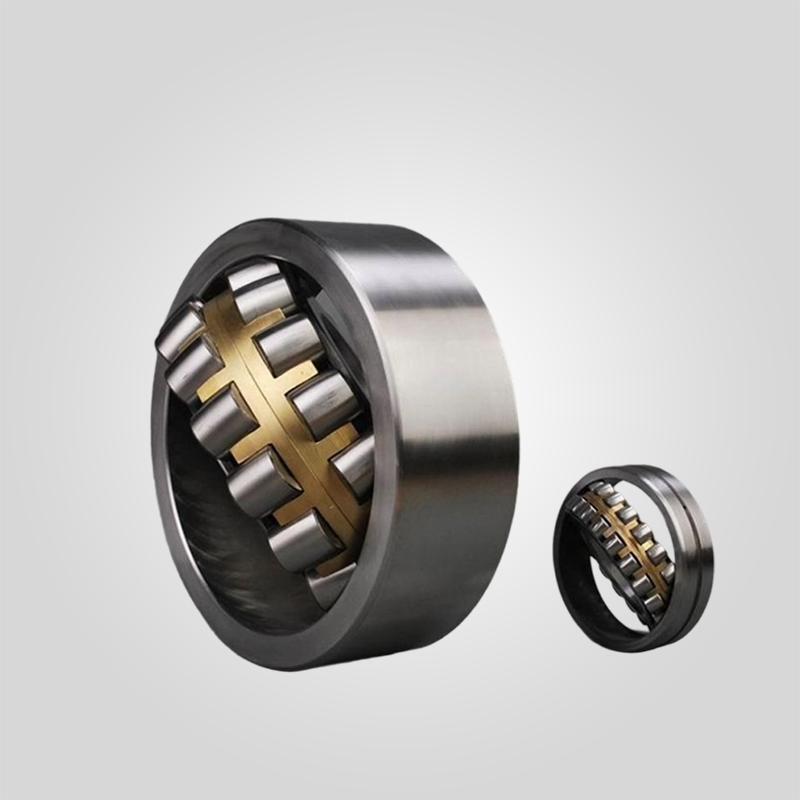
The primary function of the SRB in this application is not just rotation, but the accommodation of misalignment. As the eccentric shaft flexes under the crushing load (often exceeding 4,000 kN in large primary jaws), a rigid bearing would edge-load and spall rapidly. Our bearings feature two rows of barrel-shaped rollers on a common spherical raceway, allowing for ±1.5 degrees of angular misalignment. This geometric flexibility ensures that the load zone remains distributed across the full length of the roller, preventing localized stress concentrations that lead to early fatigue failure.
Cage Dynamics: The “Gold” Standard
The “Gold Cage” visible in product imagery is machined from high-tensile brass (CuZn40Al2). In high-acceleration applications like jaw crushers, stamped steel cages suffer from fatigue cracking at the bridge points. Machined brass cages offer superior inertial strength and self-lubricating properties against the steel rollers, reducing friction during the boundary lubrication regimes typical of slow-speed, high-load crushing.
Metallurgical Integrity: SAE 52100 and Vacuum Degassing
Bearing life is fundamentally limited by the cleanliness of the steel. We utilize SAE 52100 (100Cr6) high-carbon chromium steel, produced via vacuum degassing to minimize non-metallic inclusions (oxides/sulfides) to less than 10 ppm.
- Hardness Profile: Through-hardened to 60-64 HRC. This hardness is maintained throughout the cross-section of the ring, ensuring resistance to subsurface fatigue crack propagation.
- Dimensional Stabilization: Rings are heat-treated to S1 or S2 specifications, ensuring dimensional stability up to 200°C. Standard bearings (S0) can undergo permanent dimensional growth at these temperatures, causing a loss of interference fit on the shaft—a catastrophic failure mode known as “spinning on the journal.”
- Surface Finish: Raceways are super-finished to Ra ≤ 0.2 μm to ensure an adequate lambda ratio ($\lambda$)—the ratio of oil film thickness to surface roughness—even under heavy loads.
Internal Clearance and Thermal Management
Selecting the correct Radial Internal Clearance (RIC) is non-negotiable. Jaw crusher bearings operate with a heavy interference fit on the shaft, which expands the inner ring. Furthermore, the inner ring runs hotter than the outer ring (which is cooled by the massive frame housing). This thermal gradient consumes the internal clearance.
We strictly supply C3 (Greater than Normal) or C4 clearance classes.
Example: A 22330 bearing with C3 clearance has an unmounted gap of 150-190 μm. After mounting and thermal expansion, the operating clearance reduces to the optimal 40-60 μm. Using a standard “CN” clearance bearing in this application guarantees seizure and thermal runaway.
Technical Specifications Table
| Parameter | Specification Value | Engineering Standard / Note |
|---|---|---|
| Material Grade | SAE 52100 / GCr15 | Vacuum Degassed Steel |
| Hardness | HRC 60 – 64 | Through-hardened martensitic structure |
| Internal Clearance | C3 / C4 / C5 | Dependent on shaft fit and ambient temp |
| Cage Material | Machined Brass (MA/MB) | Preferred for high vibration (>5g) |
| Bore Taper | 1:12 (Suffix K) or 1:30 | For adapter sleeve mounting |
| Dynamic Load ($C_r$) | Up to 2,200 kN | Varies by bearing size (ISO 281) |
| Vibration Class | V3 / ZV4 | Low noise/vibration per ISO 15242 |
| Lubrication Feature | W33 | Annular groove + 3 holes in outer ring |
Compatibility Matrix: Bearing Selection
We stock and engineer bearings for the full spectrum of jaw crusher models. Correct identification usually requires the bore diameter, OD, width, and the specific suffix (K for tapered, W33 for lube groove).
Small to Medium Crushers
- PE-400×600: 22324 CCK/W33 (Eccentric)
- PE-600×900: 22330 CC/W33 (Frame)
- PE-500×750: 22228 CCK/W33 (Eccentric)
Large Primary Crushers
- PE-900×1200: 22338 CCK/W33 (Eccentric)
- PE-1000×1200: 22340 CC/W33 (Frame)
- CJ411 / CJ612: 22326 CAM / 23244 CAM
Total Cost of Ownership (TCO) & Reliability
A “budget” bearing costing 40% less typically delivers 20% of the service life in mining applications. The math is brutal:
Standard Bearing: Fails at 2,000 hours due to cage fracture. Replacement requires 24 hours downtime + Crane + Labor.
Heavy-Duty Brass Cage Bearing: Survives 8,000+ hours.
The cost of one unscheduled bearing change (approx. $40,000 in lost production) exceeds the price of premium bearings by a factor of ten. Our bearings are subjected to 100% Ultrasonic Testing (UT) to ASTM A388 standards to ensure no internal voids exist before they ever reach your site.
Engineer’s Advice: Field Installation & Maintenance
[Option B: Pro-Tip] – The Clearance Reduction Rule:
For tapered bore bearings (Suffix K) mounted on adapter sleeves, torque wrenches are unreliable due to thread friction variability. You must use the “Drive-Up Method” measuring Radial Internal Clearance (RIC) reduction.
The Rule: Measure the unmounted clearance with feeler gauges. As you tighten the nut, the inner ring expands and clearance decreases. Stop when you have achieved the manufacturer’s specified reduction (typically 0.05mm – 0.09mm depending on size). Over-tightening eliminates clearance and causes rapid overheating; under-tightening allows the sleeve to spin on the shaft.
[Option C: Field Case Snippet] – The Labyrinth Seal Trap:
In a limestone quarry in Texas, bearings were failing every 3 months. The oil analysis showed massive silica spikes. The culprit? The labyrinth seals were packed with hard, dried grease. The operators were greasing the bearings but not purging the seals. Fresh grease follows the path of least resistance. If the seals are blocked, grease won’t flush out contaminants. We implemented a protocol to purge the seals until fresh grease appeared while the crusher was running slow. Bearing life extended to 14 months instantly.
Quality Assurance
Our production line integrates automated quality checks at every stage:
- Raw Material: Spectroscopic verification of chemical composition.
- Heat Treatment: Jominy end-quench testing to verify hardness depth.
- Finishing: Taylor Hobson roundness measurement to verify raceway geometry.
- Final Audit: 100% Magnetic Particle Inspection (MPI) to detect surface cracks per ISO 9934-1.
This rigorous approach ensures that every bearing delivered is capable of handling the 25G impacts inherent to the crushing process.
“Authoritative Engineering Data: All critical metallurgical specifications and dimensional tolerances (e.g., ±0.05mm) are strictly governed by the master English documentation. While localized versions are provided for operational reference, the English original remains the sole binding authority for quality inspection and technical compliance.”

 English
 French
 German
 Spanish
 Russian
 Arabic
 Portuguese
 Turkish