
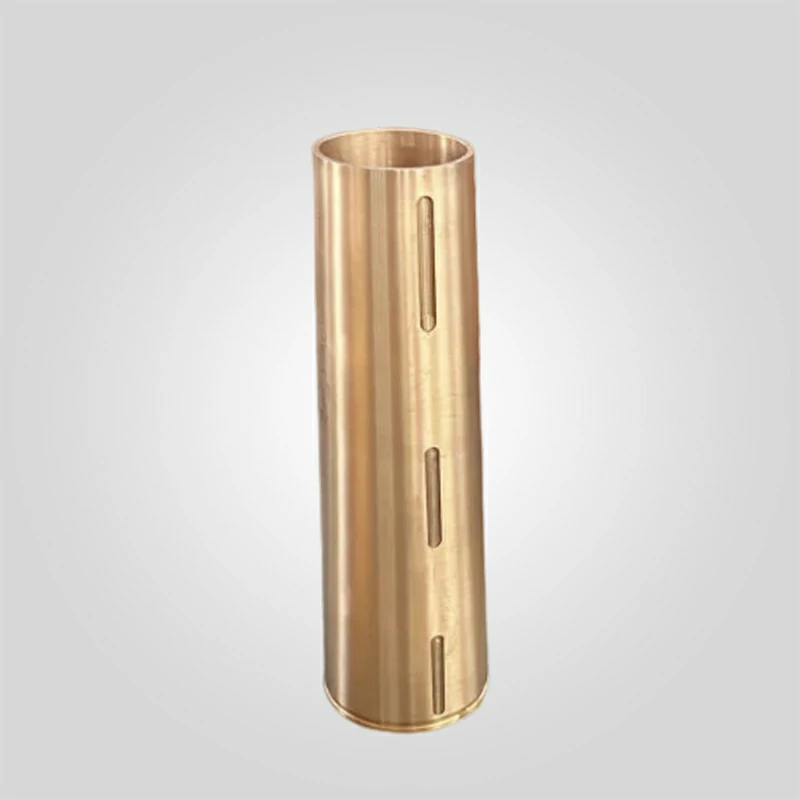
Sandvik CH440 Inner Eccentric Bushing 442.9643-01 | C93700 Bronze
Compatible Crusher Models : Sandvik CH/CS Series 44 Cone Crusher
Part Name : Inner Eccentric Bushing, Eccentric Sleeve
Primary Material : High-Lead Tin Bronze (e.g., C93200/C93400)
Key Features: Excellent wear resistance, high load capacity, good thermal conductivity
Lubrication Requirement: Continuous, clean oil flow with correct viscosity and pressure is critical.
库存 221 件
PRODUCT
Description
| Technical Parameter | Specification Value | Engineering Standard |
|---|---|---|
| OEM Part Number | 442.9643-01 | Sandvik CH440 / H4800 |
| Component Name | Inner Eccentric Bushing | Main Shaft Interface Bearing |
| Throw Configuration | 16, 20, 24, 28, 32 mm | Determines Crushing Stroke |
| Design Feature | Without Keyway | Interference Fit (Freeze Install) |
| Material Grade | C93700 High-Lead Bronze (SAE 64) | High Anti-Seize Properties |
| Manufacturing Method | Centrifugal Casting | Dense, Defect-Free Structure |
| Weight | ~ 130.2 kg | Precision Machined |
| Hardness | 60 – 70 HBW | Optimized for Shaft Protection |
Sandvik CH440 Inner Eccentric Bushing | 442.9643-01 | C93700 Bronze
The Inner Eccentric Bushing (442.9643-01) is the “heartbeat” component of the Sandvik CH440 (formerly Svedala H4800) cone crusher. It is pressed into the rotating Eccentric Assembly and provides the bearing surface against the stationary Main Shaft. This specific part number is engineered for variable throw settings (typically 16mm to 32mm range), allowing operators to fine-tune the crusher’s capacity and product gradation.
As a specialized bronze cone crusher parts supplier, we do not compromise on metallurgy. We utilize Centrifugally Cast C93700 High-Lead Tin Bronze. Unlike standard sand-cast SAE 660 bushings, our SAE 64 alloy contains 8-10% Lead, which forms a microscopic self-lubricating film. This is critical for preventing catastrophic “shaft burn” during high-load crushing or momentary lubrication pressure drops.
Core Engineering: The Importance of “Throw”
The 442.9643-01 bushing defines the geometry of the crusher’s movement.
- Eccentric Throw: This bushing is machined with a precise offset. This offset determines how far the mantle moves from the closed side to the open side during one revolution.
- Application Logic:
- Small Throw (e.g., 16-20mm): Best for Fine Crushing (secondary/tertiary) to produce cubical product.
- Large Throw (e.g., 28-32mm): Best for High Capacity, but may produce more flaky material.
- Zero Backlash: Our bushings are machined to ISO H7 tolerance to ensure no play between the bushing and the eccentric steel, preventing “fretting corrosion.”
Engineer’s Maintenance Advice (Information Gain)
Diagnostic: The “Copper Flash” in Oil Analysis
How do you know if your Inner Bushing 442.9643-01 is failing without opening the crusher?
- Oil Analysis: Regularly sample your return oil.
- Warning: A sudden spike in Copper (Cu) > 50 ppm indicates abnormal wear.
- Critical: If you see Lead (Pb) spiking alongside Copper, the bushing has worn through the optimal bearing layer.
- Temperature Delta: Monitor the difference between feed oil and return oil temperature. If the delta exceeds 5°C (9°F) under no-load conditions, the clearance between the Inner Bushing and Main Shaft is likely too tight or the bushing has deformed (ovalized).
- Installation Tip: This bushing has No Keyway. It relies on a heavy interference fit. You MUST use Dry Ice or Liquid Nitrogen to shrink the bushing by approx. 0.15mm before dropping it into the Eccentric. Never hammer it.
Why Source From Our Bronze Foundry?
We supply crusher spares that outperform OEM costs while matching performance.
- Material Certs: Every batch comes with a spectrometer report verifying Sn, Pb, and Cu content.
- Dimensional Check: We use CMM to verify the eccentric offset angle is accurate to 0.01 degrees.
- Stock Strategy: We hold 442.9643-01 in stock for immediate breakdown relief.
“Authoritative Engineering Data: All critical metallurgical specifications and dimensional tolerances (e.g., ±0.05mm) are strictly governed by the master English documentation. While localized versions are provided for operational reference, the English original remains the sole binding authority for quality inspection and technical compliance.”


 English
 French
 German
 Spanish
 Russian
 Arabic
 Portuguese
 Turkish