

| Technical Specification | Data / Standard |
|---|---|
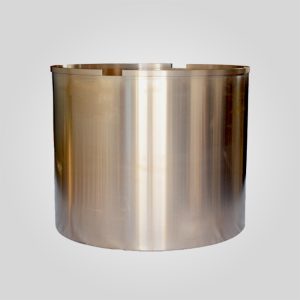
| Part Name | Eccentric Bushing (Inner & Outer) |
| Compatible Series | Symons 2ft, 3ft, 4ft, 4¼ft, 5½ft, 7ft |
| Material Grade | High-Leaded Tin Bronze (ASTM C93700 / SAE 64) |
| Casting Method | Centrifugal Casting (Zero Porosity) |
| Lead Content (Pb) | 9.0% – 11.0% (Critical for Anti-Seize) |
| Hardness | 65 – 80 HBW |
| Machining Tolerance | ISO 2768-mK / H7 (Interference Fit) |
Symons Eccentric Bushing: Inner & Outer Bronze Replacements
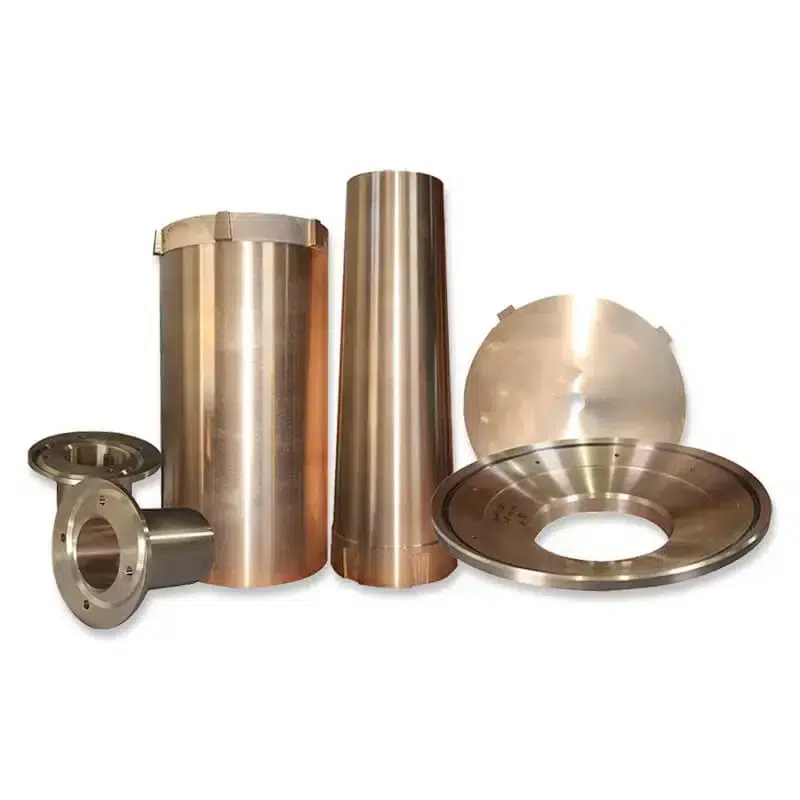
The Eccentric Bushing assembly is the heart of the Symons cone crusher’s drive system. It consists of two critical components: the Inner Eccentric Bushing (which supports the main shaft) and the Outer Eccentric Bushing (which rotates within the main frame bushing). These components transmit the crushing force while enduring high-speed rotation and eccentric loading.
Our bushings are manufactured from ASTM C93700 High-Leaded Tin Bronze using Centrifugal Casting technology. This process spins the molten alloy at high G-forces, compacting the grain structure and forcing impurities to the inner bore, which are then machined away. The result is a dense, uniform bearing surface that resists fatigue spalling 30% better than sand-cast alternatives.
Metallurgy: The C93700 Advantage
We specifically select C93700 (SAE 64) for Symons applications due to its tribological properties:
- Fail-Safe Lubrication: The 10% Lead content acts as a solid lubricant. If the oil film is compromised by a tramp iron event or pump failure, the lead smears to prevent the bronze from welding to the steel eccentric or main shaft.
- Embeddability: Hard rock dust (silica) often contaminates the oil. Our bronze is formulated (65-80 HBW) to allow these particles to embed safely into the bushing wall, preventing them from scoring the expensive Main Shaft journals.
Field Diagnosis: When to Replace
Eccentric bushing wear directly affects crusher performance. Watch for these symptoms:
1. “Gear Howl” or Root Bottoming
As the Outer Eccentric Bushing wears, the entire eccentric assembly drops slightly or moves laterally. This changes the backlash of the bevel gear and pinion, causing a loud howling noise. If ignored, it will strip the gear teeth.
2. Countershaft Vibration
Excessive clearance in the bushings allows the eccentric to wobble, transmitting vibration back through the pinion to the countershaft box.
3. Bronze Flakes in Oil
Large, non-magnetic gold flakes in the return screen indicate that a bushing is delaminating or “wiping.” Immediate inspection is required to save the main shaft.
Dimensions & Compatibility
| Crusher Size | Component | Approx. Weight (kg) |
|---|---|---|
| Symons 3′ | Inner / Outer Bushing | ~35 / ~45 |
| Symons 4¼’ | Inner / Outer Bushing | ~95 / ~120 |
| Symons 5½’ | Inner / Outer Bushing | ~180 / ~240 |
| Symons 7′ | Inner / Outer Bushing | ~350 / ~480 |
Installation Expert Tip
[Pro-Tip] Installing eccentric bushings requires thermal management.
1. Shrink Fitting: The Outer Eccentric Bushing is an interference fit into the Main Frame Bushing. Use Dry Ice (-70°C) to shrink the new bushing. Never use a torch and hammer, as this distorts the bore.
2. Locking: Ensure the keys or locking screws are properly seated. If the inner bushing spins inside the eccentric, it will ruin the eccentric casting, which costs 10x more than the bushing.
3. Clearance Check: After installation, verify the clearance between the Main Shaft and Inner Bushing using long feeler gauges. It must be within OEM specs (typically 0.4mm – 0.8mm depending on size) to allow for thermal expansion.
Workshops And Warehouses


 English
 French
 German
 Spanish
 Russian
 Arabic
 Portuguese
 Turkish