

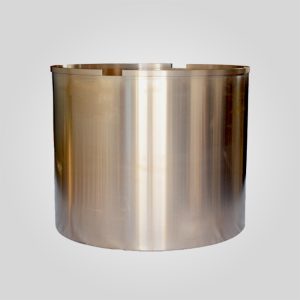
Cone Crusher Bottom Shell | ASTM Cast Steel Main Frame | OEM Fit
Wall Thickness: 50-100mm (varies by model)
Bottom Shell Weight: 2-8 tons (model dependent)
Surface Hardness: 180-220 HB
Dimensional Tolerance: ±0.5mm critical dimensions
Service Life: 12-24 months in normal abrasive applications
库存 214 件
PRODUCT
Description
| Technical Parameter | Specification Data |
|---|---|
| Material Standard | ASTM A216 WCB / EN 10293 G20Mn5 (Modified ZG275-485) |
| Tensile Strength | ≥ 485 MPa |
| Yield Strength | ≥ 275 MPa |
| Surface Hardness | 180 – 220 HBW (Heat Treated) |
| Machining Tolerance | ISO 2768-mK / Bore Tolerance H7 (+0.046/-0) |
| Surface Finish (Bores) | Ra 1.6 μm |
| Operating Temperature | -40°C to +80°C |
| Weight Range | 2,800 kg – 14,500 kg (Model Dependent) |
| Non-Destructive Testing | Level 2 UT (ASTM A609) & MT (ASTM E709) |
Heavy-Duty Bottom Shell Assemblies for High-Inertia Crushing
The structural integrity of a cone crusher relies entirely on the bottom shell’s ability to dissipate up to 180 MPa of cyclic impact stress generated during the crushing of granite, basalt, or iron ore. Unlike wear parts that are designed to fail sacrificially, the bottom shell (or main frame) must maintain absolute dimensional stability to prevent the catastrophic misalignment of the eccentric assembly. A deviation of just 0.15mm in the central hub geometry can lead to eccentric bushing burn-out or main shaft fracture within 500 operating hours.
Our manufacturing process addresses the common failure modes of OEM heavy castings: porosity in the rib sections and thermal stress cracking. By utilizing vacuum degassing during the ladle refining phase and employing localized chillers in the sand casting mold, we ensure a dense, defect-free grain structure. This component serves as the backbone for Metso Nordberg HP series, Sandvik CH series, and Symons cone crushers, providing a drop-in replacement solution that meets or exceeds the original metallurgical specifications.
Engineering and Metallurgy: Beyond Standard Cast Steel
While generic crusher part suppliers often utilize standard carbon steel, our bottom shells are engineered using a modified ASTM A216 WCB grade cast steel. This material choice balances weldability with high structural rigidity. The casting process involves a strict normalizing and tempering heat treatment cycle to relieve internal residual stresses caused by the cooling process of such a massive component.
The chemical composition is strictly controlled to minimize sulfur and phosphorus (P ≤ 0.035%, S ≤ 0.035%), which are the primary causes of cold shortness and cracking under low-temperature operations. For applications in extreme environments, such as arctic mining operations, we offer impact-tested grades capable of maintaining ductility at -40°C.
[Option B: Pro-Tip] When inspecting your current bottom shell, pay close attention to the area where the mainframe ribs meet the central hub. This is the highest stress concentration point. If you detect hairline fractures here during a dye penetrant test, strictly avoid welding without a proper pre-heat (min 150°C) and post-weld stress relief protocol, otherwise, the repair will fail within weeks.
Precision Machining and Geometric Tolerances
The longevity of internal spare parts like the eccentric bushing and socket liner is dictated by the machining precision of the bottom shell. We utilize 5-axis CNC Vertical Boring Mills to machine the critical datums in a single setup. This ensures:
- Eccentric Bore Concentricity: The central bore is machined to an H7 tolerance grade. This tight fit is critical to prevent “bushing spin,” a failure mode where the eccentric bushing rotates inside the frame, destroying the housing.
- Pinion Shaft Housing Alignment: The perpendicularity between the pinion shaft bore and the main vertical axis is maintained within 0.05mm/m. Misalignment here is the leading cause of premature bevel gear wear and excessive noise.
- V-Seat or Flat Seat Planarity: For Symons-style crushers utilizing a V-seat, the angle is matched perfectly to the top shell to prevent “chatter” and fretting corrosion during operation.
Field Diagnosis: When to Replace Your Bottom Shell
Replacing a main frame is a significant capital expenditure. However, continuing to operate with a compromised bottom shell increases the Total Cost of Ownership (TCO) by damaging other crusher spares. Here is a technical guide to diagnosing end-of-life conditions:
1. Hub Bore Ovality
Over years of operation, the constant radial load from the crushing action can deform the central hub bore. Measure the bore diameter at 0°, 45°, and 90°. If the ovality exceeds 0.3mm, the eccentric bushing will not maintain a hydrodynamic oil wedge, leading to metal-on-metal contact and rapid overheating (temperatures exceeding 65°C).
2. Seat Wear and Fretting
Inspect the mounting flange where the top shell rests. If you observe “steps” or significant fretting wear deeper than 1.5mm, the crusher setting (CSS) cannot be maintained accurately. This results in the top shell “bouncing” under load, which can snap the main locking bolts.
[Option C: Field Case Snippet] We recently analyzed a failure in a Chilean copper mine where the customer replaced three bronze bushings in six months. The root cause was not the bronze quality, but the bottom shell bore which had washed out by 0.6mm due to oil contamination over 10 years. After installing our precision-machined bottom shell, the bushing life returned to the standard 18 months, reducing their annual maintenance downtime by 40%.
Installation and Maintenance Best Practices
To maximize the service life of this component, proper installation procedures must be followed. The bottom shell must be leveled on the foundation to within 0.5mm/m. Utilizing epoxy grout specifically designed for dynamic loads is recommended over standard concrete.
Lubrication Management:
Our bottom shells feature optimized oil gallery designs. However, sludge buildup in these internal channels can restrict flow. We recommend high-pressure flushing of the integral oil lines during the replacement process. Ensure that the return oil line has a downward slope of at least 15 degrees to prevent oil pooling in the crusher base, which can lead to seal leakage.
Arm Guard Protection:
The ribs (arms) of the bottom shell are subject to intense abrasion from falling ore. We strongly suggest installing high-chrome or overlaid wear plates (Arm Guards) immediately. Running a bottom shell without arm guards is a false economy that will erode the structural ribs, permanently weakening the frame.
Quality Assurance and Traceability
We do not simply pour metal; we engineer reliability. Every bottom shell undergoes a rigorous quality control regimen before leaving the foundry:
- Dimensional Verification: Validated via CMM (Coordinate Measuring Machine) reports.
- Material Certification: Full chemical and physical reports supplied to EN 10204 3.1 standards.
- Ultrasonic Testing (UT): Scanned according to ASTM A609 Level 2 to ensure no internal voids exists in critical stress zones.
- Magnetic Particle Inspection (MT): Performed on all machined surfaces to detect surface-breaking defects.
Whether you are operating a stationary aggregate plant or a mobile mining circuit, our bottom shell assemblies provide the geometric precision and metallurgical toughness required to keep your production targets on track.
“Authoritative Engineering Data: All critical metallurgical specifications and dimensional tolerances (e.g., ±0.05mm) are strictly governed by the master English documentation. While localized versions are provided for operational reference, the English original remains the sole binding authority for quality inspection and technical compliance.”



 English
 French
 German
 Spanish
 Russian
 Arabic
 Portuguese
 Turkish