
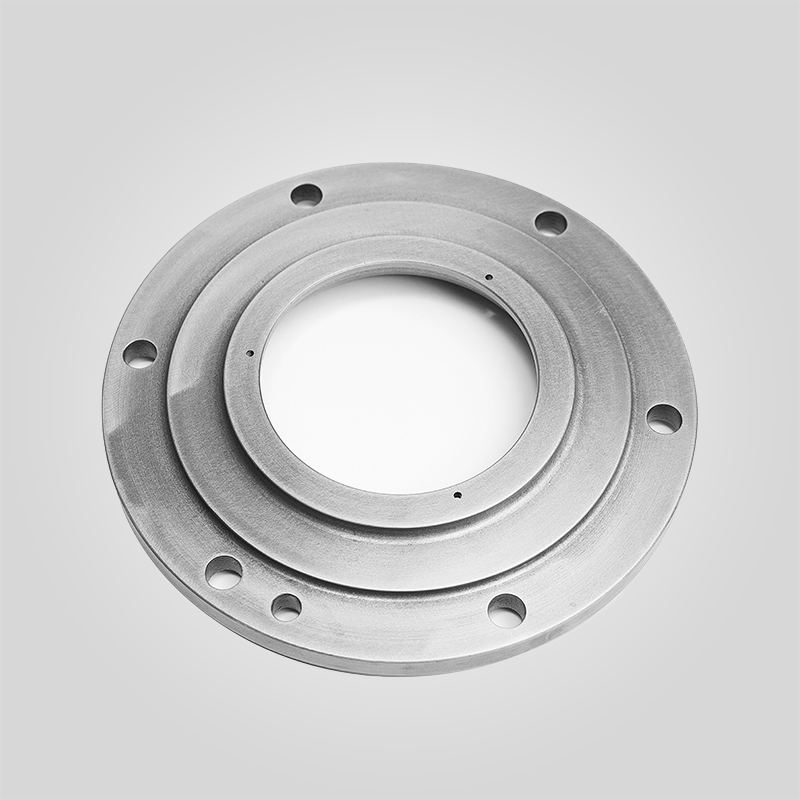
Cone Crusher Bearing Cover – Essential Crusher Parts
Bearing Cover Material Grade: QT500-7/Cast Steel ZG270-500
Sealing Standard: ISO 6194-1 compliant
Protection Rating: IP65 dust/water protection
Temperature Range: -40℃ to 150℃
Bearing Compatibility: Tapered roller bearings/Spherical roller bearings
库存 214 件
PRODUCT
Description
| Technical Specification | Data / Standard |
|---|---|
| Material Standard | Ductile Iron ASTM A536 Grade 80-55-06 (QT500-7) |
| Tensile Strength | ≥ 500 MPa |
| Yield Strength | ≥ 320 MPa |
| Machining Tolerance | ISO 2768-m / Seal Grooves h9 |
| Surface Roughness | Ra 1.6 μm (Mating Surfaces) |
| Corrosion Protection | Manganese Phosphate Coating / Anti-rust Oil |
| Operating Temp | -40°C to +120°C (Standard) |
| Seal Compatibility | Nitrile (NBR), Viton (FKM), Labyrinth Seals |
Precision-Engineered Bearing Covers for Cone Crushers
The reliability of a cone crusher’s drive train depends entirely on the cleanliness of the lubricant. This bearing cover serves as the primary defense line, preventing abrasive dust ingress (silica, granite fines) from contaminating the eccentric assembly and countershaft box. Unlike generic cast iron covers that often suffer from porosity, our components are manufactured using high-density Ductile Iron (QT500-7/GGG50). This material choice provides superior vibration damping properties and prevents micro-cracking under the high-frequency oscillation typical in hard rock crushing.
As one of the specialized crusher part suppliers, we utilize CNC turning centers to machine the critical seal grooves and mounting flanges. This ensures perfect concentricity with the shaft, preventing the “wobble” that leads to premature lip seal failure and oil leakage. These spares act as essential insurance for your expensive tapered and spherical roller bearings.
Metallurgy and Manufacturing Process
Standard grey iron is often too brittle for modern high-inertia crushers. We adhere to ASTM A536 standards for Spheroidal Graphite Iron, ensuring a nodularity rate above 85%. This microstructural integrity allows the cover to withstand accidental impacts during maintenance without fracturing.
- Stress Relief: All castings undergo low-temperature annealing to eliminate residual casting stresses, ensuring the flatness remains within 0.05mm over the service life.
- Seal Surface Finish: The contact areas for O-rings and lip seals are polished to Ra 1.6 μm or better. A rough surface here acts like a file, shredding rubber seals within weeks of operation.
- Pressure Testing: Random batch samples are subjected to pneumatic leak testing to verify casting density.
Field Diagnosis: When to Replace Bearing Covers
Bearing covers are often overlooked during routine liner changes, yet they are critical crusher spares. Engineers should monitor the following indicators to determine end-of-life status:
1. The “Silica Spike” in Oil Analysis
If your regular ISO 4406 oil analysis shows a sudden increase in Silicon (Si) particles without a corresponding rise in Iron (Fe) wear from gears, your bearing cover seals have likely failed. The cover itself may have warped, breaking the hermetic seal.
2. Groove Erosion
Inspect the O-ring and lip seal grooves during disassembly. If you can feel a ridge or “step” with your fingernail inside the groove, the cover must be replaced. Reusing a grooved cover will prevent new seals from seating correctly, leading to immediate leakage.
3. Fretting Corrosion on Flanges
Look for reddish-brown powder on the mounting face. This indicates movement between the cover and the housing. If the metal loss exceeds 0.2mm, tightening the bolts will distort the cover, causing further leaks.
Compatibility and Applications
Our bearing covers are engineered as direct aftermarket replacements for major OEM platforms. We ensure complete interchangeability without the need for on-site modification.
- Metso Nordberg: HP100, HP200, HP300, HP400, HP500, HP800, GP Series.
- Sandvik: CH420, CH430, CH440, CH660, CS Series.
- Symons: 3ft, 4.25ft, 5.5ft, 7ft Standard and Short Head.
- Telsmith & Terex: Select models (consult for part numbers).
Installation and Expert Advice
To ensure maximum service life and prevent oil leaks, follow this installation protocol:
[Expert Tip] Never install a bearing cover completely dry. Apply a thin film of Moly-based grease to the O-rings and the seal grooves to prevent “pinching” or cutting the rubber during assembly. Furthermore, use a cross-pattern torque sequence when tightening the mounting bolts. Uneven tightening is the #1 cause of cover warping, which leads to mystery oil leaks even with new seals. Always replace the copper or aluminum washers on the bolts, as old washers work-harden and fail to seal.
“Authoritative Engineering Data: All critical metallurgical specifications and dimensional tolerances (e.g., ±0.05mm) are strictly governed by the master English documentation. While localized versions are provided for operational reference, the English original remains the sole binding authority for quality inspection and technical compliance.”


 English
 French
 German
 Spanish
 Russian
 Arabic
 Portuguese
 Turkish