

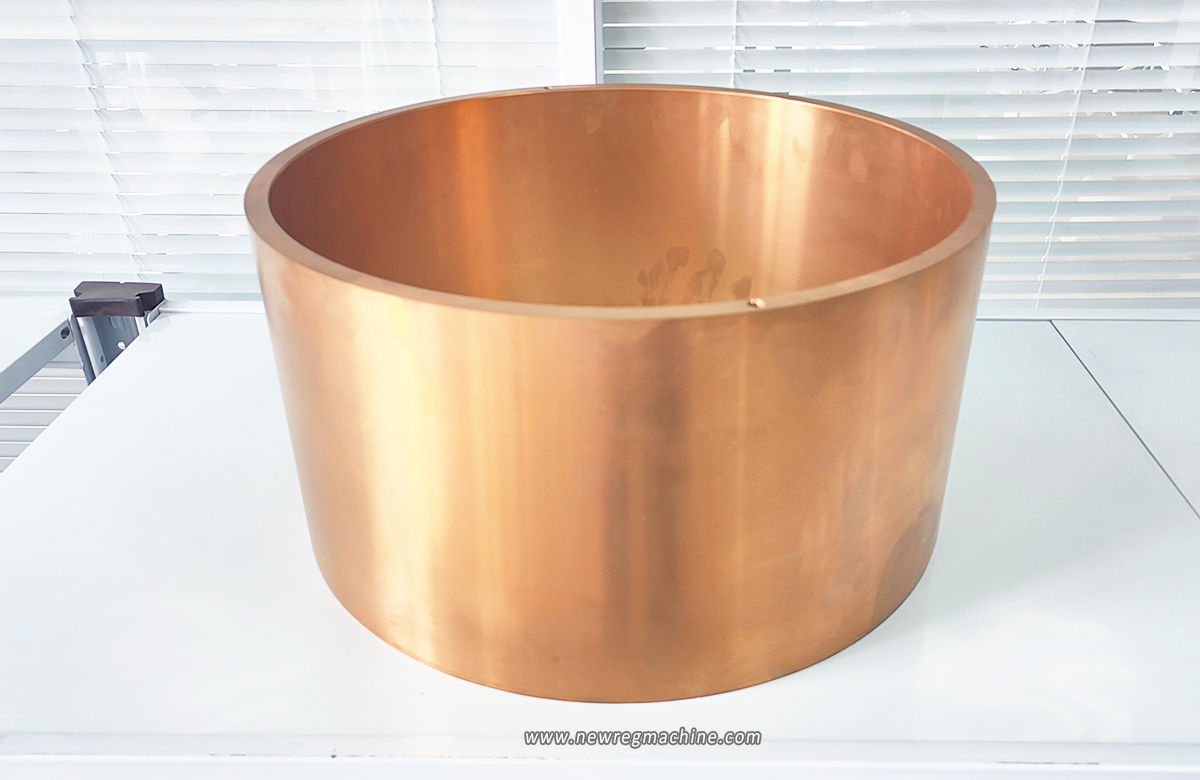
The Physics of the 8,000 kN Interface: Managing Boundary Lubrication
In a primary gyratory crusher like the Metso Superior MK-II 60-89, the Bronze Bearing Liner—specifically the eccentric bushing and bottom shell bushing—operates in a regime that defies standard tribology. While the shaft rotates at a seemingly slow 150 RPM, the eccentric assembly generates radial crushing forces exceeding 8,000 kN. Under these conditions, the hydrodynamic oil wedge often collapses to less than 20 microns, pushing the system into “boundary lubrication.”
The reliability of the entire crushing circuit depends on the metallurgical ability of the bronze liner to survive this metal-to-metal contact without seizing. A failure here is not a simple parts swap; it requires lifting the 100-ton main shaft, incurring downtime costs of $50,000 per hour. This article audits the specific alloy compositions, manufacturing densities, and installation protocols required to ensure these critical components survive beyond 12,000 hours.
1. Metallurgy: Why C93700 Beats Generic Bronze
The choice of alloy is a trade-off between load-bearing capacity (Yield Strength) and emergency lubricity (Lead Content).
The High-Lead Advantage (C93700 / SAE 64)
For the eccentric bushing, we specify C93700 High-Lead Tin Bronze.
* Composition: 80% Cu, 10% Sn, 10% Pb.
* Mechanism: The 10% Lead content exists as discrete globules within the copper matrix. During startup or shock loading (Tramp Iron), friction heat causes the lead to smear onto the steel shaft.
* Tribology: This “Lead Sweat” creates a solid lubricant film that prevents adhesive wear (welding) when the oil film breaks. A standard Tin Bronze (C90300) without lead would seize instantly under the same conditions.
The High-Strength Option (CuSn12Ni2)
For the outer eccentric bushing (Bottom Shell Bushing), where alignment stability is paramount:
* Composition: 86% Cu, 12% Sn, 2% Ni.
* Properties: The Nickel addition increases the Yield Strength to > 220 MPa.
* Application: Resists deformation (“bell-mouthing”) caused by the gyroscopic precession of the eccentric assembly.
| Alloy Grade | Hardness (HBW) | Lead Content | Critical Function |
| C93700 (SAE 64) | 60 – 70 | 9.0 – 11.0% | Anti-Seizure. Sacrificial wear surface for main shaft protection. |
| CuSn12Ni2 | 90 – 100 | < 0.5% | Structural Stability. Resists compressive yield under eccentric loads. |
| C95400 (Al-Bronze) | 150 – 170 | 0% | Corrosion Resistance. Used only in specific wet/acidic applications. Poor embeddability. |
2. Manufacturing: The Density Imperative
The method of casting defines the liner’s fatigue life.
The Centrifugal Standard
We mandate Centrifugal Casting for all rotating Bronze Bearing Liners.
* Process: The mold spins at 50-100 Gs during solidification.
* Density: Achieves 8.96 g/cm³ (vs. ~8.4 g/cm³ for sand casting).
* Grain Structure: The G-force compresses the grain structure and floats impurities (slag, gas) to the ID, which is machined away.
* Benefit: Eliminates microporosity. Porosity acts as a stress riser for fatigue cracks and disrupts the oil film integrity.
3. Geometric Engineering: Oil Grooves and Taper
The geometry of the liner is as critical as the material.
Helical Oil Grooves
* Design: Grooves must be helical (spiral) to pump oil upwards against gravity and centrifugal force.
* Machining: Edges must be chamfered/radiused. A sharp edge on an oil groove acts as a scraper, removing the oil film from the shaft.
* Flow Rate: The groove cross-section must support a flow rate of > 80 L/min to carry away the heat generated by friction (approx. 40 kW of heat in large crushers).
Tapered Bore Compensation
* Problem: Under load, the main shaft deflects (bends).
* Solution: The Bronze Bearing Liner bore is often machined with a slight taper or “hourglass” profile to compensate for this deflection, ensuring the load is distributed over the full height of the bushing rather than point-loading the edges.
4. Maintenance Protocols: Predictive Intelligence
How do you know when a liner is about to fail?
Oil Analysis (Ferrography)
* Sampling Frequency: Every 250 hours.
* Copper (Cu) + Lead (Pb): A steady trend is normal. A sudden spike (e.g., Cu > 50ppm rise) indicates the liner is “wiping.”
* Iron (Fe): Indicates the shaft is wearing. Stop immediately. The liner has failed.
* Silicon (Si): Indicates dust seal failure. Silica particles > 20μm will embed in the liner and turn it into a grinding wheel.
Temperature Monitoring
* Baseline: 45°C – 50°C return oil temp.
* Warning: > 55°C.
* Trip: > 60°C.
* Physics: At 90°C shaft surface temp (approx. 60°C oil temp), the viscosity of ISO VG 150 oil drops to the point where it can no longer support the 8,000 kN load. Seizure is imminent.
5. Installation Best Practices: The Cryogenic Shrink
Installing a 1,000mm diameter liner requires thermal physics.
1. Measure Housing: Verify the housing bore is round within 0.05mm. If oval, the new liner will distort and pinch the shaft.
2. Cryogenic Cooling: Use Solid CO2 (Dry Ice) and Alcohol slurry to shrink the liner.
* Target Shrinkage: ~1.0mm for a 1000mm bushing.
* Caution: Liquid Nitrogen (-196°C) can cause thermal shock cracking in thin-walled, high-tin bronzes. Use with extreme caution.
3. Alignment: Mark the oil hole alignment on the flange. You have < 60 seconds to drop and align before thermal lock occurs.
Field Case Snippet: “I investigated a failure on a CH895 where the eccentric bushing spun in the housing 2 hours after startup. The root cause: The maintenance team used a torch to heat the housing instead of cooling the bushing. The uneven heating distorted the housing bore, creating only 30% contact area. The lack of friction allowed the bushing to break the locking keys and spin. Always shrink the bushing, don’t heat the frame.”
Conclusion: The “Cheap” Liner Myth
A Bronze Bearing Liner represents less than 2% of the crusher’s capital cost but controls 100% of its availability. Saving 20% by purchasing a sand-cast, low-lead generic bushing is a false economy that risks a $100,000 main shaft failure. By specifying Centrifugal C93700, verifying density, and adhering to strict installation protocols, mining operations can turn this consumable component into a predictable asset.


 English
 French
 German
 Spanish
 Russian
 Arabic
 Portuguese
 Turkish