

Three year s ago, a procurement manager at an open-pit copper operation in Zambia switched crusher parts suppliers mid-season to save approximately 18% on unit cost. Within 90 days, the site had logged four unplanned shutdowns. The replacement jaw plates — advertised as Mn18Cr2 — failed spectroscopic verification on arrival, testing at Mn11.4% and Cr 0.3%, a composition closer to standard Mn13 without the chromium modification that gives the alloy its resistance to abrasive quartzite. The dimensional tolerance on the mating surfaces was out by 1.8 mm, causing uneven load distribution across the toggle plate. Two toggle plates fractured within 200 operating hours. The total financial impact across lost production, emergency air freight, and reactive maintenance labor exceeded $340,000 USD — against an annual parts saving that had been projected at $28,000. The wrong crusher parts supplier did not just cost money. It cost the operation its crushing availability for an entire quarter.
That scenario is not exceptional. It is repeatable, and it is repeating itself at quarries and mineral processing plants across every major mining region in the world. Choosing a crusher parts supplier is not a procurement exercise. It is an engineering decision with direct consequences for machine availability, component service life, and total cost of ownership.
Understanding What a Crusher Parts Supplier Is Actually Selling You
The category of crusher parts covers a wide and technically varied group of components. Primary wear items — jaw plates, mantles, bowl liners, blow bars, and concaves — account for the majority of replacement spend and carry the highest consequence of failure. Secondary components including toggle plates, pitman assemblies, eccentric bushings, thrust bearings, and tension rods operate under sustained mechanical loads and require equally rigorous material and dimensional control. Tertiary items such as seals, springs, and fasteners are often sourced opportunistically, but incorrect specification here can accelerate wear in adjacent primary components.
A credible crusher parts supplier must demonstrate capability across all three tiers. A vendor who can produce jaw plates to specification but cannot reliably supply certified toggle plates or eccentric bushings will create sourcing fragmentation, which increases procurement overhead and introduces dimensional compatibility risk when components from different sources are fitted to the same machine.
The Technical Baseline Every Supplier Must Meet
Before any commercial negotiation begins, a crusher parts supplier must be assessed against a non-negotiable technical baseline. The following parameters define the minimum standard for primary wear components.
| Component | Material Specification | As-Cast Hardness | Tensile Strength | Dimensional Tolerance | Required Certification |
|---|---|---|---|---|---|
| Jaw Plates | Mn13Cr2 / Mn18Cr2 per ASTM A128 Grade E-1 | 180–240 HB | 700–900 MPa | ±0.5 mm on mating surfaces | EN 10204 3.1 MTC |
| Cone Mantles / Concaves | Mn18Cr2 / Mn22Cr2 | 200–250 HB | 750–950 MPa | ±0.3 mm on seating surfaces | EN 10204 3.1 or 3.2 MTC |
| Blow Bars (Impact) | High Cr White Iron Cr26 per BS EN 12513 | 58–65 HRC | 400–550 MPa (brittle alloy) | ±0.2 mm on rotor slot fit | EN 10204 3.1 MTC + hardness report |
| Toggle Plates | Cast iron or structural steel, site-dependent | 180–220 HB | 600–750 MPa | ±0.5 mm on bearing contact face | EN 10204 2.2 minimum |
| Eccentric Bushings | Tin bronze CuSn10 or white metal | 80–100 HB | 280–350 MPa | ±0.05 mm bore tolerance (H7/h6 fit) | EN 10204 3.1 MTC |
Any crusher parts supplier who cannot provide EN 10204-compliant material test certificates for primary wear components upon request — before the purchase order is raised — should be disqualified immediately. The certificate must state the heat number, chemical composition, mechanical test results, and the name of the responsible inspection authority. A document that lists only nominal grades without heat-specific data is not a valid material test certificate; it is a marketing document.
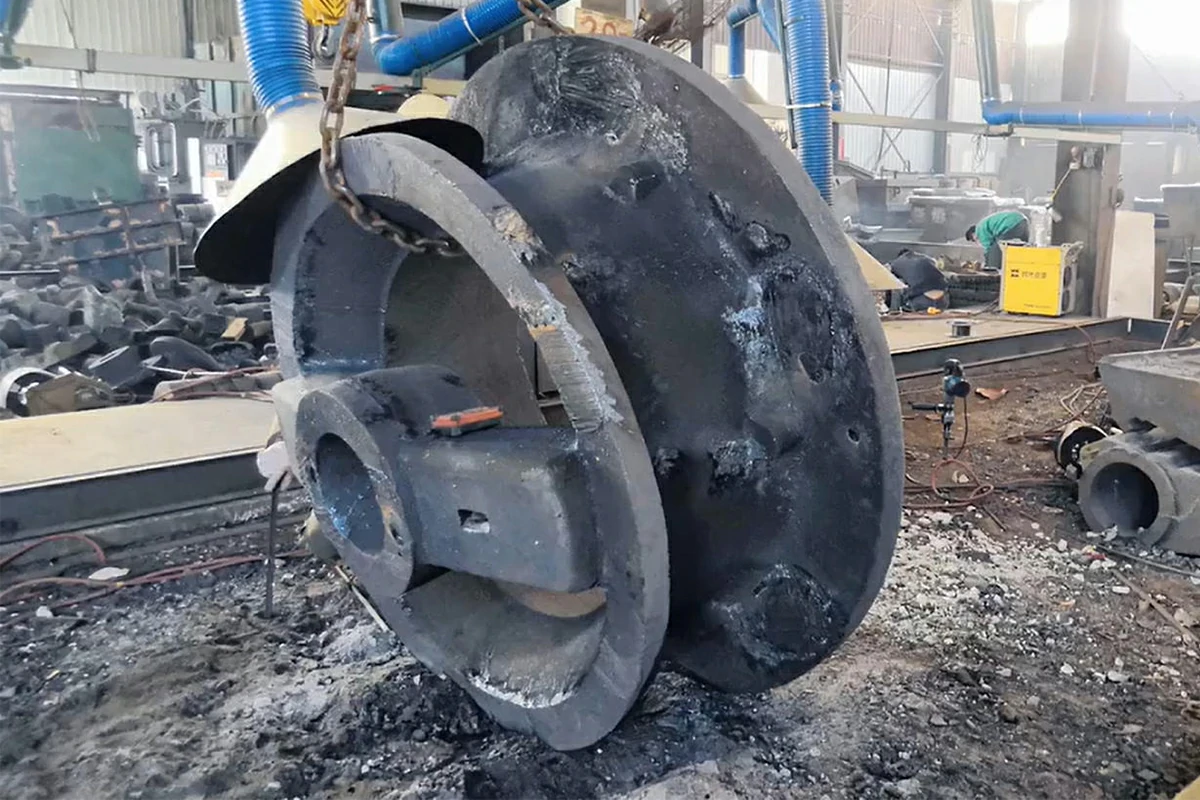
Supplier Qualification Criteria Beyond the Datasheet
Technical documentation is necessary but not sufficient. A crusher parts supplier must also be evaluated on manufacturing process control, quality assurance infrastructure, and the practical experience of their engineering team. The following criteria provide a structured qualification framework.
Manufacturing Process Verification
The production of high manganese steel castings for crusher applications requires precise control of pouring temperature, typically between 1,380°C and 1,450°C, and solution annealing at 1,050°C–1,100°C followed by rapid water quenching. Deviations in heat treatment protocol directly affect the austenitic microstructure that gives manganese steel its capacity to work-harden under impact stress. Ask the supplier to provide their standard heat treatment procedure and cross-reference it against published foundry practice for ASTM A128 or equivalent grades. A supplier who cannot explain their heat treatment cycle in engineering terms is operating on institutional recipe knowledge rather than controlled metallurgical process.
Dimensional Inspection Capability
Confirm that the supplier operates a coordinate measuring machine (CMM) or equivalent dimensional inspection equipment capable of verifying critical tolerances to ±0.05 mm resolution. For cone crusher liners, the seating surface profile must be verified against the original equipment geometry to within ±0.3 mm. Accumulated deviation beyond this threshold creates point loading on the head assembly, which accelerates eccentric bushing wear and increases the risk of liner spin — a failure mode that can destroy a cone crusher in under two hours of operation.
Lead Time and Inventory Position
A reliable crusher parts supplier maintains a balance between made-to-order manufacturing and strategic stock inventory. Request the supplier’s lead time commitment in writing, distinguishing between in-stock and manufactured-to-order items. For standard jaw plates and cone liners matching common OEM platforms — Metso Outotec HP and GP series, Sandvik CH and CS series, Thyssenkrupp and FLSmidth gyratory liners — a credible supplier should be able to confirm ex-stock or 7–15 day lead time for standard configurations. Lead times exceeding 30 days for non-custom components indicate insufficient inventory investment and represent a genuine supply continuity risk for your operation.
After-Sales Technical Support
The relationship with a crusher parts supplier does not end at delivery. Evaluate whether the supplier can provide dimensional installation guidance, torque specifications for critical fasteners, and failure analysis support if a component underperforms. For reference, M36 grade 10.9 bolts used to secure cone crusher liners require a verified torque of 820–900 Nm; M30 equivalents on jaw plate mounting systems require 680–750 Nm. A supplier who cannot confirm these values for your specific application is not equipped to support your maintenance team when problems occur.
Red Flags That Disqualify a Supplier at Qualification Stage
- No traceable material certification: Generic grade declarations without heat-specific test data indicate either uncontrolled sourcing or deliberate misrepresentation of alloy content.
- Price significantly below market average: For Mn18Cr2 jaw plates in the 500–800 kg range, a price more than 25% below the market average for equivalent specification should trigger material verification before use. The economics of manganese steel are well-established; extreme discounting is typically achieved by reducing alloy content or omitting solution annealing.
- Inability to provide reference installations: Any supplier claiming to support Thyssenkrupp, FLSmidth, Krupp, or similar heavy-duty platform equipment should be able to name at least three active customer sites running the same machine model with their components.
- Inconsistent dimensional results across batches: Request inspection reports from two separate production batches of the same part number. Variation in key dimensions between batches exceeding ±0.5 mm indicates inadequate process control at the foundry level.
- No ISO 9001:2015 certification: While ISO certification alone does not guarantee product quality, the absence of any third-party quality management system audit is a significant governance risk for operations with ISO-aligned procurement requirements.
Building a Dual-Source Supply Strategy
No single crusher parts supplier should hold a monopoly position over your critical wear component supply. A dual-source strategy — maintaining two qualified and audited suppliers for each primary wear item category — provides continuity protection against production disruptions, shipping delays, and supplier financial instability. The secondary supplier should be activated on a defined rotation, typically receiving 20–30% of routine volume, sufficient to maintain an active commercial relationship and validated installation history. A supplier who only receives emergency orders will not maintain the stock depth or lead time discipline required to be genuinely useful in a crisis.
Document the qualification status of both suppliers in your CMMS and schedule re-qualification audits on a 24-month cycle. Supplier capability can degrade over time — key personnel leave, foundry equipment ages, and cost pressures can lead to subtle specification drift that only becomes apparent through periodic dimensional and material re-verification.
The Total Cost of Ownership Calculation Your Procurement Team Needs
The most persistent mistake in crusher parts procurement is evaluating supplier performance on unit purchase price rather than total cost of ownership. The correct metric is cost per tonne crushed, which integrates component unit price, actual service life achieved, installation labor, downtime hours attributable to premature failure, and disposal cost. A jaw plate priced at $1,800 USD that delivers 2,200 operating hours costs $0.82 per hour. A plate priced at $1,450 USD that delivers 1,400 hours before reaching discard limit costs $1.04 per hour — and that calculation does not yet include the additional downtime exposure from more frequent change-outs. When these numbers are presented to operations management in cost-per-tonne terms, the comm


 English
 French
 German
 Spanish
 Russian
 Arabic
 Portuguese
 Turkish