

Operational monitoring of a Metso HP500 cone crusher (355 kW) reveals that return oil temperatures exceeding 60°C correlate directly to the degradation of the eccentric bushing’s hydrodynamic surface. When the radial clearance of this crusher part exceeds 1.2 mm, the machine loses its ability to maintain a stable lubricating film, leading to boundary friction and eventual seizure of the main shaft.
1. Diagnostic Metrics: Identifying Sub-Surface Failure
In high-capacity Turkish mining operations, the eccentric bushing must endure continuous 355 kW load cycles. Failure is rarely instantaneous; it is a progressive mechanical decline identifiable through vibration analysis and oil debris monitoring.
| Diagnostic Parameter | HP500 Nominal Range | Critical Failure Threshold | Mechanical Root Cause |
|---|---|---|---|
| Return Oil Temp | 40°C – 50°C | > 62°C | Collapse of the oil wedge; friction increase. |
| Radial Vibration | 4.5 – 8.0 mm/s | > 15 mm/s | Bell-mouthing of the bushing inner diameter. |
| Coast-down Time | 90 – 120 seconds | < 30 seconds | Kinetic energy lost to mechanical drag (seizure risk). |
| Oil Contamination | ISO 16/14/11 | Visible Bronze Flakes | Adhesive wear of the wear part surface. |
2. Metallurgy and Manufacturing: UNS C93800 Standards
A cone crusher part is only as reliable as its grain structure. For the HP500, the eccentric bushing must be cast from UNS C93800 (High-Lead Tin Bronze). This specific alloy contains 13-16% Lead (Pb), which acts as a secondary lubricant should the oil pump fail or the oil viscosity drop below critical levels.
2.1 Centrifugal vs. Sand Casting
NewReg utilizes Centrifugal Casting for all crusher spare parts. By rotating the mold at high speeds during solidification, the centrifugal force (up to 70G) pushes impurities to the center for removal, resulting in:
- Uniform Grain Structure: Ensures a fine, dense matrix throughout the entire wall thickness.
- Porosity Control: Zero gas inclusions, ensuring the bushing does not crack under the 355 kW impact loads of an HP500.

3. Engineering Protocol: Interference Fit & Thermal Calculation
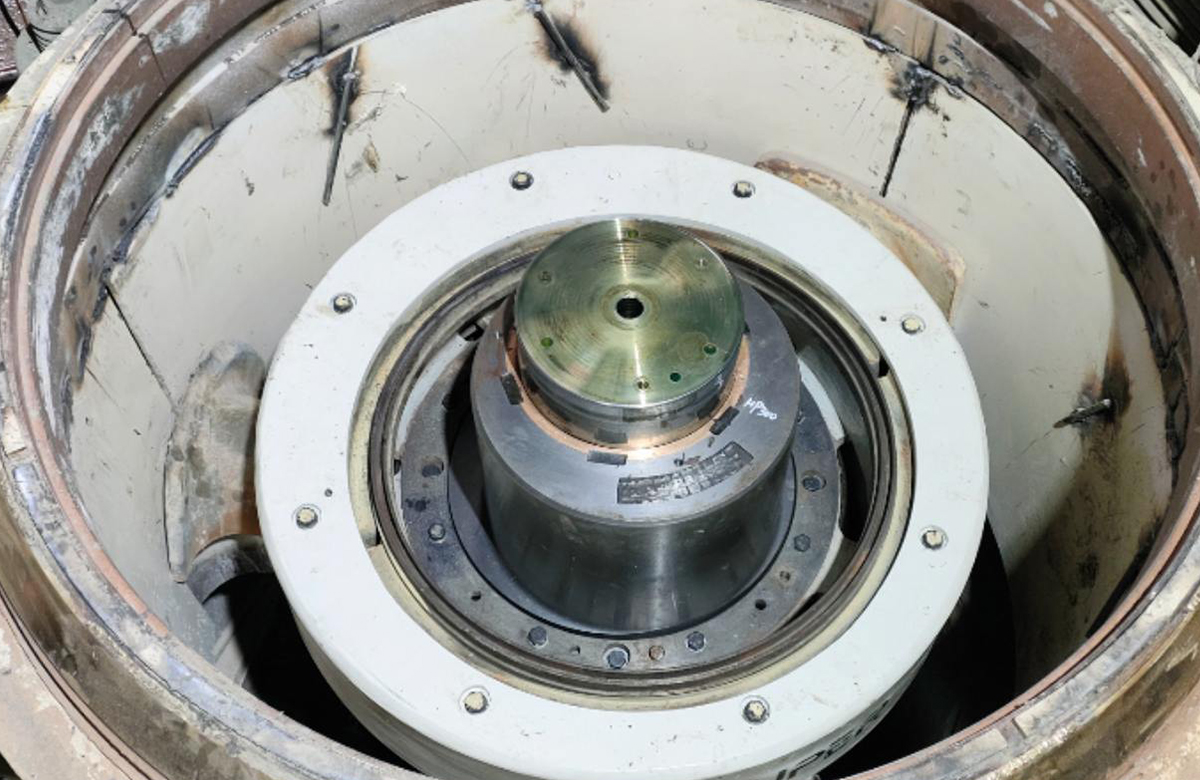
The installation of a new eccentric bushing into the eccentric steel body requires a precise interference fit. Using a hydraulic press at room temperature is prohibited as it causes galling of the mating surfaces.
3.1 Thermal Contraction Analysis
To achieve a “drop-in” fit, the bushing must be cooled using dry ice or liquid nitrogen. For an HP500 bushing with an outer diameter (D) of approximately 500 mm, the contraction (ΔD) is calculated using the linear thermal expansion coefficient (α) for C93800 (18.5 × 10⁻⁶ / °C):
ΔD = D × α × ΔT
If using dry ice to reach -78°C from an ambient 22°C (ΔT = 100°C):
ΔD = 500 × 0.0000185 × 100 = 0.925 mm
This contraction provides sufficient clearance to slide the crusher bushing into the housing without surface damage.
3.2 Lubrication and Clearance Limits
The design radial clearance for a new HP500 eccentric bushing is typically 0.60 mm to 0.90 mm. If the clearance reaches 1.5 mm, the cone crusher part is considered “end-of-life.” Operation beyond this point results in “point-loading” the main shaft, which leads to fatigue spalling.
4. Field Installation Checklist
- Bore Inspection: Verify the eccentric bore surface roughness (Ra) is 1.6 or better.
- Thermal Prep: Soak the bushing in dry ice for a minimum of 4 hours.
- Alignment: Ensure the oil distribution grooves align perfectly with the oil supply ports in the eccentric body.
- Locking: Use high-strength thread locker on all locking bolts and torque to the OEM specification (typically 450 Nm for this model).
5. Strategic Maintenance for Turkish Mining Sites
For mines operating in remote locations, unplanned downtime can cost upwards of $15,000 per hour. Utilizing NewReg crusher spare parts—engineered to C93800 standards—extends the service life of the eccentric bushing by up to 25% compared to generic sand-cast alternatives. By maintaining a scheduled replacement every 6,000–8,000 operating hours, operators protect the integrity of the main shaft and ensure the crusher maintains its nameplate capacity.
Technical Advice: If you detect return oil temperatures consistently exceeding 65°C or notice a reduction in coast-down time, contact our application engineers for a tailored clearance adjustment guide for your HP500.



 English
 French
 German
 Spanish
 Russian
 Arabic
 Portuguese
 Turkish