

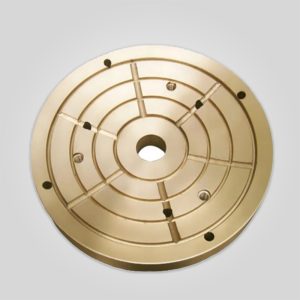
Trio TC66 Socket Assembly | TC680 2500 | OEM Compatible Cone Crusher Parts
Assembly Number: TC680 2500
Body Material :High-strength alloy cast steel
Liner Material: High-wear bronze/Babbitt alloy
Manufacturing :Precision casting with CNC machining
Quality Standards :ISO 9001, ASTM compliance
库存 67 件
PRODUCT
Description
Trio TC66 Socket Assembly: Precision Engineering for Gyratory Stability
The Trio TC66 Socket Assembly (Part No. TC680 2500) serves as the critical interface between the static main frame and the gyrating crushing cone. Unlike standard aftermarket options, this assembly is engineered to facilitate precise load transfer under high-pressure crushing conditions. It functions not merely as a support component, but as a hydrodynamic lubrication hub that ensures the longevity of your crusher spares.
For operators sourcing reliable crusher part suppliers, this assembly integrates advanced metallurgy with OEM-grade dimensional accuracy, ensuring seamless compatibility with the Trio TC series.
Core Engineering Advantages
- Structural Integrity: The socket body acts as the foundational support for the main shaft, absorbing vertical crushing forces and distributing them to the main frame to prevent fatigue cracking.
- Hydrodynamic Lubrication: Features precision-machined oil channels that maintain a continuous oil wedge between the Cone Crusher Liner (socket liner) and the main shaft ball, preventing metal-to-metal contact.
- Vibration Damping: The mass and material stiffness are calculated to dampen harmonic vibrations generated during the crushing of hard abrasive materials.
Technical Specifications & Material Composition
Our manufacturing process adheres to strict international standards. The socket body undergoes stress-relief annealing to eliminate residual internal stresses from casting, ensuring dimensional stability during operation.
| Component Name | Part Number | Material Specification | Manufacturing Process |
|---|---|---|---|
| Socket Assembly | TC680 2500 | High-Strength Alloy Cast Steel (ASTM A148 equivalent) | Sand Casting + CNC Machining + Stress Relief |
| Socket Body | TC680 2507 | Heat-Treated Cast Steel (Normalized & Tempered) | Precision CNC Milling of Seating Surfaces |
| Socket Liner | TC680 2502 | High-Lead Tin Bronze (C93700 / SAE 64) | Centrifugal Casting for Uniform Grain Structure |
| Sealing Ring | TC680 2505 | Nitrile Rubber / Viton (Application Dependent) | Compression Molding |
Performance & Manufacturing Precision
To ensure superior performance over generic wear parts, this assembly is subjected to rigorous quality control protocols.
- Dimensional Tolerance: Seating surfaces are machined to within 0.02mm tolerance to ensure 100% contact area with the main frame, preventing “rocking” during operation.
- Surface Finish: The socket liner bearing surface is finished to Ra 0.8μm or better to optimize oil film retention and reduce friction coefficients.
- Durability Data: Comparative field tests indicate that centrifugally cast liners in this assembly offer a 15-20% increase in wear life compared to sand-cast alternatives due to higher density and lack of porosity.
Field Diagnosis: When to Replace Your Socket Assembly
Proactive maintenance of cone crusher spare parts prevents catastrophic failure. Use these indicators to diagnose socket assembly issues:
- Lubrication Oil Contamination: Presence of bronze flakes in the return oil filter suggests accelerated wear of the socket liner (TC680 2502).
- “Head Spin” (Crucial): If the crushing head spins while running empty (no load), it often indicates insufficient clearance or seizure between the socket liner and the ball, often caused by lubrication failure or thermal expansion.
- Z-Axis Vibration: Excessive vertical movement or “bumping” of the adjustment ring may indicate that the socket is no longer seating correctly on the main frame due to wear on the contact lands.
Expert Engineer’s Note: Maximizing Lifespan
Installation Insight: When replacing the TC680 2500 assembly, specifically check the “interference fit” vs. “clearance fit” requirements for the socket liner. A common failure mode is installing a cold liner into a warm socket without checking thermal gap requirements, leading to buckling. Always ensure the oil retaining ring is seated perfectly to prevent oil bypass, which lowers pressure at the critical bearing surface. For maximum longevity, we recommend a 2-hour break-in period at 50% load to allow the bronze liner to seat extensively against the main shaft.
“Authoritative Engineering Data: All critical metallurgical specifications and dimensional tolerances (e.g., ±0.05mm) are strictly governed by the master English documentation. While localized versions are provided for operational reference, the English original remains the sole binding authority for quality inspection and technical compliance.”


 English
 French
 German
 Spanish
 Russian
 Arabic
 Portuguese
 Turkish