
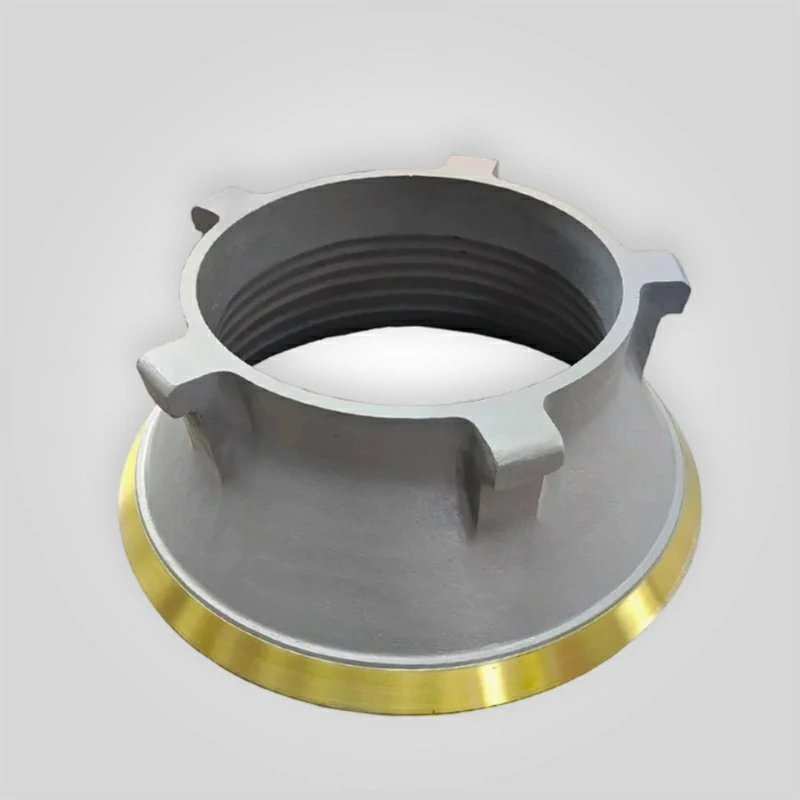
Manganese Steel Concave and Mantle | Mn18Cr2 Cone Crusher Liners
Exceptional Wear Resistance
The hardened surface layer effectively resists severe abrasion, making it ideal for crushing hard and highly abrasive materials.
High Impact Resistance
Excellent plasticity and toughness allow it to withstand massive impact forces and pressure during crushing operations without fracturing.
Broad Compatibility
Designed to fit various standard cone crusher models, including hydraulic and mechanical types, ensuring versatility across different crushing setups.
Multiple Cavity Options
Available in coarse, medium, fine, and extra-fine cavity designs to meet diverse particle size requirements and production goals.
库存 111 件
PRODUCT
Description
Manganese Steel Concave and Mantle: Advanced Metallurgy for Cone Crushers
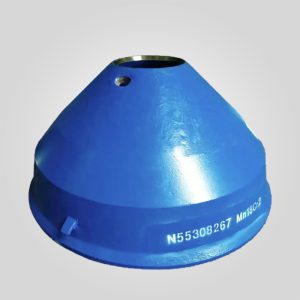
The Concave and Mantle (Bowl Liner and Mantle) represent the primary crushing interface in all gyratory and cone crushers. These wear parts are subjected to extreme compressive stress and abrasive gouging. Unlike standard commercial castings, our liners are engineered using modified Hadfield Steel (Austenitic Manganese Steel) protocols. By controlling the grain structure through precise heat treatment, we ensure the material delivers the optimal balance between ductility (to prevent cracking) and surface hardness (to resist wear).
For operations managers sourcing from crusher part suppliers, selecting the correct alloy grade is the single most effective method to reduce Cost Per Ton. Our range covers standard Mn13 to premium Mn18Cr2 alloys, designed to fit major OEM platforms including Symons, Metso HP/GP, and Sandvik CH/CS series.
Core Engineering Advantages: The Work-Hardening Effect
- Metallurgical Transformation: Upon impact, the surface of the austenitic manganese steel undergoes a phase transformation, developing a hardened “skin” (up to 550-600 HB) while the core remains ductile (approx. 220 HB). This unique property prevents catastrophic brittle failure.
- Alloy Modification: We incorporate Chromium (Cr) and Molybdenum (Mo) in our premium grades. This dispersion strengthening improves the initial yield strength, preventing the Cone Crusher Liner from flowing or “pancaking” under extreme load.
- Precision Machining: All seating surfaces (mating interfaces) are CNC machined to ensure 100% contact with the head center and adjustment ring, preventing stress risers that lead to liner cracking.
Technical Specifications: Material Grade Selection
We adhere to ASTM A128 and GB/T 5680 standards. The selection of the correct alloy depends on the abrasiveness (Silica content) and hardness of the feed material.
| Material Grade | Standard Equivalent | Chemical Composition (Approx.) | Initial Hardness | Work Hardened Potential |
|---|---|---|---|---|
| Mn13 (Standard) | ASTM A128 Grade A | Mn: 11-14%, C: 1.0-1.3% | 180 – 200 HB | ~450 HB |
| Mn18 (Heavy Duty) | ASTM A128 Grade C | Mn: 17-19%, C: 1.0-1.3% | 200 – 220 HB | ~500 HB |
| Mn18Cr2 (Premium) | Modified Grade E | Mn: 17-19%, Cr: 1.5-2.5% | 210 – 230 HB | 550 – 650 HB |
Cavity Configuration & Application
Choosing the correct cavity profile is critical for maintaining crusher throughput and product gradation.
| Cavity Type | Feed Opening | Application Scenario |
|---|---|---|
| Extra Coarse (EC) | Maximum Intake | Primary/Secondary crushing positions; large feed size. |
| Medium (M) | Balanced | General secondary crushing; balanced reduction ratio. |
| Fine (F) / Short Head | Restricted Intake | Tertiary crushing; producing chips/fines; requires choke feeding. |
Performance Comparison
Field data from aggregate quarries demonstrates the efficiency gains of upgrading to alloyed manganese steel:
- Lifespan Extension: Transitioning from standard Mn13 to Mn18Cr2 typically yields a 20% to 40% increase in wear life in high-silica applications (>150 MPa rock hardness).
- Profile Retention: Modified alloys maintain the cavity profile longer, ensuring the Close Side Setting (CSS) remains stable for extended periods, reducing the frequency of calibration stops.
Field Diagnosis: When to Replace Liners
Do not wait for a hole to wear through the liner. Monitor these indicators to determine end-of-life:
- Production Drop: A 10-15% sustained drop in throughput often indicates the crushing zone has worn effectively “smooth,” losing its nipping angle.
- Power Spikes: If the crusher amperage spikes irregularly, it may indicate the liners have worn thin and flexed, losing their tight fit against the frame.
- Thickness Measurement: As a rule of thumb, replace the mantle when the wall thickness at the bottom 1/3rd of the liner reaches approximately 25mm (1 inch) to prevent structural collapse.
Expert Engineer’s Note: Installation & Backing
Critical Maintenance Advice: The longevity of a Cone Crusher Liner is 50% material quality and 50% installation quality. Never reuse old zinc backing. We recommend high-impact epoxy backing compounds. Ensure the backing material fills the void between the liner and the frame completely; air gaps lead to “liner flutter,” which will work-harden the back of the liner and cause it to crack vertically. Additionally, always rotate the feed distribution. Segregated feeding (fines on one side, coarse on the other) causes uneven wear (ovalization), forcing premature replacement of otherwise healthy crusher spares.
“Authoritative Engineering Data: All critical metallurgical specifications and dimensional tolerances (e.g., ±0.05mm) are strictly governed by the master English documentation. While localized versions are provided for operational reference, the English original remains the sole binding authority for quality inspection and technical compliance.”



 English
 French
 German
 Spanish
 Russian
 Arabic
 Portuguese
 Turkish