

Centrifugally Cast Main Shaft Step Plates: Maximizing Load Capacity and Crusher Uptime
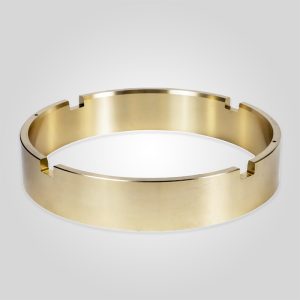
Reduced Friction: Bronze surface minimizes metal-to-metal contact with the main shaft
Thermal Stability: Maintains performance under temperatures up to 180°C
Corrosion Resistance: Withstands harsh crushing environments and lubricant additives
OEM Compatibility: Interchangeable with Metso, Sandvik, Symons, and other major brands
Customization: Available in various sizes and threading specifications (e.g., M48×2, M56×3)
库存 214 件
PRODUCT
Description
Main Shaft Step Plate: High-Load Bronze Alloy Engineering for Cone Crushers
When a cone crusher’s main shaft is subjected to vertical static loads exceeding 60 tons, combined with the dynamic gyratory forces of crushing hard granite or basalt, the structural integrity of the base support becomes the single point of failure. The Main Shaft Step Plate is not merely a spacer; it is a critical hydrodynamic bearing surface that must withstand compressive stresses up to 30 MPa while maintaining an oil film thickness of less than 15 microns.
Premature failure of this component—often manifesting as “pancaking” or severe scoring—can lead to catastrophic main shaft misalignment. Our Main Shaft Step Plate is engineered using Centrifugal Casting technology to eliminate porosity, ensuring distinct advantages over standard sand-cast crusher spares found in the low-cost aftermarket.
Core Material Science & Manufacturing Precision
The longevity of a cone crusher part is dictated by its metallurgical DNA. Unlike generic commercial bronze, our step plates are manufactured from CuSn12Ni (CC491K) or high-grade Aluminum Bronze variants depending on the specific crusher application (e.g., Metso HP series vs. Symons styles). The addition of Nickel (Ni) to the copper-tin matrix increases the yield strength, preventing plastic deformation under shock loads.
| Specification Parameter | Engineering Standard / Value | Operational Benefit |
|---|---|---|
| Material Alloy | CuSn12Ni / ASTM B271 C93700 Equivalent | Superior load-bearing capacity and anti-seizing properties. |
| Casting Method | Centrifugal Casting (High Velocity) | Denser grain structure, zero porosity, 20% higher tensile strength than sand casting. |
| Hardness Range | 180 – 220 HBW (Brinell) | Optimized balance between wear resistance and shaft protection. |
| Surface Roughness | Ra ≤ 1.6 μm (Precision Ground) | Ensures immediate hydrodynamic lift-off during startup. |
| Dimensional Tolerance | ISO 2768-mK / ±0.05mm | Guarantees exact axial positioning and OEM interchangeability. |
Failure Analysis: Why Standard Plates Fail
In my 20 years of field diagnostics, I have seen hundreds of step plate failures. Understanding these failure modes is key to selecting the right crusher part suppliers.
- Plastic Deformation (“Mushrooming”): This occurs when the yield strength of the bronze is insufficient for the crushing force. If a step plate is too soft (below 160 HB), the outer edges will roll over, restricting oil flow channels. Our heat-treated alloy prevents this by maintaining structural rigidity up to 180°C.
- Galling (Adhesive Wear): When the oil film breaks down, copper migrates onto the steel shaft. This is catastrophic. We incorporate specific lead (Pb) distributions or solid lubricant inclusions within the alloy matrix to provide emergency self-lubrication during oil starvation events.
- Cavitation Erosion: Improperly designed oil grooves cause bubbles to collapse against the metal, pitting the surface. Our spiral oil grooves are CNC-machined to precise angles calculated to maximize laminar flow and heat dissipation.
Technical Performance & TCO Analysis
Switching to a premium Main Shaft Step Plate directly impacts your Total Cost of Ownership (TCO). While a generic sand-cast plate might save $200 initially, the downtime cost of replacing it after 800 hours is substantial.
[Option C: Field Case Snippet]
“Last year, a quarry in Nevada was experiencing recurring temperature spikes in their secondary crusher. We swapped their standard aftermarket plate for our centrifugally cast CuSn12Ni step plate. The denser material improved thermal conductivity, dropping the return oil temperature by 8°C. More importantly, the wear interval extended from 1,200 hours to 2,100 hours, aligning perfectly with their liner change schedule.”
Installation & Maintenance Protocols
Even the highest quality wear parts will fail if installed incorrectly. To maximize the life of your Main Shaft Step Plate, adhere to the following engineering protocols:
1. The “Blue Fit” Check
Before final installation, apply engineer’s blue to the seating surface. We require a contact area of at least 80%. Poor seating creates point loads that can crack the plate under hydraulic pressure.
2. Oil Analysis as a Diagnostic Tool
Don’t just change oil; analyze it. When monitoring your cone crusher, track the Copper (Cu) and Lead (Pb) ppm levels.
- Steady Cu rise: Normal abrasive wear.
- Sudden Cu spike (>100 ppm increase): Potential metal-to-metal contact; check oil viscosity and cooling system.
- Silicon (Si) spike followed by Cu spike: Dust seal failure has allowed grit to enter, acting as a grinding compound on the step plate.
[Option B: Pro-Tip]
“Always inspect the spiral oil grooves on the old plate you remove. If the edges of the grooves are sharp or burred, it indicates possible debris cycling. If the grooves are flattened or disappearing, you have severe compression wear, suggesting the crusher is operating beyond its tonnage rating or the tramp release system is set too high.”
Compatibility & Applications
Our manufacturing database allows for precise replication of OEM dimensions for major global brands. Whether you are running a Metso HP series, Sandvik CH/CS series, or a classic Symons crusher, the step plate is machined to match the specific thermal expansion coefficients of the OEM design.
- Primary Application: Bottom support for main shafts in Gyratory and Cone Crushers.
- Industries: Hard rock mining (Gold, Copper), Aggregate Quarries, and Cement production.
- Interchangeability: Fully compatible with OEM part numbers for seamless preventive maintenance replacement.
Quality Assurance: Beyond the Certificate
We do not rely solely on batch testing. Every Main Shaft Step Plate undergoes a rigorous quality control regimen before crating:
- Spectrographic Analysis: Verification of chemical composition (Cu, Sn, Ni, Pb percentages) to EN 1982 / ASTM standards.
- Ultrasonic Testing (UT): To detect subsurface voids or inclusions inherent in inferior casting processes.
- CMM Verification: Coordinate Measuring Machines ensure the parallelism of the top and bottom faces is within 0.02mm, critical for preventing shaft wobble.
Expert Recommendation
The Main Shaft Step Plate is a relatively low-cost component that protects your crusher’s most expensive asset—the Main Shaft. Do not compromise on metallurgy. Ensure your replacement parts utilize centrifugal casting for maximum density and load-bearing reliability. If you are unsure about the specific alloy requirements for your crushing application or need advice on diagnosing abnormal bronze wear, contact our engineering team for a consultation.
“Authoritative Engineering Data: All critical metallurgical specifications and dimensional tolerances (e.g., ±0.05mm) are strictly governed by the master English documentation. While localized versions are provided for operational reference, the English original remains the sole binding authority for quality inspection and technical compliance.”


 English
 French
 German
 Spanish
 Russian
 Arabic
 Portuguese
 Turkish