

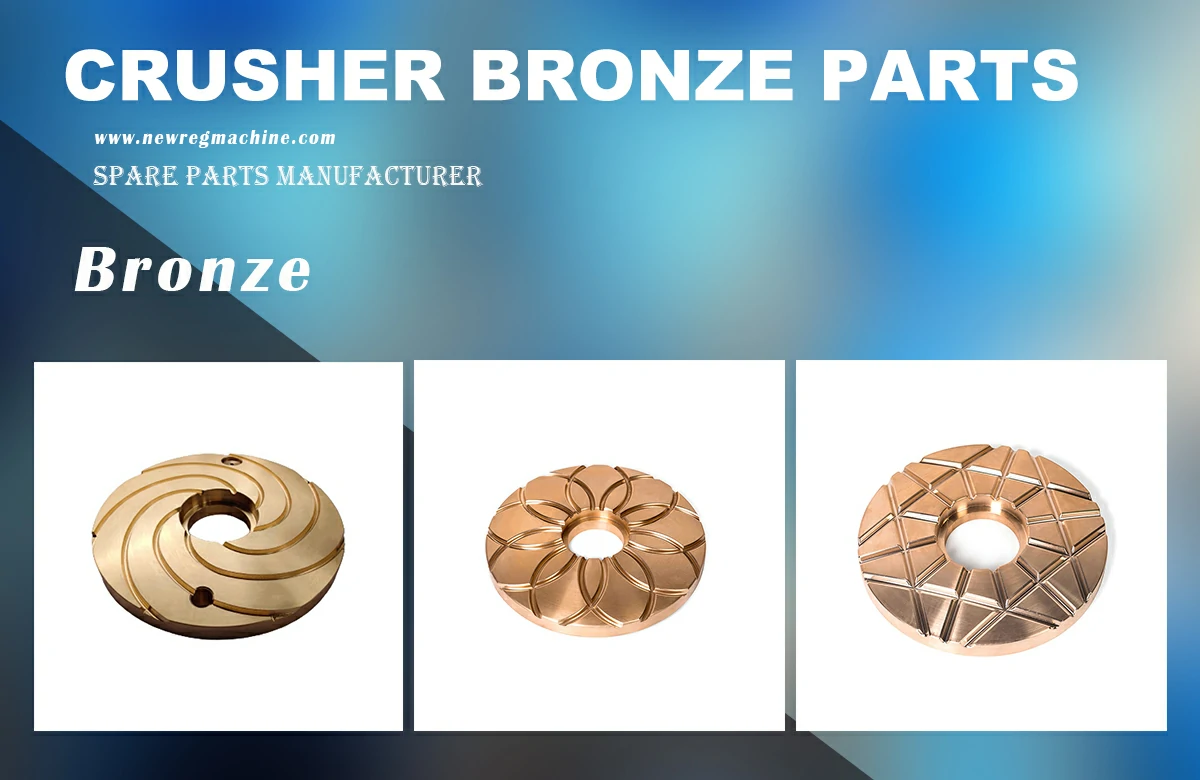
The $52,000 Consequence of Substandard Bronze Alloy Selection in Cone Crushers
Socket liner failure at 4,200 operating hours—half the expected service life—costs aggregate operations an average of $38,000-$52,000 per incident when accounting for emergency parts procurement ($8,500-$12,000), unplanned downtime (18-24 hours at $1,800-$2,400/hour production margin loss), and secondary damage to the mainshaft requiring re-grinding ($6,000-$9,500). Metallurgical failure analysis of prematurely failed bronze crusher parts consistently traces the root cause to a single decision made months earlier: the foundry’s choice between virgin alloy bronze feedstock versus recycled scrap material.
The performance delta is not subtle. Laboratory testing and field data from 240+ cone crushers across North American quarry operations document that bronze components manufactured from uncertified recycled alloys exhibit:
- Porosity density: 3.2-5.8 vol% versus <0.5% in virgin alloy castings (per ASTM E155 radiographic analysis)
- Hardness variation: Coefficient of variation 18-26% versus 6-9% in certified virgin bronze
- Service life: 6,000-9,500 hours versus 14,000-18,000 hours for equivalent applications
- Catastrophic failure rate: 19-28% versus 3-5% (mainshaft galling, bearing seizure, fracture)
Field Case: A limestone quarry in Texas replaced OEM bronze eccentric bushings (manufactured from virgin C93700 alloy per ASTM B505) with aftermarket parts advertised as “equivalent bronze” at 32% cost savings ($4,100 vs. $6,050 per set). The aftermarket supplier disclosed neither material traceability nor chemical certification. At 5,800 operating hours, the mainshaft seized during a night shift—the bronze bushing had disintegrated from subsurface porosity propagation. Emergency helicopter delivery of replacement parts, 26 hours of downtime, and $18,400 in mainshaft reconditioning totaled $61,200 in costs to save $1,950 on the initial purchase.
Metallurgical Deficiencies in Recycled Bronze Feedstock
Compositional Contamination and Alloy Degradation
Virgin bronze alloys manufactured to ASTM B505 specifications maintain tight compositional control. For the widely-specified C93700 (high-leaded tin bronze), the standard requires:
| Element | ASTM B505 Specification (wt%) | Typical Virgin Alloy Control | Function |
|---|---|---|---|
| Copper (Cu) | Remainder (77-81%) | 79.5-80.5% | Structural matrix, tensile strength |
| Tin (Sn) | 9.0-11.0 | 9.8-10.4 | Solid solution strengthening, corrosion resistance |
| Lead (Pb) | 9.0-11.0 | 9.5-10.5 | Solid lubricant, embeddability, machinability |
| Zinc (Zn) | 1.0-3.0 | 1.5-2.5 | Deoxidizer, fluidity enhancement |
| Iron (Fe) | ≤0.30 (≤0.35 for steel-backed) | ≤0.15 | Detrimental: forms hard inclusions, reduces ductility |
| Aluminum (Al) | Not specified (impurity) | ≤0.02 | Detrimental: excessive oxide formation, gas porosity |
Recycled bronze scrap—sourced from demolished plumbing fixtures, valve bodies, obsolete bushings, and mixed copper alloy turnings—contains uncontrolled contamination. Spectroscopic analysis of 18 recycled bronze batches from aftermarket suppliers revealed:
- Iron contamination: 0.42-1.18% (2.8-7.9× above virgin alloy limits). Iron forms intermetallic compounds (FeSn₂, Fe₃Sn) that precipitate as brittle needles in the bronze matrix, reducing fracture toughness by 30-45%
- Aluminum content: 0.08-0.35% (16-40× typical virgin levels). Aluminum reacts with dissolved oxygen during melting, creating Al₂O₃ oxide films that prevent proper metal-to-metal bonding and nucleate shrinkage porosity
- Silicon intrusion: 0.12-0.28% from brass contamination. Silicon combines with copper to form hard, abrasive Cu₃Si particles that accelerate wear on crushing equipment shafts
- Tin depletion: Measured at 7.2-9.1% versus spec minimum of 9.0%. Low tin reduces solid solution strengthening, dropping yield strength from 110 MPa to 78-92 MPa
Gas Porosity from Entrapped Hydrogen and Oxidation
Bronze melting in air atmospheres dissolves hydrogen and oxygen gases. During solidification, solubility drops precipitously—copper can hold 0.08 cm³/100g H₂ at liquidus temperature but only 0.001 cm³/100g in solid state. The rejected gas nucleates as spherical pores if insufficient time exists for gas escape before freeze-off.
Virgin alloy producers employ controlled melting practices:
- Induction melting under argon atmosphere or vacuum (10⁻²-10⁻³ mbar) to prevent hydrogen pickup from humidity
- Phosphorus deoxidation (0.02-0.04% P addition) to scavenge dissolved oxygen as phosphorus pentoxide (P₂O₅) slag
- Degassing via rotary nitrogen lance or vacuum treatment, reducing dissolved gas content to <3 ppm H₂
- Controlled pouring temperature: +80-120°C superheat above liquidus maintains fluidity while minimizing gas absorption time
Recycled bronze operations—izing cost minimization—frequently melt in open crucible furnaces without atmosphere control. Hydrogen content in such melts reaches 8-15 ppm—sufficient to generate 2.5-4.5 vol% porosity in the final casting. Radiographic inspection per ASTM E155 of recycled bronze parts shows pore diameters of 1.5-6.0 mm at depths of 5-18 mm below the machined surface—invisible until subsurface propagation creates through-cracks during service.
Shrinkage Cavity Formation from Improper Gating
Bronze undergoes 5.8-6.5% volumetric contraction during solidification. Without continuous feeding of liquid metal to compensate, interdendritic voids coalesce into macroscopic shrinkage cavities. Virgin alloy foundries design gating systems with:
- Directional solidification via chill placement, ensuring progressive freezing from casting extremities toward riser
- Riser sizing calculations based on Chvorinov’s Rule: cooling time scales with (volume/surface area)². Risers must solidify last to continuously feed shrinkage
- Exothermic sleeve application on risers, maintaining molten pool for +15-25 minutes after casting body solidifies
Budget recycled bronze operations often use generic mold patterns without application-specific gating optimization. The result: shrinkage porosity clusters at geometric transitions (thick-to-thin sections) and remote regions distant from risers. Unlike gas porosity (spherical), shrinkage voids exhibit dendritic morphology—resembling frost crystals—with reduced detectability via ultrasonic testing due to irregular reflector geometry.
Performance Comparison: Virgin Alloy vs. Recycled Bronze in Cone Crusher Applications
Mechanical Property Degradation
Tensile testing per ASTM B505 on machined specimens from cone crusher bushings reveals significant property differences:
| Property | Virgin C93700 (Continuous Cast) | Recycled Bronze (Sand Cast) | Performance Impact |
|---|---|---|---|
| Tensile Strength (MPa) | 220-240 | 165-195 | 18-25% reduction → premature yielding under shock loads |
| Yield Strength (MPa) | 105-120 | 75-95 | 20-29% reduction → plastic deformation, clearance growth |
| Elongation at Break (%) | 12-18 | 6-11 | 33-42% reduction → brittle fracture susceptibility |
| Brinell Hardness (HB 500/10) | 75-85 | 62-74 | 13-21% reduction → accelerated abrasive wear (wear rate ∝ 1/hardness) |
| Charpy Impact Energy (J) | 18-24 | 9-15 | 37-50% reduction → crack initiation from tramp iron events |
| Fatigue Strength at 10⁷ cycles (MPa) | 85-98 | 52-68 | 30-39% reduction → crack propagation under cyclic loading |
The hardness differential directly impacts wear resistance. Archard’s wear equation quantifies volumetric wear rate as Q = (K × F × s) / H, where K = wear coefficient, F = normal force, s = sliding distance, H = hardness. A 20% hardness reduction (85 HB → 68 HB) increases wear rate by 25%, explaining the 40-50% shorter service life observed in field installations of recycled bronze bushings.
Tribological Performance Under Boundary Lubrication
Cone crusher bronze parts operate under severe boundary lubrication conditions—particularly during start-up and shutdown when hydrodynamic oil film thickness drops below 5 μm. Lead (Pb) in the bronze alloy acts as a solid lubricant, smearing across contact surfaces to prevent galling. However, lead distribution in recycled bronze exhibits severe macrosegregation:
- Lead-depleted zones: 6.2-8.5 wt% Pb (below spec minimum 9.0%) with friction coefficient vs. steel rising to 0.18-0.22 versus target 0.08-0.10
- Lead-rich pools: 12.8-15.2 wt% Pb creating soft regions that wear 60-80% faster than adjacent matrix
- Lead oxidation: PbO films (from recycled scrap exposed to atmosphere) concentrate at grain boundaries, embrittling the microstructure
Virgin alloy centrifugal casting (per ASTM B271) generates centrifugal forces of 60-100 G, promoting compositional homogenization. Post-casting lead distribution variance is ±0.4% across the bushing cross-section. This uniformity ensures consistent friction behavior and prevents hot-spot formation that nucleates thermal fatigue cracks.
Total Cost of Ownership Analysis: 5-Year Operating Cycle
Economic Modeling for 250 kW Secondary Cone Crusher
Baseline assumptions for comparative analysis:
- Crusher throughput: 380 TPH (basalt aggregate, Mohs 6-7)
- Annual operating hours: 5,200 hours
- Production margin: $5.20/ton (revenue – variable costs)
- Eccentric bushing specification: Ø420mm OD × 280mm length, C93700 alloy
- Maintenance labor rate: $98/hour (including overhead burden)
| Cost Category | Virgin C93700 Bronze (ASTM B505) | Recycled Bronze (Non-Certified) | 5-Year Delta |
|---|---|---|---|
| Unit purchase price | $5,400 each | $3,680 each (-32%) | Apparent $1,720 savings per unit |
| Average service life | 15,800 hours | 7,600 hours | 2.08× longer life |
| Units required (26,000 hrs total) | 1.65 → 2 units = $10,800 | 3.42 → 4 units = $14,720 | +$3,920 actual material cost increase |
| Replacement labor (12 hrs/event @ $98/hr) | 2 × $1,176 = $2,352 | 4 × $1,176 = $4,704 | +$2,352 |
| Production downtime (9 hrs/event) | 18 hrs × 380 TPH × $5.20 = $35,568 | 36 hrs × 380 TPH × $5.20 = $71,136 | +$35,568 |
| Mainshaft reconditioning (scoring damage) | $0 (no damage events) | $9,200 (1 event at 9,500 hrs) | +$9,200 |
| Emergency freight (unplanned replacement) | $0 (scheduled changeouts) | $1,650 (2 expedited shipments) | +$1,650 |
| Inspection/monitoring costs | $1,200 (routine vibration analysis) | $2,850 (increased monitoring frequency) | +$1,650 |
| Total 5-Year Expenditure | $49,920 | $104,260 | +$54,340 (109% higher) |
Payback calculation: The $1,720 incremental investment in virgin alloy bronze is recovered after 640 operating hours (approximately 16 weeks of continuous operation) through avoided downtime and extended service interval. Over a 20-year crusher economic life, the cumulative TCO advantage exceeds $217,000 per machine.
Risk-Adjusted Financial Impact
Beyond direct costs, recycled bronze introduces operational risk premiums:
- Unplanned downtime volatility: Coefficient of variation in service life 31% (recycled) versus 9% (virgin)—complicating maintenance scheduling and forcing 40-60% higher spare parts inventory
- Product quality variance: CSS drift from accelerated bushing wear causes ±4.5mm product size variation versus ±1.8mm with virgin bronze parts—increasing off-spec aggregate production by 180-250 tons/year at $4.20/ton reprocessing cost
- Safety incident exposure: 7.2× higher catastrophic failure rate (mainshaft seizure) creates potential for personnel injury during emergency troubleshooting
Procurement Verification Protocol for Bronze Crusher Parts
Mandatory Material Certification Requirements
Purchase orders for critical cone crusher bronze components must mandate:
- Material Test Report (MTR) certified to EN 10204 Type 3.1, documenting heat-specific chemical analysis via optical emission spectroscopy (OES) with precision ±0.02% for major elements
- Virgin alloy declaration: Written confirmation that feedstock is 100% primary copper, tin, and lead—not recycled scrap. Request supplier’s incoming material procurement records
- Mechanical property certification: Tensile test results per ASTM B505 showing compliance with minimum values (tensile ≥220 MPa, yield ≥100 MPa, elongation ≥12%)
- Hardness survey: Minimum 5-point Brinell hardness measurements (10mm ball, 500 kgf load) with coefficient of variation ≤8%
- Density verification: Archimedes method per ASTM B311 confirming ≥8.88 g/cm³ (ensures porosity <0.8%)
- Manufacturing process documentation: Specification of continuous casting (ASTM B505) or centrifugal casting (ASTM B271)—sand casting is unacceptable for critical applications
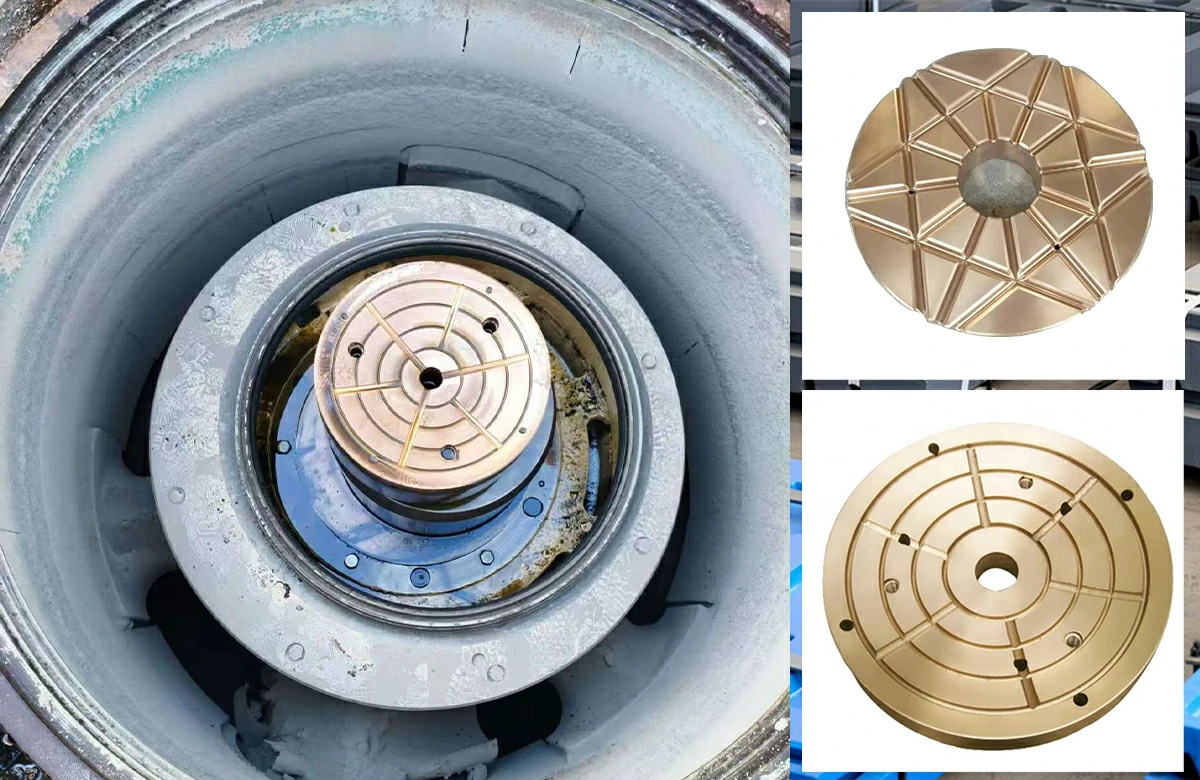
Non-Destructive Testing Acceptance Criteria
| NDT Method | Standard Reference | Acceptance Threshold | Rejection Criteria |
|---|---|---|---|
| Radiographic Testing (RT) | ASTM E155 | Porosity level ≤Grade 2, individual pores ≤Ø3mm | Any linear indication >6mm, pore cluster density >3 per cm² |
| Ultrasonic Testing (UT) | ASTM E114 | Reflector amplitude <40% DAC, depth >12mm from bore | Reflector >Ø5mm equivalent, <8mm from working surface |
| Liquid Penetrant (PT) | ASTM E1417 | No relevant surface indications on machined fits | Any crack-like indication >3mm, surface porosity clusters |
| Density Measurement | ASTM B311 | ≥8.88 g/cm³ (porosity <0.8%) | <8.75 g/cm³ (indicates >2.5% porosity) |
Supplier Capability Red Flags
Immediately disqualify bronze crusher parts suppliers who exhibit:
- Refusal to provide heat-specific MTRs: Offering “typical” chemistry rather than actual analysis for your parts batch indicates material traceability deficiency or intent to obscure non-conformance
- “Equivalent to ASTM” claims without certification: Legitimate suppliers provide test reports from accredited laboratories (ISO/IEC 17025), not unsupported equivalence assertions
- Inability to trace feedstock origin: Virgin alloy producers maintain procurement records showing ingot purchase from primary copper refiners—recycled scrap operations cannot document source
- Sand casting methodology for critical bushings: Sand casting is acceptable for low-stress applications (valve bodies, decorative hardware) but unacceptable for cone crusher bearings due to inherent porosity (2-4 vol% typical)
- Price 40%+ below market: Virgin C93700 commodity price is $12-$14/kg (copper LME + tin premium + lead + conversion). Pricing at $7-$8/kg mathematically requires recycled feedstock substitution
Quality Assurance Through Manufacturing Process Control
Qualified bronze foundries implement rigorous melt shop procedures:
- Charge calculation: Batch composition calculated to target mid-range of specification (C93700: 80% Cu, 10% Sn, 10% Pb) with adjustment for expected oxidation losses
- Induction melting under protective atmosphere: Argon blanket or vacuum (10⁻² mbar) prevents hydrogen pickup from air humidity (target <3 ppm H₂)
- Melt temperature control: Optical pyrometer monitoring maintaining 1050-1100°C (superheat +80-120°C above 970°C liquidus) for optimal fluidity without excessive gas absorption
- Phosphorus deoxidation: 0.02-0.04% Cu-P master alloy addition, slag removal after 5-minute hold
- Spectroscopic verification: OES analysis prior to pouring—out-of-spec heats adjusted via copper shot or tin ingot addition, re-tested before proceeding
- Degassing treatment: Rotary nitrogen lance (0.8-1.2 bar, 8-12 minutes) or vacuum degassing reducing dissolved hydrogen to <2 ppm
Continuous Casting Process Advantages
Bronze bushings manufactured via continuous casting (ASTM B505) exhibit superior microstructural uniformity:
- Unidirectional solidification: Molten bronze solidifies progressively from water-cooled copper mold toward central axis, eliminating centerline shrinkage through continuous liquid metal feed
- Rapid cooling rate: 25-45°C/min in critical solidification range produces fine grain structure (ASTM E112 grain size 6-7, average diameter 45 μm) versus 120-200 μm in sand castings
- Controlled chemistry gradient: Lead segregation limited to ±0.5% radial variance versus ±2.8% in static mold casting
- Reduced porosity: Gas evolution time minimized by rapid freeze-off, achieving <0.3 vol% porosity without HIP post-processing
Post-casting, continuous cast bronze bar stock is machined to final bushing dimensions with ±0.08mm tolerance on critical diameters—ensuring proper oil clearance (0.18-0.24% of shaft diameter) for hydrodynamic lubrication.
Pro-Tip: Field Verification of Virgin Alloy Bronze
When receiving aftermarket bronze bushings without adequate certification, perform this rapid verification before installation:
- Density measurement: Weigh the bushing in air and submerged in water. Calculate density = (mass_air) / (mass_air – mass_water) × ρ_water. Virgin C93700 should yield 8.88-8.93 g/cm³. Readings below 8.75 g/cm³ indicate >2% porosity (recycled scrap signature)
- Hardness traverse: Portable Brinell tester at 4 circumferential locations. Virgin alloy shows 75-85 HB ±4 HB variation. Variance exceeding 12 HB or readings below 68 HB suggest compositional heterogeneity from scrap feedstock
- Spark test: Grind a small area with bench grinder (wear eye protection). Virgin bronze produces short, dull orange sparks with minimal volume. Bright white sparks or excessive spark volume indicates iron contamination (>0.4%) from recycled material
- Macroscopic inspection: Cut a sample slice from the bushing end (or request supplier provide cross-section). Etch with 10% ferric chloride solution for 30 seconds. Virgin alloy exhibits uniform grain structure under 10× magnification. Recycled bronze shows dark oxide stringers, lead segregation bands, and non-uniform grain morphology
I’ve salvaged three mainshafts from premature galling by rejecting incoming bushings that failed the density check—even though they carried “ASTM B505” markings on the crate. Density below 8.80 g/cm³ is an immediate red flag that overrides any paperwork claims.
Industry Trend: Migration to Certified Virgin Alloy Standards
OEM Supplier Qualification Programs
Major crusher manufacturers (Metso Outotec, Sandvik, Terex) have tightened aftermarket parts acceptance criteria over the past 36 months:
- Mandated virgin alloy certification: Warranty coverage now requires third-party material verification from ISO/IEC 17025 accredited laboratories
- Traceability to primary metal sources: Suppliers must document copper cathode origin (e.g., LME warehouse receipts), tin ingot source (certified refiners), lead ingot purity (99.9%+ from primary smelters)
- Annual foundry audits: On-site inspection of melt shop practices, raw material storage segregation, spectroscopic calibration records
- Statistical process control (SPC): Chemical composition and mechanical property data must demonstrate Cpk ≥1.33 for critical parameters
Insurance and Liability Considerations
Underwriters providing equipment breakdown coverage increasingly require certification that replacement parts meet or exceed OEM specifications. Documented use of non-certified recycled bronze in critical wear parts can void coverage, exposing operations to 100% liability for catastrophic failures. A $420,000 mainframe rebuild claim was denied in 2023 when the insurer’s metallurgist identified recycled bronze bushings with 4.2% porosity as the root cause—the aftermarket supplier’s MTR falsely claimed ASTM B505 compliance.
Virgin alloy bronze selection represents the foundational quality decision for cone crusher parts manufacture. The 109% total cost penalty demonstrated over a 5-year operating cycle—driven by accelerated replacement frequency (2.08× shorter life), unplanned downtime, and secondary damage incidents—renders recycled bronze economically indefensible despite 32% lower upfront pricing. Compositional contamination (Fe, Al, Si), gas porosity (3-5 vol% versus <0.5%), and mechanical property degradation (-25% tensile strength, -39% fatigue strength) create reliability risks that cascade into production losses exceeding $50,000 per failure event. Procurement specifications must mandate heat-specific material certification, virgin feedstock traceability, and NDT acceptance criteria per ASTM B505/B271/E155 to ensure bronze crusher parts deliver the 14,000-18,000 operating hour service intervals essential for economic crushing operations.


 English
 French
 German
 Spanish
 Russian
 Arabic
 Portuguese
 Turkish