

Metso MM1051364 Cone Crusher Bowl Liner for GP330
Part Number: MM1051364
Component Type: Bowl Liner (Concave)
Material: Premium Manganese Steel
Compatibility: Metso GP330 Cone Crushers
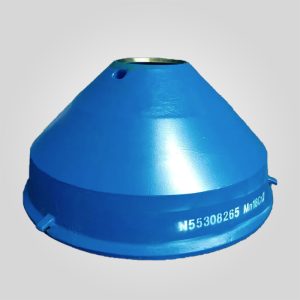
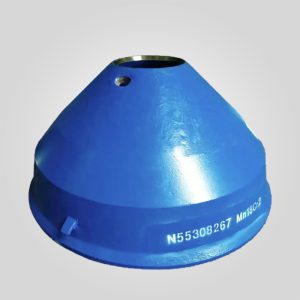
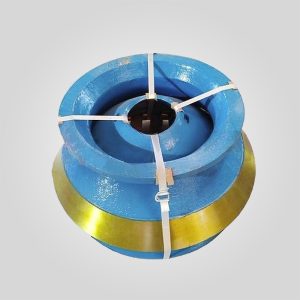
Visual Identification:
Blue main body
Gold accent ring at base
Protruding blue structures for reinforcement
库存 182 件
PRODUCT
Description
Metso GP330 Compatible Bowl Liner – OEM MM1051364
The efficiency of a secondary or tertiary crushing circuit is defined by the profile of the crushing chamber. The Bowl Liner (OEM: MM1051364) is the stationary wear component for the Metso GP330 cone crusher, designed to work in tandem with the mantle to break rock via compression.
In high-abrasion applications processing granite or quartzite (Bond Work Index > 16 kWh/t), standard manganese steel often fails to work-harden quickly enough, leading to rapid profile degradation. Our aftermarket cone crusher liner utilizes a modified Mn18Cr2 chemistry, optimized to maintain the crushing cavity shape longer, ensuring consistent product gradation throughout the wear life.
Technical Specifications & Metallurgy
| Technical Parameter | Specification Data | Industrial Standard |
|---|---|---|
| Part Number | MM1051364 | OEM Interchangeable |
| Material Code | Mn18Cr2 (High Manganese) | ASTM A128 Grade C |
| Initial Hardness | 200 – 220 HBW | As Cast / Solution Annealed |
| Work Hardened Hardness | 500 – 550 HBW | Under Impact Load |
| Yield Strength | ≥ 350 MPa | ISO 6892-1 |
| Machining Tolerance | ISO 2768-m (Backing Surface) | Critical for Fitment |
Material Science: The Mn18Cr2 Advantage
Reliability in crusher spares comes from the heat treatment process. This bowl liner undergoes a water-quenching process at approximately 1050°C to dissolve carbides and produce a fully austenitic structure.
- Work Hardening Physics: When the rock impacts the surface, the outer layer of the liner transforms from austenite to martensite, raising the hardness from ~220 HB to over 500 HB. This creates a hard wear-resistant skin while the core remains ductile (Impact Toughness > 100J) to prevent cracking under shock loads.
- Chrome Addition: The addition of 2% Chromium (Cr) improves yield strength and prevents the manganese from flowing (“mushrooming”) under high compression, which is a common issue that makes worn liners difficult to remove.
Performance Analysis: Profile Retention
Cheap aftermarket liners often prioritize initial price over profile engineering. However, a liner that loses its shape reduces crusher throughput.
- Throughput Consistency: By maintaining the “choke point” geometry for 25% longer than standard Mn13 liners, this component ensures the crusher draws full power amperage for a longer duration of the service cycle.
- Scrap Rate Reduction: Our precision casting minimizes internal shrinkage porosity. This allows operators to wear the liner down to a thinner cross-section without risking catastrophic breakage, effectively utilizing 65-70% of the casting weight.
Field Diagnosis: When to Change Your Bowl Liner?
[Option B: Pro-Tip]
“Don’t just look at the hours. Look at the amp draw and product shape. If your GP330 is drawing high amps but producing an excessive amount of oversize material (flakey product), your bowl liner has likely lost its compression zone profile. Physically measure the liner thickness at the bottom 300mm of the chamber. If the thickness is less than 25mm, or if you see ‘cupping’ where the intake is restricted, replace immediately to protect the top shell.”
Installation & Compatibility
This bowl liner is engineered for the Metso GP330 unit. It requires correct installation procedures to ensure longevity.
- Backing Compound: We recommend using a high-impact epoxy backing compound (compression strength > 120 MPa) to fill the void between the liner and the top shell. This prevents the liner from flexing and cracking under load.
- Mating Surface: The top mounting flange is CNC machined to ensure it sits flat against the top shell. Ensure this surface is clean and free of old backing material before installation.
Frequently Asked Questions (FAQ)
Q1: Do I need to use backing compound with this liner?
Yes. Even for “precision machined” surfaces, Metso GP series crushers typically require a layer of epoxy backing compound behind the bowl liner to absorb shock and fill any minor gaps between the casting and the frame. Failure to use backing can lead to liner breakage.
Q2: What is the difference between Mn13 and Mn18?
Mn13 (standard Hadfield steel) is good for soft to medium rock. Mn18 (used in this product) contains higher Manganese content, which provides better work-hardening capabilities and wear resistance for hard, abrasive materials like granite or basalt. It generally offers 20-30% longer life in tough conditions.
Q3: How do I identify if this fits my specific cavity (Fine/Coarse)?
The part number MM1051364 corresponds to a specific chamber profile. Please check your crusher’s parts manual or send us the serial number. Installing the wrong profile (e.g., using a Fine liner for Coarse feed) will cause feed bridging and reduced capacity.
Expert Reminder: When replacing the bowl liner (concave), it is industry best practice to also replace the mantle (moving liner). Mixing a worn mantle with a new bowl liner distorts the crushing angle, leading to uneven wear and potential mechanical stress on the main shaft.
*All manufacturer names, part numbers and descriptions are used for reference only. They belong to their respective OEMs. NEWREG supplies aftermarket replacement parts – independently manufactured and warranted, not OEM-originated. No affiliation with OEMs is claimed or implied.
“Authoritative Engineering Data: All critical metallurgical specifications and dimensional tolerances (e.g., ±0.05mm) are strictly governed by the master English documentation. While localized versions are provided for operational reference, the English original remains the sole binding authority for quality inspection and technical compliance.”


 English
 French
 German
 Spanish
 Russian
 Arabic
 Portuguese
 Turkish