
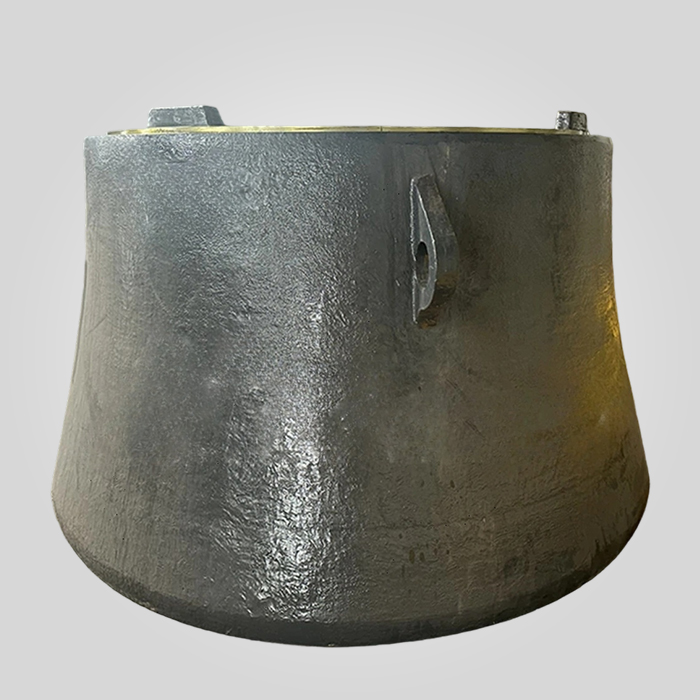
KB63-89 Lower Mantle 4609954 | Mn18Cr2 Gyratory Wear Parts
Model: KB63-89 Weights: 7,080 kg Item code: 4609954,2080656716
Casting Material: M13Cr2, Mn18Cr2, Mn22Cr2
Applicable Material: Gravel, Granite, Basalt, Ore, Limestone, Sandstone ,Quatz,Cobblestone
库存 182 件
PRODUCT
Description
Technical Specifications: KB63-89 Lower Mantle (Item 4609954)
The lower mantle is the primary wear interface in a gyratory crusher, bearing the brunt of high-tonnage compressive loads. Item 4609954 (also referenced as 2080656716) is the standard-profile lower mantle for the KB63-89 series. Engineering this component requires a precise balance between surface hardness for abrasion resistance and core toughness to withstand the shock of tramp iron or uncrushable feed.
| Technical Parameter | Specification Data |
|---|---|
| OEM Item Codes | 4609954, 2080656716 |
| Compatible Equipment | Thyssenkrupp KB Series 63-89 Gyratory Crusher |
| Net Weight | 7,080 kg (±2% Casting Tolerance) |
| Material Standards | ASTM A128 Grade C / DIN 1.3401 (Mn18Cr2) |
| Manganese Content | 17% – 19% (Optimized for work hardening) |
| Machining Precision | Internal Taper CNC Machined / Ra ≤ 3.2μm |
| Heat Treatment | Solution Annealing & Water Quenching (HB 180-220) |
| Hardness (Work Hardened) | 450 – 550 HBW |
Core Advantages: Metallurgy and Structural Integrity
As leading crusher part suppliers, we understand that “manganese steel” is a broad term. For primary gyratory applications involving Granite, Basalt, and Ores, the alloy chemistry must be strictly controlled to prevent “mushrooming” or premature cracking.
Advanced Material Science: Mn18Cr2
The addition of 2% Chromium to the 18% Manganese matrix significantly increases the yield strength of the casting. This prevents the metal from flowing (plastic deformation) during the early stages of the crushing campaign before the work-hardening effect has fully taken hold. This structural stability ensures that the mantle maintains its seating pressure on the main shaft, preventing fretting and internal erosion.
Precision Manufacturing Process
- Directional Solidification: Our foundry uses advanced casting simulation software to ensure the 7,080kg mass solidifies without internal shrinkage or centerline porosity in the critical crushing zone.
- CNC Precision Machining: The internal taper that mates with the main shaft is machined to an H7 tolerance. This tight fit is essential to prevent the mantle from shifting during tramp iron events.
- Solution Annealing: Castings are heated to 1050°C and rapidly water-quenched to ensure all carbides are in solid solution, maximizing impact toughness (Charpy V-notch ≥ 100 J/cm²).
Performance Comparison: Campaign Longevity
Data from copper and gold mining operations indicate that our Mn18Cr2 formulation provides superior cost-per-ton compared to standard Mn13 alternatives.
| Metric | Standard Mn13 Mantle | Our Mn18Cr2 Mantle (4609954) |
|---|---|---|
| Initial Surface Hardness | 170 – 190 HBW | 200 – 225 HBW |
| Crushing Life (Hard Rock) | Base (100%) | 120% – 135% Increase |
| Deformation (Mushrooming) | Significant after 500 hrs | Minimal / High Yield Strength |
| Maintenance Downtime | Standard Intervals | Reduced by 15% (Extended Cycles) |
Field Diagnostic & Maintenance Tips
1. Evaluating Wear Patterns:
When inspecting the mantle during a liner change, look for “washouts” or localized deep grooves. If wear is concentrated only on the bottom 20% of the mantle, your feed height or Closed Side Setting (CSS) may be improperly calibrated. This concentrated wear leads to early discard despite significant metal remaining on the upper section.
2. The Torque Check:
For the 7,080kg KB63-89 mantle, the locking nut tension must be checked after the first 24 hours of operation and again at 100 hours. If the nut requires more than a 5-degree turn to reach torque, it indicates the mantle has seated further into the backing compound or the main shaft taper, and failure to tighten will result in the mantle “walking” and damaging the main shaft.
3. Detecting Premature Cracking:
Perform a Dye Penetrant Inspection (PT) on the lifting lugs and the top locking taper during every scheduled stop. Hairline cracks in these areas are early indicators of structural fatigue due to excessive tramp iron passage.
Quality Assurance & Global Support
Every lower mantle leaves our facility with a full 3.1 Material Certificate. We conduct 100% Non-Destructive Testing (NDT) on critical load-bearing zones to ensure your Crusher spares meet or exceed OEM specifications. We provide global logistics support for these 7-ton components, utilizing reinforced steel framing to prevent transit damage to the machined internal surfaces.
Frequently Asked Questions (FAQ)
Q1: Is Item 4609954 interchangeable with Thyssenkrupp part 2080656716?
A: Yes. These are equivalent part numbers for the standard-profile lower mantle of the KB63-89 series. Our engineering team has verified the dimensional compatibility with the original Thyssenkrupp drawings.
Q2: When should I choose Mn22Cr2 over the standard Mn18Cr2?
A: Mn22Cr2 is recommended for extreme abrasion scenarios where the ore has a high silica content (e.g., Quartzite or Magnetite). While more expensive, it offers an additional 15-20% wear life in those specific high-abrasion environments.
Q3: Does this mantle require a specific type of backing compound?
A: We recommend high-compressive-strength epoxy backing resins. For a 7,080kg mantle, the backing must be able to withstand the crushing pressures without crumbling, as any void will lead to localized stress concentrations and potential cracking.
Engineer’s Final Reminder: When sourcing Spare parts for primary gyratories, the biggest risk is “taper mismatch.” A mantle that does not seat 100% on the main shaft will fail prematurely. Always verify your main shaft’s current condition; if the shaft is worn, even the best-quality mantle will fail to seat correctly.
As a manufacturer of crusher parts, we provide technical on-site consultation to ensure your Wear parts are installed with the precision required for maximum operational uptime.
“Authoritative Engineering Data: All critical metallurgical specifications and dimensional tolerances (e.g., ±0.05mm) are strictly governed by the master English documentation. While localized versions are provided for operational reference, the English original remains the sole binding authority for quality inspection and technical compliance.”



 English
 French
 German
 Spanish
 Russian
 Arabic
 Portuguese
 Turkish