
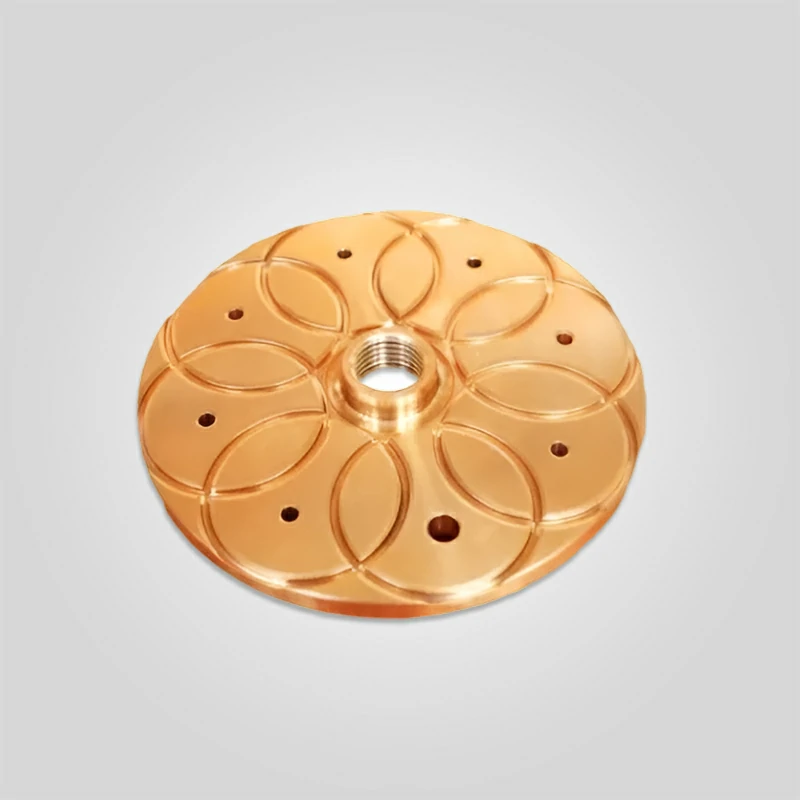
Metso Nordberg GP550 Thrust Bearing Set | OEM Ref: N02580184 / N02580185 | Centrifugal Cast C93700 Leaded Bronze
Compatible Brands :Metso, Nordberg
Applicable Models :GP550 Cone Crusher and related GP Series models
Primary Material :High-Grade Bronze Alloy (Customized compositions available)
Hardness :60-90 HB (Brinell Hardness)
Maximum Load Capacity: Designed for extreme axial crushing loads
Operating Temperature Range:: -20°C to 150°C (-4°F to 302°F)
Quality Standards :ISO 9001 certified manufacturing processes
库存 90 件
PRODUCT
Description
Technical Highlights: Tribology, Solidification Kinetics, and Hydrodynamic Efficiency
The GP550, being one of the most powerful crushers in the Nordberg GP series (315-400 kW), exerts immense axial down-pressure. The Thrust Bearing Set is not merely a washer; it is a hydrodynamic bearing that supports the entire dynamic mass of the main shaft assembly plus the crushing force (up to 250 metric tons). Its function depends entirely on the formation and maintenance of an oil wedge between the stationary piston and the rotating shaft. The engineering integrity of this component is defined by the homogeneity of the lead distribution and the geometric flatness of the sliding interface.
1. Metallurgical Architecture: C93700 (SAE 64) High-Leaded Tin Bronze
For the GP550 application, standard “gunmetal” (CuSn10) or Aluminum Bronze is tribologically unsuitable due to excessive hardness. We utilize ASTM B271 C93700 (DIN 1705 CuSn10Pb10).
- The Lead Phase (8.0-11.0% Pb): In this alloy, lead is insoluble in the copper matrix and exists as microscopic globules. Under “Boundary Lubrication” conditions (start-up, shut-down, or hydraulic overload), these globules smear across the mating steel surface. This creates a solid lubricant film (shear strength < 20 MPa) that prevents the bronze from welding to the steel piston, a failure mode known as “galling.”
- The Matrix (Sn 9.0-11.0%): The tin is dissolved in the copper to form a hard alpha-phase matrix. This provides the compressive yield strength (approx. 170 MPa) required to support the GP550’s crushing load without “mushrooming” or plastic deformation.
2. Manufacturing Process: Vertical Centrifugal Casting
Static sand casting is strictly prohibited for high-load thrust bearings due to the risk of subsurface porosity. Our GP550 bearings are manufactured using Vertical Centrifugal Casting at rotational forces exceeding 70G.
- Impurity Segregation: The high G-force drives the denser pure metal to the mold wall (the OD), while lighter impurities (sulfides, oxides, and gas porosity) are forced to the center bore.
- Machining Logic: The inner 15mm of the cast ring—containing these impurities—is machined away. The remaining material has a density >8.9 g/cm³ and a fine-grained microstructure. This density is non-negotiable; porous bronze will compress under hydraulic load, leading to unstable crusher settings and rapid failure.
3. Geometric Metrology: Flatness and The Lambda Ratio
The interface between the thrust bearing and the steel backing plate requires absolute geometric precision to maintain the oil film.
- Flatness Tolerance: The sliding faces are lapped to a flatness of < 0.02mm (20 microns). If the surface is wavy (>0.05mm), the load concentrates on the “peaks,” rupturing the oil film and initiating metal-to-metal contact.
- Surface Roughness (Ra): We machine to Ra 0.4μm – 0.6μm. This is optimized for the “Lambda Ratio” ($\lambda$). If the surface is too smooth (< 0.2μm), the bearing suffers from “stiction” (high breakout friction). If too rough (> 0.8μm), the metal asperities penetrate the 25-micron oil film, causing abrasive wear.
Specifications Table: Physical and Mechanical Parameters
The following technical data reflects the baseline engineering standards for our Premium GP550 Thrust Bearing replacements. These specifications are verified via Mill Test Certificates (MTC).
| Technical Parameter | Specification Value | Engineering Standard / Note |
|---|---|---|
| Component Designation | Upper/Lower Thrust Bearing Plates | GP550 Series Specific |
| Material Grade | C93700 (SAE 64) High-Leaded Tin Bronze | ASTM B271 / DIN 1705 |
| Chemical Composition | Cu: 80%, Sn: 10%, Pb: 10% | Spectrometer Verified |
| Tensile Strength | ≥ 240 MPa (35,000 psi) | Structural Limit |
| Yield Strength (0.5% Ext) | ≥ 110 MPa (16,000 psi) | Critical for Load Support |
| Hardness (Brinell) | HBW 65 – 85 (10/1000 Ball) | Optimized for Embeddability |
| Thermal Conductivity | 47 W/m·K @ 20°C | Heat Dissipation Capability |
| Max Operating Load | Designed for 400 kW Crushing Power | High Axial Compression |
| Surface Flatness | ≤ 0.020mm | Optical Flat / CMM Verified |
| NDT Protocol | Dye Penetrant (PT) Level II | ASTM E165 |
Deep Dive: Failure Analysis and Operational Stress
Understanding the failure modes of the GP550 thrust system is critical for preventing repeat failures. The thrust bearing is the “fuse” of the mechanical system.
1. Particle Embeddability and Scoring
Crusher lubrication oil is inevitably contaminated with silica dust and microscopic steel particles from gear wear.
- The Mechanism: A bearing material must be soft enough to allow hard particles to “sink” (embed) into the surface, moving them out of the contact zone.
- The Failure: If an incorrect, harder alloy (like C95400 Aluminum Bronze) is used, these particles remain on the surface, acting as a grinding paste. This scores the polished steel piston face. Once the steel piston is scored, it acts like a file, destroying any subsequent replacement bearing in hours. C93700 is selected specifically for its superior embeddability.
2. Thermal Runaway (The “Meltdown”)
The GP550 operates with tight internal clearances.
- The Scenario: If the oil flow is reduced (clogged filter) or the crusher is overloaded (high power draw), the oil film temperature rises.
- The Critical Limit: At temperatures above 160°C, the lead globules in the bronze begin to sweat out of the matrix. If the bulk temperature exceeds 200°C, the bronze loses 50% of its yield strength. The bearing “smears,” closing off oil grooves and leading to catastrophic seizure.
Engineer’s Advice: Installation, Maintenance, and Diagnostics
Installing a GP550 thrust bearing is a precision task. It is not a simple “swap-out.”
Protocol 1: The “Oil Saturation” Pre-Soak
Never install a bronze thrust bearing dry.
- The Physics: Even centrifugal bronze has microscopic surface porosity. If installed dry, the bearing will absorb the initial oil supply like a sponge, causing momentary starvation during the first rotation.
- The Procedure: Submerge the new bronze plates in a bath of clean ISO VG 150 (or 220) oil heated to 50°C for at least 2 hours before installation. This pre-saturates the pores. If heating is not possible, soak at ambient temperature overnight.
Protocol 2: The Piston Face Audit
The health of the bronze bearing is entirely dependent on the condition of the steel piston it sits on.
- The Check: Before installing new bearings, clean the steel piston top surface with solvent. Run a fingernail across the surface. If you can feel a scratch, catch, or ridge, the piston surface is compromised.
- The Tolerance: Use a straight edge and feeler gauge. If there is a depression >0.03mm in the center, the piston must be machined or replaced. Installing a flat bronze bearing onto a dished piston will result in point-loading at the outer edges, leading to rapid cracking of the new bearing.
Protocol 3: Oil Analysis Interpretation
Your oil analysis report gives you X-ray vision into the crusher.
- Rising Lead (Pb): This is the first warning. It means the sacrificial lead layer is wearing away or the oil film is too thin (viscosity too low).
- Rising Copper (Cu): This is the “Red Alert.” It means the lead is gone, and the structural copper matrix is now grinding against steel. Failure is imminent.
- High Silicon (Si): Dust ingress. Silicon kills bronze bearings faster than overload. Check your breather and seals immediately.
Why Source From Us?
We provide bronze crusher parts that are engineered to lower your Cost Per Ton.
- Traceability: Every GP550 bearing is stamped with a heat number traceable to the foundry melt and chemical analysis.
- Packaging: Bronze is soft and susceptible to impact damage. We ship bearings in reinforced crates to ensure they arrive perfectly flat and round.
Do not compromise the availability of your GP550. Contact our technical team today to secure OEM-spec C93700 thrust bearings.
“Authoritative Engineering Data: All critical metallurgical specifications and dimensional tolerances (e.g., ±0.05mm) are strictly governed by the master English documentation. While localized versions are provided for operational reference, the English original remains the sole binding authority for quality inspection and technical compliance.”



 English
 French
 German
 Spanish
 Russian
 Arabic
 Portuguese
 Turkish