

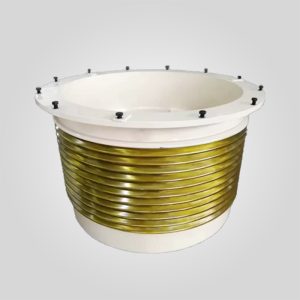
HP4 Cone Crusher Mantle & Bowl Liner | OEM P/N N55209252 | Mn18Cr2 Grade C
Equipment Model : HP4 Series Cone Crusher
Component Name : Mantle / Bowl Liner
Part Number : N55209252
Material Grade : Mn18Cr2 (High Manganese Steel)
Hardness Level : Initial HB180-220 (Work hardens to 450+ HB)
Processing Method : Heavy-duty Casting & Precision CNC Finishing
Primary Applications : Basalt, Granite, Iron Ore, and Hard Rock Mining
库存 331 件
PRODUCT
Description
Technical Highlights: Metallurgy, Tribology, and Dimensional Metrology
The operational efficiency of the Metso Nordberg HP4 cone crusher relies fundamentally on the geometric integrity and metallurgical stability of the crushing chamber. The N55209252 mantle and corresponding bowl liner are not merely “wear parts”; they are the kinetic interface where hydraulic force transforms into comminution energy. Our engineering approach prioritizes the crystallographic structure of the manganese steel and the tolerance stack-up of the machined surfaces.
1. Metallurgical Architecture: Mn18Cr2 (ASTM A128 Grade C)
Standard Mn13 (Hadfield steel) is often insufficient for the high-pressure crushing forces (400-500 MPa) exerted by the HP4 mechanism. We utilize Mn18Cr2, a hyper-eutectoid alloy modification that enhances the mechanical properties through specific alloying elements:
- Manganese Content (17.0% – 19.0%): This increased manganese volume stabilizes the austenite phase at room temperature. Upon impact, the surface lattice structure undergoes a phase transformation (twinning), increasing surface hardness from an initial ~220 HBW to >500 HBW, while the core remains ductile (>100 J/cm² impact toughness) to prevent catastrophic shattering.
- Chromium Addition (1.5% – 2.5%): Chromium forms hard carbide precipitates and increases the yield strength of the austenitic matrix. This prevents “flow” or plastic deformation of the liner under the high crushing load. Plastic flow is a primary cause of liner loose fitment, where the metal effectively stretches and loses contact with the head or bowl seating.
2. Heat Treatment Cycle: Solution Annealing (Water Quenching)
The performance of Manganese steel is dictated by the cooling rate. Our liners undergo a precise Water Quenching process from 1050°C – 1100°C.
- Objective: To dissolve embrittling carbides that form at grain boundaries during solidification.
- Process Control: The transfer time from furnace to quench tank is strictly controlled (<45 seconds) to prevent temperature drops that allow carbide reprecipitation.
- Result: A fully austenitic structure free of grain-boundary carbides. Inferior liners often skip this precise control, resulting in brittle castings that crack vertically when processing tramp iron or uncrushable materials.
3. CNC Machining and Geometric Tolerances
The HP4 utilizes a thread-locking bowl and a taper-fit head. The mating surfaces of our liners are machined on vertical turning lathes (VTL) to strict ISO IT tolerances.
- Backing Surface Finish: Ra 6.3μm or better. A rough surface acts as a file, wearing down the expensive crusher head or bowl.
- Concentricity: The liner wall thickness is controlled to ensure concentricity within 0.5mm. Variation in wall thickness creates dynamic imbalance in the eccentric assembly, leading to vibration (bushing wear) and uneven product gradation (poor particle shape).
4. Nondestructive Testing (NDT) Protocols
Visual inspection is insufficient for critical casting components. We employ Level II NDT technicians to verify internal integrity:
- Ultrasonic Testing (UT): Performed according to ASTM A609 to detect subsurface shrinkage porosity, particularly in the thick sections near the lifting hooks and lower flange.
- Dye Penetrant Inspection (MPI/DPI): Applied to the machined surfaces and high-stress transition radii to detect micro-cracks initiated during the cooling or grinding phases.
Detailed Specifications Table
The following parameters define the engineering baseline for the N55209252 HP4 Liner. These specifications are non-negotiable for ensuring OEM-level performance and fitment.
| Technical Parameter | Specification Value | Reference Standard / Note |
| OEM Reference | N55209252 (Mantle / Bowl Liner set) | Direct Interchangeable Fit |
| Material Grade | Mn18Cr2 (High Manganese Steel) | ASTM A128 Grade C / GB/T 5680 |
| Carbon Content (C) | 1.15% – 1.30% | Spectrometer Verification |
| Manganese Content (Mn) | 17.5% – 19.0% | Critical for Work Hardening |
| Chromium Content (Cr) | 1.5% – 2.5% | Yield Strength Enhancer |
| Initial Hardness | 210 – 240 HBW | Brinell Hardness (10/3000) |
| Work-Hardened Hardness | 450 – 550 HBW | Operational dependent |
| Tensile Strength (Rm) | ≥ 800 MPa | Standard Tensile Test |
| Elongation (A) | ≥ 40% | Indicator of Ductility |
| Impact Toughness (Ak) | ≥ 110 J/cm² | Charpy-U Notch @ 20°C |
| Machining Tolerance | ISO 2768-mH | Critical for seating fit |
| Weight | Variable per cavity type (Fine/Coarse) | Typically 1000kg – 2500kg range |
Deep Dive: Material Selection Logic (Mn13 vs. Mn18 vs. Mn22)
The selection of Mn18Cr2 for the HP4 is not arbitrary. It represents the intersection of cost-efficiency and mechanical performance for medium-hard to hard rock applications.
Mn13Cr2 (Standard Manganese):
While cheaper, Mn13 lacks the initial yield strength required for modern high-pressure cone crushers like the HP series. Under high hydraulic clamping forces and crushing loads, Mn13 can exhibit plastic deformation, causing the liner to “grow” and warp. This makes removal extremely difficult (requiring torch cutting) and can damage the crusher head seating surface.
Mn18Cr2 (Specified Grade):
This is the industry standard for HP4 applications. The additional manganese and chromium provide a higher yield point, resisting the “flow” effect. It work-hardens rapidly, making it ideal for abrasive materials like Granite (SiO2 content >60%) and Basalt.
Mn22Cr2 (Ultra-Heavy Duty):
Reserved for extreme applications with very high impact and extreme abrasion. While it offers longer wear life, the cost premium (often 30-40% higher) must be justified by the reduction in change-out labor. For standard aggregate production, Mn18Cr2 typically offers the best Cost Per Ton (CPT) ratio.
Engineer’s Advice: Installation, Maintenance, and Failure Prevention
In my 20 years of field analysis, 60% of premature liner failures are not due to casting defects, but due to procedural errors during installation or operation. The following protocols are critical for the HP4.
1. Critical Protocol: Backing Compound Application
The gap between the liner (mantle or bowl) and the crusher frame is not perfectly flush. Crusher backing compound (epoxy resin) is mandatory to fill this void.
- Function: It acts as a shock absorber and prevents “fretting” (micro-motion) between the liner and the head/bowl. Without backing, the liner will rock under load, hammering the seating surface of the crusher head.
- The Mistake: Many operators fail to measure the temperature or mix ratio correctly, leading to soft backing or voids. A void behind the liner creates a stress concentration point. When a rock impacts that specific unsupported spot, the manganese steel—which is relatively brittle until work-hardened—will crack vertically.
- Requirement: Ensure 100% fill. Check for leaks at the bottom seal. Allow full cure time (temperature dependent) before putting the crusher under load.
2. Operational Protocol: Choke Feeding and “Ring Bounce”
The HP4 is designed to operate with a “Choke Feed” (chamber full of rock).
- Work Hardening: Manganese steel requires impact and pressure to harden. If you trickle feed (run the crusher half-empty), the liners are subjected to abrasive sliding wear rather than compressive impact. This scrapes away the soft base metal before the hard skin can form, reducing liner life by up to 50%.
- Ring Bounce Protection: Running empty or with uneven feed causes the adjustment ring to bounce. This hydraulic overload flexes the liners. Repeated flexing causes fatigue failure at the liner neck. Maintain a consistent feed level using automated bin sensors to keep the crusher head buried.
3. Storage and Handling
Manganese steel has a high coefficient of thermal expansion.
- Temperature Shock: Never store spare liners outdoors in freezing conditions immediately before installation. Installing a -10°C liner into a crusher with residual heat, or pouring hot backing compound (exothermic reaction >80°C) against a freezing liner, can induce thermal shock cracks.
- Pre-warming: In cold climates, bring the liner into the workshop 24 hours prior to installation to normalize its temperature.
For technical consultation regarding chamber selection (Fine, Medium, Coarse, or Extra Coarse) based on your specific feed gradation curve, or to request Mill Test Certificates (MTC) for heat #N55209252, contact our engineering support team. We do not just sell iron; we sell uptime.
“Authoritative Engineering Data: All critical metallurgical specifications and dimensional tolerances (e.g., ±0.05mm) are strictly governed by the master English documentation. While localized versions are provided for operational reference, the English original remains the sole binding authority for quality inspection and technical compliance.”


 English
 French
 German
 Spanish
 Russian
 Arabic
 Portuguese
 Turkish