

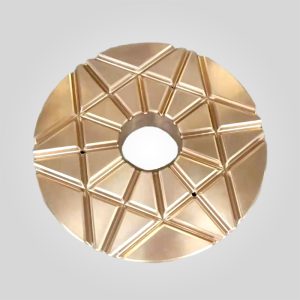
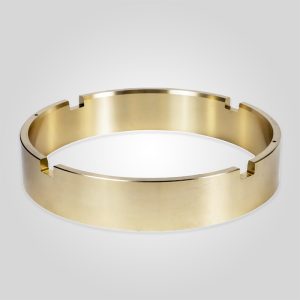
Cone Crusher Parts Bronze Socket Liner
Hardness: HB 70-90
Tensile Strength: ≥200 MPa
Yield Strength: ≥100 MPa
Elongation: ≥10%
Density : 8.8 g/cm³
Part Name : Bronze Socket Liner
库存 182 件
PRODUCT
Description
Technical Guide: Bronze Alloys for Cone Crusher Components
Choosing the right bronze alloy is critical for the longevity of your crusher. Different parts of the machine—Eccentric Bushings, Socket Liners, Step Washers—experience vastly different loads and speeds. We utilize a range of premium copper alloys, adhering strictly to ASTM and DIN standards, to match the tribological requirements of each component. Below is a comprehensive comparison of the materials we use in our aftermarket crusher spares.
1. High-Leaded Tin Bronze (The “Standard” for Bushings)
Common Grades: C93700 (ASTM), CuPb10Sn10 (DIN), SAE 64
This is the workhorse alloy for Eccentric Bushings and Socket Liners in Metso HP, Sandvik CH, and Symons crushers.
| Properties | Why It’s Used |
|---|---|
| The high lead content provides “emergency lubrication.” If the oil film fails, the lead smears onto the shaft, preventing seizing. It also embeds abrasive particles, protecting the main shaft from scoring. |
2. Aluminum Bronze (For High-Load / Low-Speed)
Common Grades: C95400 (ASTM), CuAl10Fe5Ni5 (DIN), C95500 (Nickel Al-Bronze)
Used for Bottom Shell Bushings, Toggle Seats (Jaw Crushers), and specific heavy-duty eccentric bushings where load capacity exceeds the limit of tin bronze.
| Properties | Why It’s Used |
|---|---|
| Extremely high compressive strength and fatigue resistance. However, it has zero self-lubricating properties. It requires a flawless, continuous oil film. If lubrication fails, it will seize instantly and destroy the shaft. |
3. Leaded Gunmetal (General Purpose)
Common Grades: C83600 (ASTM), CuSn5Zn5Pb5 (DIN), SAE 40 (Red Brass)
Used for lower-stress components like Seal Rings, Countershaft Bushings (in smaller machines), and spacer rings.
| Properties | Why It’s Used |
|---|---|
| Excellent machinability and corrosion resistance. Suitable for parts that do not carry the primary crushing load but require good sliding properties. |
4. Manganese Bronze (High-Strength Brass)
Common Grades: C86300 (ASTM), CuZn25Al6Fe3Mn3 (DIN), SAE 430
Used for Toggle Plates, Thrust Plates, and structural wear blocks.
| Properties | Why It’s Used |
|---|---|
| Operates under extremely high static loads where motion is minimal. Not suitable for high-speed rotation due to poor anti-friction properties. |
Material Selection Guide: Which Do You Need?
[Expert Tip] Never “upgrade” a bushing material without consulting an engineer. Replacing a C93700 (Lead Bronze) eccentric bushing with a “stronger” C95400 (Aluminum Bronze) one is a common mistake. While stronger, the Aluminum Bronze lacks embeddability and will score your main shaft if any dust enters the oil. Stick to the OEM specification unless you have a specific engineering reason to change.
| Component | Recommended Alloy | Key Attribute |
|---|---|---|
| Metso HP Eccentric Bushing | C93700 | Anti-Seize & Embeddability |
| Symons Socket Liner | C93700 / C83600 | Lubricity & Conformability |
| Jaw Crusher Toggle Seat | C95400 / C86300 | Impact Strength |
“Authoritative Engineering Data: All critical metallurgical specifications and dimensional tolerances (e.g., ±0.05mm) are strictly governed by the master English documentation. While localized versions are provided for operational reference, the English original remains the sole binding authority for quality inspection and technical compliance.”

 English
 French
 German
 Spanish
 Russian
 Arabic
 Portuguese
 Turkish