
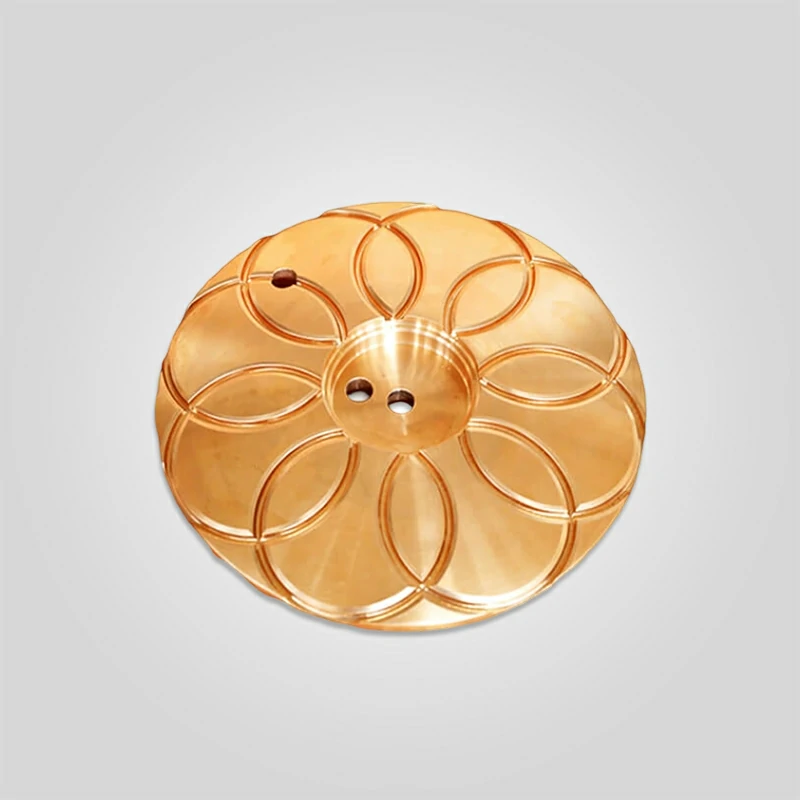
Metso Nordberg GP100/GP100S Thrust Bearing Set | OEM Ref: N100-TB-Set | Centrifugal Cast C93700 Leaded Bronze
Compatible Models :Metso GP100, GP100S Cone Crushers
Material Grade: High-grade bronze alloy (CuSn12, CuSn10Zn2)
Load Capacity :Dynamic: 150-200 kN, Static: 300-400 kN
Operating Temperature :-30°C to 200°C operational range
Surface Hardness :70-100 HB (Brinell Scale)
库存 78 件
PRODUCT
Description
Technical Highlights: Tribology, Solidification Kinetics, and Precision Machining
In the hydraulic architecture of the Metso GP100 and GP100S cone crushers, the Thrust Bearing (often a multi-disc assembly) acts as the fundamental axial load interface. Unlike the HP series which uses a thread-adjustment mechanism, the GP series utilizes a hydraulic piston to support the main shaft. The thrust bearing sits directly atop this piston, supporting the entire weight of the main shaft, mantle, and the dynamic crushing force (often exceeding 150 tons). This component does not merely support weight; it must facilitate low-friction rotation under extreme compressive stress while submerged in a hydrodynamic oil bath.
The performance of a replacement thrust bearing is defined by three non-negotiable engineering variables: the homogeneity of the lead distribution within the bronze matrix, the flatness tolerance of the sliding disks, and the specific surface roughness required to maintain an elastohydrodynamic lubrication (EHL) film.
1. Metallurgical Architecture: Centrifugal Cast C93700 (SAE 64)
For high-load, low-speed sliding applications, standard tin bronzes (like CuSn12) are often too hard and lack the necessary “embeddability” to tolerate particulate contamination. Our GP100 thrust plates are manufactured from ASTM B271 C93700 (High-Leaded Tin Bronze).
- The Lead (Pb) Function: The alloy contains 8.0-11.0% Lead. In a cast structure, lead is insoluble in copper and exists as microscopic globules dispersed throughout the matrix. Under boundary lubrication conditions (such as crusher start-up or during tramp iron events where the oil film ruptures), these lead globules smear across the mating steel surface. This solid lubricant layer prevents catastrophic adhesive wear (galling) and seizing.
- Centrifugal Casting Process: We strictly prohibit static sand casting for thrust components. Our bearings are produced via Vertical Centrifugal Casting at 800-1200 RPM. This high-G-force solidification process segregates impurities (oxides, sulfides) to the inner bore, which is subsequently machined away. The resulting microstructure is dense, fine-grained, and free of subsurface porosity. A porous bearing will compress under load, causing hydraulic instability and uneven wear.
2. Geometric Metrology: Flatness and Parallelism
The GP100 thrust bearing assembly typically consists of a stack of bronze and steel plates. The interaction between these plates requires absolute geometric precision.
- Flatness Tolerance: The sliding surfaces are lapped to a flatness of < 0.02mm (20 microns). This is critical. If the plate is wavy (>0.05mm), the load will concentrate on the “peaks,” rupturing the oil film and initiating rapid scouring.
- Parallelism: The top and bottom faces must be parallel within 0.03mm. Lack of parallelism introduces a “wobble” into the main shaft, which translates to runout at the eccentric bushing, accelerating seal wear and causing oil leakage.
3. Surface Tribology: The Oil Wedge
The surface finish is engineered to specific Ra (Roughness Average) parameters to optimize the Lambda Ratio ($\lambda$).
- Target Roughness: Ra 0.4μm – 0.6μm.
- The Engineering Logic: If the surface is too smooth (< Ra 0.2μm), the surface cannot retain the necessary oil molecules during static periods (stiction), leading to high start-up torque. If too rough (> Ra 0.8μm), the asperities (metal peaks) will penetrate the oil film (typically 10-25μm thick), resulting in metal-to-metal contact. Our finish is optimized to sustain the hydrodynamic wedge while allowing for the safe passage of sub-5-micron particles.
Specifications Table: Physical and Mechanical Parameters
The following technical data represents the baseline engineering standards for our Metso GP100/GP100S Thrust Bearing replacements. These specifications are verified via Mill Test Certificates (MTC) and CMM inspection reports.
| Technical Parameter | Specification Value | Engineering Standard / Note |
|---|---|---|
| Component Name | Thrust Bearing Set (Upper/Lower) | GP Series Specific Design |
| Compatible Equipment | Metso Nordberg GP100 / GP100S | Verify Serial Number for Series 1 vs 2 |
| Material Designation | C93700 / CuSn10Pb10 | ASTM B271 (Centrifugal Cast) |
| Chemical Composition | Cu: 80%, Sn: 10%, Pb: 10% | Spectrometer Verification |
| Tensile Strength | ≥ 240 MPa (35 ksi) | ASTM B271 |
| Yield Strength (0.5% Ext) | ≥ 125 MPa (18 ksi) | Critical compressive limit |
| Hardness (Brinell) | 60 – 75 HBW | Standard 10/1000 Ball |
| Surface Flatness | ≤ 0.020mm | Optical Flat / CMM Check |
| Surface Roughness | Ra 0.4μm – 0.6μm | Ground and Lapped |
| NDT Protocol | Dye Penetrant (PT) Level II | Check for machining micro-cracks |
Deep Dive: Lubrication Physics and Failure Analysis
Understanding why thrust bearings fail allows operators to extend the MTBF (Mean Time Between Failures).
1. Boundary Lubrication & The “Wipe”
The most dangerous moment for a GP100 thrust bearing is the first 5 seconds of start-up. The oil pressure has not yet built a full hydrodynamic film. The bronze plate rubs directly against the steel plate. This is where the 10% Lead content is vital. The lead smears, protecting the copper-tin matrix. Cheap aftermarket parts often reduce lead content to save costs (replacing it with Zinc), resulting in a harder alloy that scuffs and seizes during these critical start-up moments.
2. Particle Embeddability
Crusher oil is rarely pristine. It contains silica dust and steel particles. A bearing material must be soft enough to allow these hard particles to “embed” themselves into the surface, sinking below the sliding interface. If the material is too hard (like Aluminum Bronze), the particle stays on the surface, acting as a cutting tool that scores the expensive steel mating plate. C93700 offers the perfect balance of load-bearing strength and embeddability.
Engineer’s Advice: Installation and Maintenance Protocols
Replacing a thrust bearing is not a “drop-in” job. It requires precision and cleanliness.
Protocol 1: The “Oil Film” Pre-Soak
Never install a bronze thrust bearing dry.
- The Physics: Bronze is porous. If installed dry, the initial oil supply will be absorbed into the pores rather than forming a film.
- The Procedure: Submerge the new bronze plates in a bath of clean ISO VG 150 (or 220) oil heated to 50°C for at least 2 hours before installation. This pre-saturates the surface porosity and ensures immediate lubricity upon the first rotation.
Protocol 2: The Piston Movement Check
The GP series relies on the hydraulic piston to adjust the setting.
- The Check: Before installing the new bearings, inspect the top surface of the hydraulic piston. It must be free of burrs, rust, or indentations. A single burr on the piston face will telegraph through the steel backing plate and deform the bronze bearing, creating a high spot.
- The Measurement: Use a micrometer to measure the thickness of the old bearings at four points (90 degrees apart). If the wear is uneven (tapered), it indicates the piston is cocked or the main shaft is bent. Installing new bearings without fixing the root cause will result in failure within 100 hours.
Maintenance Tip: Oil Analysis Interpretation
Your oil analysis report is the ECG of your crusher.
- High Copper (Cu) + High Lead (Pb): Normal wear if gradual. If sudden spike: Thrust bearing failure or Eccentric bushing failure.
- High Copper (Cu) only: If Lead is low but Copper is high, it indicates the bearing has worn through the lead-rich surface or you are using an incorrect alloy.
- Silicon (Si) Spike: Dust ingress. Check your breathers and seals. Silicon kills bronze bearings faster than overload.
Why Choose Our Bronze Crusher Parts?
We do not compete on being the cheapest option in the market; we compete on Cost Per Ton. A $200 saving on a thrust bearing is mathematically irrelevant if it causes a $50,000 main shaft failure or 3 days of unplanned downtime.
- Traceability: Every plate comes with a heat number traceable to the foundry melt.
- Precision: We verify flatness on granite surface plates before packaging.
- Stock Strategy: We maintain inventory for GP100, GP200, GP300, and GP500 series to minimize your logistics downtime.
Contact our technical sales team today to secure your GP100 Thrust Bearing set. Provide your crusher serial number to ensure the correct revision level compatibility.
“Authoritative Engineering Data: All critical metallurgical specifications and dimensional tolerances (e.g., ±0.05mm) are strictly governed by the master English documentation. While localized versions are provided for operational reference, the English original remains the sole binding authority for quality inspection and technical compliance.”



 English
 French
 German
 Spanish
 Russian
 Arabic
 Portuguese
 Turkish