
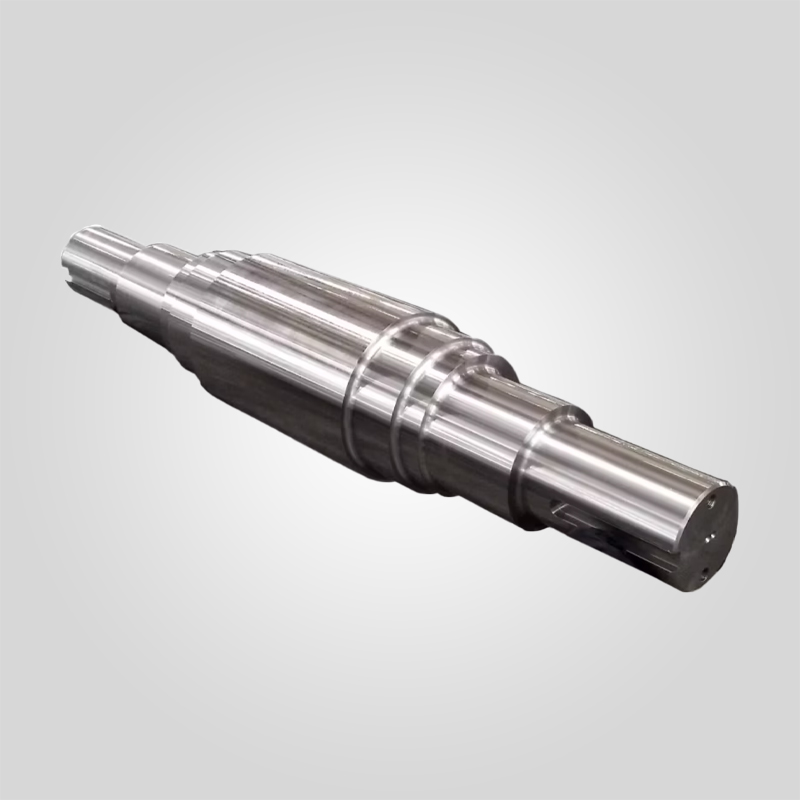
Jaw Crusher Eccentric Shaft – Heavy Duty Cast Steel Component
Model Type: Eccentric Shaft
Manufacturing Process: Precision Casting
Material: High Manganese Cast Steel
Manganese Content: 13%-24%
hrome Content: 1.7%-2.5%H
ardness: 175-225 HB
Maximum Weight: 6,000 kg
库存 182 件
PRODUCT
Description
| Technical Specification | Data / Standard |
|---|---|
| Part Name | Jaw Crusher Eccentric Shaft |
| Manufacturing Process | Open Die Forging + CNC Machining |
| Material Grade | 42CrMo4 (AISI 4140) / 34CrNiMo6 (AISI 4340) |
| Heat Treatment | Quenched and Tempered (Q&T) |
| Hardness | 260 – 310 HBW (Through-Hardened) |
| Yield Strength | ≥ 750 MPa |
| Tolerance | ISO 286 k6 / m6 (Bearing Journals) |
| Surface Finish | Ra 0.8 μm (Ground Finish) |
Premium Forged Eccentric Shaft for Jaw Crushers
The Eccentric Shaft is the most critical and expensive component of a jaw crusher drive train. It bears the full bending moment of the crushing force. A common mistake in the aftermarket is using cast steel or low-grade carbon steel. We manufacture our shafts exclusively from High-Strength Forged Alloy Steel (42CrMo4 / 4140). This ensures the structural integrity required to withstand the high-cycle fatigue inherent in crushing hard rock like granite and basalt.
As dedicated crusher part suppliers, we focus on the “Core Strength” of the shaft. Through a precise Quench and Temper (Q&T) process, we achieve a uniform hardness (approx. 280 HBW) that balances tensile strength with ductility, preventing the shaft from snapping under shock loads.
Why Forging Matters (Not Casting)
[Expert Note] Never buy a cast steel eccentric shaft. Casting defects (porosity, inclusions) act as stress concentrators that lead to sudden catastrophic failure.
- Grain Alignment: Our forging process aligns the steel’s grain structure parallel to the shaft’s axis, maximizing resistance to bending fatigue.
- Impact Resistance: 42CrMo4 Forged Steel has an impact value (Charpy V) 3x higher than cast steel, ensuring it can handle tramp iron events without cracking.
Field Diagnosis: Shaft Health Check
Before ordering a replacement, check your current shaft:
1. Bearing Spin (Fretting)
Inspect the bearing journals. If you see “red dust” or feel a step with your fingernail, the bearing inner race has been spinning on the shaft. If the diameter is worn by >0.05mm, the shaft is scrap.
2. Thread Damage
Check the threads on the flywheel ends. Damaged threads prevent proper torqueing of the locking assembly, leading to loose flywheels.
3. Keyway Wallowing
If the keyway edges are rounded or widened, the drive key will shear repeatedly. This is a sign of long-term fatigue.
Applications and Compatibility
Our shafts are engineered as direct replacements for major jaw crusher models, including:
- Metso Nordberg C Series (C80, C100, C110, C125, C140, C160, C200)
- Sandvik CJ / JM Series (CJ411, CJ412, CJ612, CJ613, CJ615)
- Terex / Pegson / Telsmith Models
Quality Assurance
- UT Testing: 100% Ultrasonic Testing according to SEP 1921 Group 3 Class C/c to ensure no internal cracks.
- Dimensional Check: Bearing journals are measured with micrometers to ensure k6/m6 tolerance for proper interference fit.
Note: Eccentric shafts are heavy (up to 6 tons) and require specialized crating. We use reinforced steel pallets to prevent bending during ocean transit.
“Authoritative Engineering Data: All critical metallurgical specifications and dimensional tolerances (e.g., ±0.05mm) are strictly governed by the master English documentation. While localized versions are provided for operational reference, the English original remains the sole binding authority for quality inspection and technical compliance.”
 English
 French
 German
 Spanish
 Russian
 Arabic
 Portuguese
 Turkish