

Metso HP Series Lower Head Bushing: 1022145730 OEM Replacement
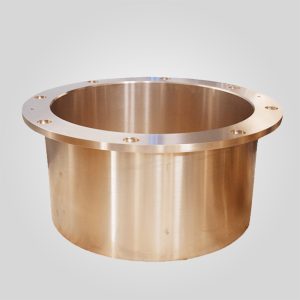
The Lower Head Bushing (Part # 1022145730) is a critical radial bearing installed inside the bottom of the Cone Head (Moving Cone) in Metso HP series crushers. It rotates around the eccentric assembly, bearing the immense radial crushing forces while maintaining the precise gyration angle. Unlike static bushings, this component operates under high-speed dynamic loads and requires a flawless hydrodynamic oil film to prevent metal-to-metal contact with the eccentric.
We manufacture this bushing using ASTM C93700 High-Leaded Tin Bronze via a Centrifugal Casting process. This method spins the molten alloy at 1500 RPM, forcing impurities to the inner bore (which is then machined away) and ensuring a dense, porosity-free grain structure. This is superior to sand-cast alternatives, offering 25% higher fatigue strength against the shock loads of crushing hard rock.
Technical Specifications
| Parameter | Data / Standard |
|---|---|
| Part Number | 1022145730 |
| Compatible Series | Metso Nordberg HP300 / HP400 / HP500 |
| Material Grade | High-Leaded Tin Bronze (ASTM C93700 / SAE 64) |
| Lead Content (Pb) | 8.0% – 15.0% (Critical for Anti-Seize) |
| Hardness | 65 – 80 HBW |
| Manufacturing Process | Centrifugal Casting + CNC Precision Turning |
| Dimensional Tolerance | ISO 2768-mK (Interference Fit OD) |
Performance Analysis: Why Material Matters
[Engineer’s Note] The HP series runs faster than traditional crushers. Using a generic bronze here will lead to immediate failure.
1. Anti-Friction: The high lead content in our C93700 alloy acts as a “smear” lubricant. If the crusher stalls under load (loss of oil wedge), the lead prevents the bronze from welding to the eccentric steel.
2. Thermal Conductivity: The dense centrifugal structure dissipates heat rapidly, preventing the bushing from expanding and locking onto the eccentric (Seizing).
Field Diagnosis: When to Replace
Monitor your crusher for these signs of Lower Head Bushing failure:
1. Head Spin (High Speed)
Run the crusher empty. The head should rotate slowly (<15 RPM). If it spins rapidly (approaching countershaft speed), the Lower Head Bushing has clamped onto the eccentric due to thermal expansion or lack of clearance. Immediate shutdown is required.
2. Burn Marks (Discoloration)
Upon inspection, if the bushing surface shows dark blue/black patches or “smearing” of bronze, the oil film has failed. The bushing must be replaced, and the eccentric surface polished.
3. Loose Fit in Head
The bushing relies on an interference fit. If it spins inside the head bore, the head casting itself is damaged. This is often caused by installing a new bushing without using liquid nitrogen.
Installation & Expert Tips
[Pro-Tip] Installation requires thermal contraction, not brute force.
- Cryogenic Fitting: Immerse the new bushing in Liquid Nitrogen (-196°C) or pack with Dry Ice for 2-3 hours. The bushing will shrink by approx. 0.5mm, allowing it to drop freely into the Head bore. NEVER use a press or hammer at room temperature.
- Alignment: Ensure the oil holes line up exactly with the head’s oil passages. Misalignment will starve the bearing of oil.
- Locking Screws: Always install new locking screws (grub screws) with Loctite to prevent the bushing from rotating during operation.
Workshops And Warehouses

Cross-Brand Compatibility Disclaimer
Our aftermarket crusher spares are engineered to be fully interchangeable with OEM components. All manufacturer names, part numbers (e.g., 1022145730), and descriptions are used for reference purposes only. NEWREG supplies independently manufactured replacement parts and is not affiliated with the OEM.



 English
 French
 German
 Spanish
 Russian
 Arabic
 Portuguese
 Turkish