

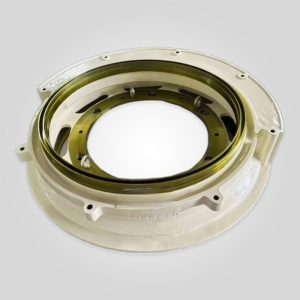
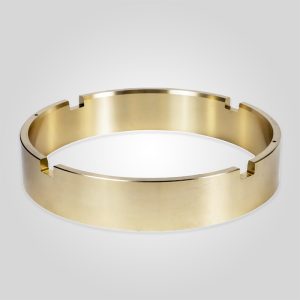
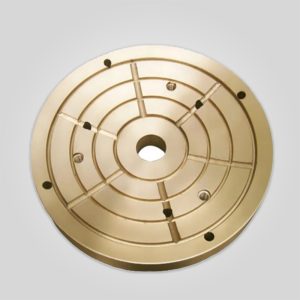
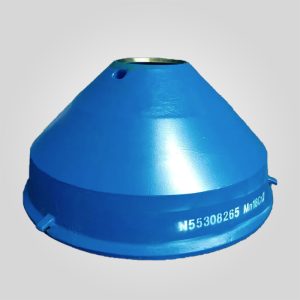
Inner Eccentric Bushing for Symons Cone Crusher
- Centrifugal casting for consistent material density
- CNC machining to exact OEM specifications
- Precision grinding for perfect dimensional accuracy
- Rigorous quality control at every production stage
库存 22 件
PRODUCT
Description
Symons Cone Crusher Inner Eccentric Bushing – Premium Bronze Replacement Parts
The Inner Eccentric Bushing is the critical interface component between the stationary main shaft and the rotating eccentric assembly in Symons cone crushers.
Operating under high crushing loads and hydrodynamic lubrication, this bronze sleeve ensures the stability of the gyratory motion.
Unlike standard brass fittings, our inner eccentric bushings are engineered from high-lead tin bronze to prevent shaft seizure and maintain precise eccentric throw, even under extreme pressure.
As a specialized crusher part supplier, we utilize advanced centrifugal casting to produce bushings that meet or exceed OEM specifications for the entire Symons range (2ft to 7ft). Our components are designed to serve as a fail-safe, protecting the expensive main shaft from damage during overload events.
Core Engineering Advantages
We strictly adhere to UNS and SAE material standards to ensure consistent performance in mining aggregates and demolition recycling.
- Centrifugal Casting Technology: Unlike sand-cast alternatives, our bushings are centrifugally cast. This high-velocity process eliminates internal porosity and impurities, creating a denser, more uniform grain structure for superior load-bearing capacity.
- Material Composition (SAE 64): Manufactured from UNS C93700 (High-Lead Tin Bronze).
The 8-11% lead content acts as a solid lubricant during start-up or oil film interruption, providing “self-lubricating” properties that prevent catastrophic metal-to-metal welding. - Precision Machining: CNC-finished surfaces ensure correct oil clearance (typically 0.001″ per inch of shaft diameter), which is vital for maintaining the hydrodynamic oil wedge required to separate the bushing from the shaft.
Technical Specifications
The following table outlines the material science and compatibility data for our premium Symons crusher parts.
Reference these parameters to verify suitability for your specific machine.
| Technical Parameter | Specification Details |
|---|---|
| Compatible Series | Symons Standard (STD) & Shorthead (SH) |
| Material Grade | UNS C93700 / SAE 64 / DIN CuSn10Pb10 |
| Tensile Strength | ≥ 240 MPa (35,000 psi) |
| Yield Strength | ≥ 110 MPa (16,000 psi) |
| Hardness (Brinell) | 60 – 80 HB (Optimal for shaft protection) |
| Lead Content | 8.0% – 11.0% (Anti-friction agent) |
| Common OEM Ref (3ft SH) | 2207-1401 |
| Common OEM Ref (5½ft STD) | 2214-5706 |
| Common OEM Ref (7ft Inner) | 2214-6721 |
Performance Comparison: Lead Bronze vs. Aluminum Bronze
While some manufacturers offer Aluminum Bronze (C95400) for its high tensile strength, it is often unsuitable for inner eccentric bushings.
Our C93700 High-Lead Bronze offers superior “embeddability,” allowing small foreign particles (like dust or metallic fines) to sink into the soft bronze rather than scoring the steel main shaft.
This sacrificial characteristic extends the lifespan of your crusher’s most expensive permanent components.
Maintenance Diagnosis: Bushing Health Check
Prevent unplanned downtime by monitoring these key indicators of bushing wear:
- Oil Temperature Spikes: A rapid rise in return oil temperature (>55°C/130°F) often indicates the oil clearance has decreased due to thermal expansion or bushing distortion (“clamping”).
- Bronze Flakes in Filter: The presence of “glittery” gold flakes in the oil filter is an early warning of lubrication failure or geometric misalignment.
- Power Draw Fluctuations: If the crusher draws excessive power while running empty, the inner bushing may be dragging on the main shaft, a precursor to burn-out.
“Authoritative Engineering Data: All critical metallurgical specifications and dimensional tolerances (e.g., ±0.05mm) are strictly governed by the master English documentation. While localized versions are provided for operational reference, the English original remains the sole binding authority for quality inspection and technical compliance.”

 English
 French
 German
 Spanish
 Russian
 Arabic
 Portuguese
 Turkish