

Jaw Crusher Pitman Assembly: Cast Steel Spares for Metso C80
Mining: Primary crushing of iron ore, copper ore, and gold-bearing rocks.
Quarrying: Processing granite, basalt, limestone, and other aggregates.
Recycling: Crushing demolition concrete and construction waste.
Cement & Metallurgy: Size reduction of raw materials and industrial minerals .
库存 112 件
PRODUCT
Description
Jaw Crusher Pitman Assembly: The Core Moving Mass
The Jaw Crusher Pitman is the central reciprocating component that converts the rotary motion of the eccentric shaft into the crushing stroke. Unlike sacrificial wear parts, the Pitman is a structural asset designed for infinite fatigue life. For Metso Nordberg C63, C80, and C-Series crushers, our Pitman assemblies are engineered from premium Cast Steel, not Manganese, to ensure rigid stability under compressive loads exceeding 400 MPa.
We supply complete Pitman assemblies that are fully machined, stress-relieved, and ready for bearing installation. As leading crusher part suppliers, we understand that a Pitman failure is catastrophic; therefore, our manufacturing process prioritizes metallurgical purity and dimensional precision.
Technical Specifications & Engineering Standards
Our Pitman assemblies are manufactured to strict OEM equivalency standards. Below are the technical parameters for our C-Series compatible units.
| Parameter | Specification Details |
|---|---|
| Structural Material | Cast Steel ASTM A27 Grade 70-40 / DIN 1681 GS-45 |
| Compatible Models | Metso C63, C80, C100, C125; Sandvik CJ408, CJ409 |
| Bearing Bore Tolerance | ISO 286-2 H7 (Precision Machined for Interference Fit) |
| Thermal Treatment | Normalization + Stress Relief Annealing (600°C) |
| Non-Destructive Testing | Ultrasonic (UT) Level II & Magnetic Particle (MPI) |
| Weight Range | 800 kg – 15,000 kg (Depending on Model) |
Manufacturing Excellence: Beyond Standard Casting
The manufacturing of a Pitman requires significantly more precision than standard crusher spares. Our process includes:
- Material Selection: We strictly use Low-Alloy Cast Steel (GS-45). We never use Manganese Steel for the Pitman body, as Manganese flows under load, which would cause the bearing housings to deform and fail.
- Stress Relief: After casting, the raw Pitman undergoes a controlled annealing cycle to remove residual internal stresses. This prevents the component from warping during machining or cracking under operation.
- CNC Precision: The bearing housings and the toggle plate seating groove are machined in a single setup on large-scale CNC boring mills. This ensures perfect parallelism between the eccentric shaft axis and the toggle seat, preventing uneven wear on the toggle plate.
Field Diagnosis: When is a Pitman at Risk?
Replacing a Pitman is a major capital expense. Regular inspection can prevent total failure. Watch for these signs:
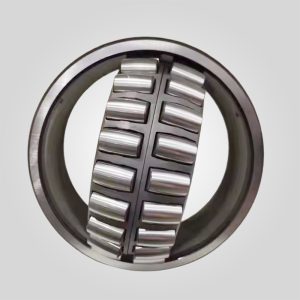
Bearing Housing Fretting: If you detect “fretting corrosion” (reddish-brown powder) around the bearing outer race, the housing bore may have become oval. This happens when the fit becomes loose. A worn bore will destroy new bearings in hours.
Stress Cracks: Inspect the transition zones (radii) near the toggle seat and the upper bearing housing using Magnetic Particle Inspection (MPI) annually. These high-stress areas are prone to fatigue cracking after 20,000 hours of operation.
Supply Chain & Compatibility
Our inventory covers critical components for the entire crushing circuit. Whether you need a massive Pitman for a primary jaw or a Jaw Crusher Pitman for a secondary unit, we ensure interchangeability. We also supply high-demand items like Cone Crusher Liner sets, allowing you to consolidate your procurement.
We provide full traceability for every casting, including heat treatment charts and dimensional inspection reports, ensuring you receive a component that meets or exceeds OEM standards.
Expert Engineer’s Note: Assembly & Logistics
Critical Reminder: Installing a Pitman requires precise alignment. When fitting the eccentric shaft and bearings, ensure the workspace is clean. Use thermal expansion (induction heating) for bearing installation, never direct flame. Also, check the toggle plate seating; a worn toggle seat on the Pitman will cause the new toggle plate to snap. We recommend replacing the toggle seat inserts whenever a new Pitman is installed.
“Authoritative Engineering Data: All critical metallurgical specifications and dimensional tolerances (e.g., ±0.05mm) are strictly governed by the master English documentation. While localized versions are provided for operational reference, the English original remains the sole binding authority for quality inspection and technical compliance.”

 English
 French
 German
 Spanish
 Russian
 Arabic
 Portuguese
 Turkish