

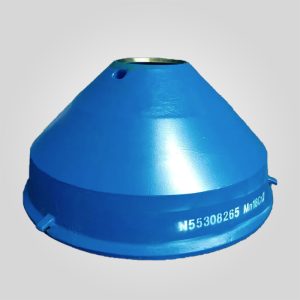
Cone Crusher Mantle & Bowl Liner: Mn18Cr2 Wear Parts
• Hardness Range: ≤220 HB (initial), increases with work-hardening
• Impact Toughness: >140 J/cm² (Ak/cm)
• Density: Approximately 7.8 g/cm³
• Work-Hardening Capability: Surface hardness increases under impact and abrasion
库存 22 件
PRODUCT
Description
Cone Crusher Mantle & Bowl Liner: Comprehensive Wear Parts Guide
The Mantle (Moving Cone) and Bowl Liner (Stationary Concave) are the fundamental Wear parts of any cone crusher. They function as a synchronized pair to define the crushing chamber geometry. Whether for a Metso HP, Sandvik CH, or Symons crusher, these components must withstand compressive forces exceeding 300 MPa while resisting abrasive gouging from granite, basalt, and iron ore.
As leading crusher part suppliers, we manufacture these liners using customized Manganese Steel alloys (Mn13, Mn18, Mn22). Our liners are engineered to optimize the “interparticle crushing” effect, ensuring consistent cubical product shape and maximizing throughput.
Technical Specifications & Material Standards
We adhere to ASTM A128 standards for austenitic manganese steel. The following table details the chemical composition and mechanical properties of our standard grades.
| Material Grade | Mn (%) | C (%) | Cr (%) | Application Scenarios |
|---|---|---|---|---|
| Mn13Cr2 (Grade A) | 11.0 – 14.0 | 1.0 – 1.3 | 1.5 – 2.5 | Soft/Medium Rock (Limestone), Low Impact |
| Mn18Cr2 (Grade C) | 17.0 – 20.0 | 1.1 – 1.4 | 1.8 – 2.5 | Hard Rock (Granite), High Impact (Standard) |
| Mn22Cr2 (Grade E) | 20.0 – 24.0 | 1.1 – 1.4 | 2.0 – 2.5 | Extreme Abrasiveness (Iron Ore/Quartzite) |
Mechanical Performance Data
- Initial Hardness: 200 – 230 HBW (Ductile State for safe installation)
- Work-Hardened Hardness: > 500 HBW (Achieved after approx. 50 operational hours)
- Impact Toughness: ≥ 140 J/cm² (Prevents cracking under shock load)
- Yield Strength: ≥ 350 MPa
Manufacturing Excellence: Beyond the Casting
Producing a high-quality Cone Crusher Liner requires more than just pouring molten metal. Our process includes:
- Heat Treatment: Solution Annealing at 1050°C followed by rapid Water Quenching. This dissolves carbides into the austenite matrix, ensuring the liner is tough, not brittle.
- CNC Machining: All seating surfaces (hooks, lands, and internal tapers) are machined to strict OEM tolerances. This prevents the “liner spin” phenomenon which can destroy the crusher’s head or adjustment ring.
- Profile Optimization: We offer redesigned cavity profiles (e.g., modifying the parallel zone length) to solve specific site issues like localized wear or poor product shape.
Field Diagnosis: The “Product Gradation Shift”
Don’t just rely on hours to decide when to change liners. Monitor your output.
The Symptom: If your product size analysis (PSD) shows a “coarsening” trend (e.g., your -20mm fraction drops from 80% to 60%) despite maintaining the same Closed Side Setting (CSS), your liners have lost their profile geometry.
The Cause: The “Parallel Zone” at the bottom of the liner has worn away, losing the ability to calibrate the final product.
The Action: Replace both the Mantle and Bowl Liner immediately. Continuing to run destroys efficiency and increases recirculating load.
Supply Chain & Global Compatibility
We supply aftermarket Crusher spares compatible with major global brands, including:
- Metso Nordberg (HP, GP, MP Series)
- Sandvik (CH, CS, S, H Series)
- Symons (Standard & Short Head)
- Terex (Cedarapids, Finlay)
All parts are shipped with detailed inspection reports verifying dimensional accuracy and material composition.
Expert Engineer’s Note: Wear Monitoring
Critical Maintenance Tip: When inspecting liners, look for “Galling” or “Peening” on the seating surfaces. If the metal looks smeared, the liner has been moving (loose). This usually means the epoxy backing was insufficient or the self-tightening mechanism failed. Always clean the seating surfaces thoroughly and apply fresh epoxy backing during every installation.
“Authoritative Engineering Data: All critical metallurgical specifications and dimensional tolerances (e.g., ±0.05mm) are strictly governed by the master English documentation. While localized versions are provided for operational reference, the English original remains the sole binding authority for quality inspection and technical compliance.”
 English
 French
 German
 Spanish
 Russian
 Arabic
 Portuguese
 Turkish