

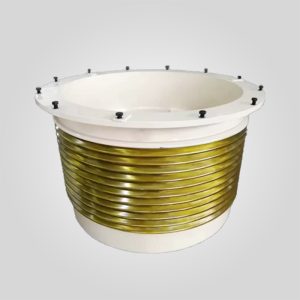
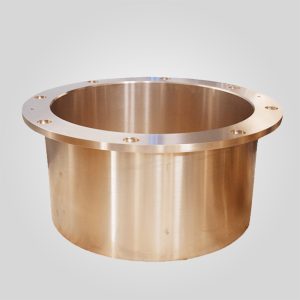
Cone Crusher Head Upper Bushing – OEM Reference for Symons 7ft / Metso HP Series
Material Grade: CuSn8 Tin Bronze (ASTM B271)
Dimensions (ID × OD × Height): Φ170mm × Φ230mm × 110mm
Hardness (HB): 85–105
Max Load Capacity: 1,200 kN
Operating Temperature : -40°C to +200°C
Typical Service Life: 8,000–12,000 hours
库存 55 件
PRODUCT
Description
The Cone Crusher Head Upper Bushing is a critical bronze wear component installed at the upper interface between the moving cone head and the crusher frame. From a mechanical engineering perspective, this bushing functions as a combined radial and axial load-bearing element, responsible for maintaining spindle concentricity, controlling axial displacement, and damping cyclic impact loads generated during compressive crushing. In high-duty cone crushers, this component operates under mixed lubrication conditions, elevated contact pressure, and repeated micro-sliding, making material selection, heat treatment control, and dimensional accuracy decisive factors for service life.
Based on two decades of field experience in hard-rock mining and aggregate production, premature failure of the head upper bushing is one of the primary root causes of spindle scoring, eccentric bushing overload, and abnormal vibration. Therefore, the following design and manufacturing specifications are defined strictly around metallurgical stability, predictable wear behavior, and repeatable installation accuracy rather than marketing claims.
Technical Highlights
- Controlled Bronze Metallurgy for High Contact Stress
The bushing is manufactured from tin bronze CuSn8 (ASTM B271) or aluminum bronze CuAl10Fe3 (EN 12163), depending on load spectrum. CuSn8 provides stable friction coefficients under boundary lubrication, while CuAl10Fe3 offers higher compressive strength for crushers exceeding 1,500 kN axial load. Chemical composition is verified by spectrometer analysis for each melt batch to avoid segregation-related soft zones. - Stress-Relieved and Machined with Predictable Clearance
After rough machining, the bushing undergoes thermal stress relief at 260–300°C to minimize residual stress distortion during final machining. The internal bore and outer diameter are finished to IT6–IT7 tolerance classes, ensuring consistent oil film thickness and preventing local contact pressure spikes during startup. - Surface Integrity and Non-Destructive Inspection
All load-bearing surfaces are turned and honed to Ra 0.8–1.6 μm. Each finished bushing is subjected to visual inspection and dimensional verification, with optional ultrasonic testing for aluminum bronze variants used in large-frame cone crushers where casting integrity is critical. - Thermal Stability Under Continuous Crushing Cycles
The selected bronze grades maintain mechanical stability up to 200–220°C, which aligns with real-world oil film temperatures measured at the head assembly during continuous crushing of basalt and iron ore. This prevents loss of interference fit and axial creep during long operating shifts.
Specifications Table
| Parameter | Standard Duty Configuration | Heavy Duty Configuration |
|---|---|---|
| Material Grade | CuSn8 Tin Bronze (ASTM B271) | CuAl10Fe3 Aluminum Bronze (EN 12163) |
| Typical Dimensions (ID × OD × Height) | Φ170 mm × Φ230 mm × 110 mm | Φ210 mm × Φ280 mm × 140 mm |
| Dimensional Tolerance | IT6–IT7 (ISO 286) | IT6–IT7 (ISO 286) |
| Hardness Range | 85–105 HBW | 95–115 HBW |
| Maximum Axial Load (Design Reference) | ≤1,200 kN | ≤1,800 kN |
| Recommended Operating Temperature | -40°C to +200°C | -30°C to +220°C |
| Typical Service Life (Field Data) | 8,000–12,000 hours | 10,000–15,000 hours |
Applicable Crusher Brands and Models
This upper bushing is dimensionally and functionally compatible with mainstream cone crusher designs widely used in mining and aggregate applications. All interfaces are designed as direct replacements based on OEM geometric references, without requiring modification of the head or frame.
| Brand | Compatible Models | Engineering Rationale |
|---|---|---|
| Symons | 4.25 ft, 5.5 ft, 7 ft (Standard and Short Head) | Matches original spindle taper ratio (1:50) and head seat geometry, ensuring correct axial load transfer and oil distribution. |
| Nordberg (Metso Outotec) | HP300, HP400, HP500 | Designed around hydraulic adjustment systems; controlled clearance prevents axial float under dynamic hydroset pressure. |
| Terex Cedarapids | TC51, TC66, CRC380 | Outer diameter tolerance matched to modular frame design, maintaining concentricity during high-speed head rotation. |
| Sandvik | CH420, CH430, CH440 | Aluminum bronze option reduces thermal expansion mismatch during high-frequency crushing cycles. |
| Chinese Domestic Brands | SBM SMH500, SMH750, Liming MC Series | Optimized for hard and abrasive ores common in China, including granite and basalt, with extended wear margins. |
Manufacturing and Quality Control Process
Each upper bushing is produced under a controlled manufacturing route. Raw bronze billets are cast or forged depending on size, followed by homogenization heat treatment to eliminate microstructural gradients. Rough machining is performed with conservative cutting parameters to avoid work hardening, particularly for aluminum bronze grades.
Final machining includes precision turning and boring on CNC lathes, with in-process measurement of critical diameters. Hardness is verified using HBW testing at multiple circumferential points to ensure uniformity. For heavy-duty models, optional magnetic particle inspection or ultrasonic testing is applied to confirm internal integrity before shipment.
Engineer’s Advice
- Installation and Clearance Control
Before installation, always measure the spindle journal and frame bore rather than relying solely on nominal dimensions. Recommended diametral running clearance is typically 0.08–0.12 mm for standard frames and slightly higher for large machines. Excessive interference will lead to oil starvation during cold starts, while excessive clearance accelerates impact wear. - Lubrication and Operating Discipline
Ensure that the lubrication system delivers clean oil with viscosity matched to ambient temperature and load. For most cone crushers, ISO VG 150–220 oil is appropriate. Avoid extended idle rotation without load, as boundary lubrication conditions at low speed can increase adhesive wear on the upper bushing surface.
Related Products and Spare Parts
This component is part of a complete range of cone crusher wear and replacement parts, including head bushings, eccentric bushings, thrust bearings, and main shafts. For a full overview of compatible assemblies, please refer to our cone crusher parts catalog.
From an engineering and lifecycle cost perspective, a correctly specified and properly installed head upper bushing contributes directly to stable crusher operation, reduced vibration levels, and predictable maintenance intervals. In high-throughput operations, this translates into measurable reductions in unplanned downtime and secondary component damage.
“Authoritative Engineering Data: All critical metallurgical specifications and dimensional tolerances (e.g., ±0.05mm) are strictly governed by the master English documentation. While localized versions are provided for operational reference, the English original remains the sole binding authority for quality inspection and technical compliance.”



 English
 French
 German
 Spanish
 Russian
 Arabic
 Portuguese
 Turkish