

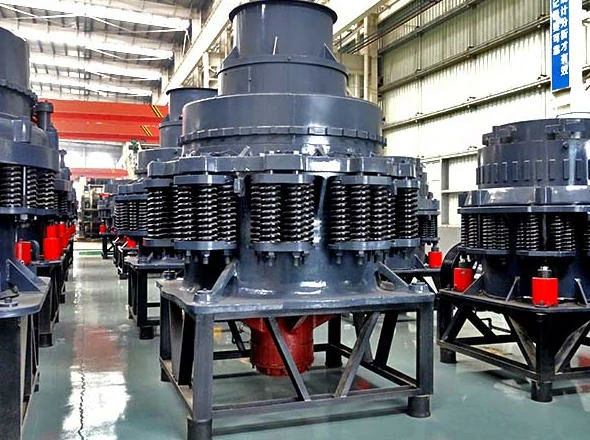
The profitability of a comminution circuit is not determined by the brand on the nameplate, but by the kinematic interaction between the crushing chamber geometry and the specific ore characteristics. For a procurement engineer or site manager, choosing between a Spring (Symons-type), Single-Cylinder (GP/CH style), or Multi-Cylinder (HP style) cone crusher requires analyzing three variables: Eccentric Speed (RPM), Crushing Force (kN), and Discharge Geometry.
This guide replaces general marketing claims with specific mechanical parameters to determine the correct machine for your Crushing Plant layout.
Field Case: The Cost of “Good Enough”
Failure Analysis Report: I recently audited an aggregate plant in Nevada running three legacy 4.25ft Spring Cones. They were rejecting 25% of their product due to a Flakiness Index >30%. The root cause? The low eccentric speed (~485 RPM) of the spring cone was relying on compression crushing rather than inter-particle lamination. By swapping the tertiary stage to a Multi-Cylinder Hydraulic unit running at 1050 RPM, we reduced flaky particles to <10% and eliminated the need for a VSI reshaping circuit.
1. Spring Cone Crusher (The Symons Legacy)
While often viewed as obsolete technology, the spring cone remains relevant for specific low-CapEx applications. However, its mechanical limitations are significant.
- Mechanism: Uses external coil springs for Tramp Iron Relief. If uncrushable material enters, the springs compress to lift the adjustment ring.
- Critical Flaw: The tramp release is violent and imprecise. Repeated events fatigue the Bronze Bushings (C93700) and can cause “bell-mouthing” of the adjustment threads.
- Adjustment: Manual or hydraulic motor rotation of the bowl. Adjusting Closed Side Setting (CSS) under load is generally impossible, leading to significant downtime.
2. Single-Cylinder Hydraulic (The “Floating Shaft” Design)
Commonly seen in Sandvik CH/S series or Metso GP series. The main shaft is supported directly by a hydraulic cylinder at the bottom.
- Kinematics: The shaft “floats” on oil. The steep crushing angle allows for a higher feed intake capability.
- Hydraulics: The system relies on a high-pressure accumulator (typ. Nitrogen pre-charge 40-60 bar) to handle tramp release.
- Application: Ideal for Secondary Crushing where feed size varies. The steep head angle accepts larger stones without bridging.
3. Multi-Cylinder Hydraulic (The “Fixed Shaft” Design)
Commonly seen in Metso HP series. The main shaft is fixed to the frame; the eccentric sleeve rotates around it, and the bowl is held down by hydraulic clamping cylinders.

- Lamination Crushing: Operates at high speeds (Countershaft speed 800-1100 RPM). This density creates “rock-on-rock” crushing, improving particle shape (cubicity).
- Protection: Accumulators connected to the clamping cylinders allow the entire bowl to lift during a tramp event, instantly resetting the CSS.
- Application: The gold standard for Tertiary/Quaternary Crushing or pebble crushing where product shape and fine gradation are critical.
Technical Parameter Comparison
Do not base decisions on “efficiency” labels. Base them on these engineering specs.
| Specification | Spring Cone | Single-Cylinder (Hydraulic) | Multi-Cylinder (Hydraulic) |
| Eccentric Speed | Low (~480 – 580 RPM) | Medium (~700 – 800 RPM) | High (~850 – 1100 RPM) |
| Crushing Force | Low (Spring Tension Limited) | Medium (Hydraulic Piston) | High (Multi-Piston Clamp) |
| Product Shape | Poor (Flaky/Needle-like) | Good | Excellent (Cubic) |
| CSS Adjustment | Manual/Slow (Requires Downtime) | Instant (PLC Controlled) | Instant (PLC Controlled) |
| Wear Part Material | Standard Mn13Cr2 | Mn18Cr2 (Recommended) | Mn18Cr2 / Mn22Cr2 (Required) |
| Maintenance Intensity | High (Bronze bushing maintenance) | Low (Fewer moving parts) | Medium (Complex seal kits/hydraulics) |
Procurement Decision Logic: Which Machine Fits?
When evaluating quotes, map your operational constraints to the machine type:
Scenario A: Secondary Crushing & Large Feed Size
Selection: Single-Cylinder Hydraulic.
Why? The steep mantle geometry allows for a larger feed opening (OSS). The “Floating Shaft” design handles variable feed loads better than fixed-shaft designs. Ensure the Dust Seal Ring is upgraded to a high-temp polymer if operating in hot climates (>40°C).
Scenario B: Aggregate Production (Concrete/Asphalt)
Selection: Multi-Cylinder Hydraulic.
Why? ASTM standards for concrete aggregate often require a flakiness index <15%. Only the high eccentric speed and high crushing force of a multi-cylinder unit can achieve this via lamination crushing.
Warning: These machines are sensitive to “trickle feeding.” They must be choke fed (cavity full) to function correctly. Running them empty damages the Socket Liner.
Scenario C: Remote Mining / Tight Budget
Selection: Spring Cone (with Caution).
Why? If hydraulics expertise is unavailable on-site, the mechanical simplicity of a spring cone is an asset. However, ensure you stock extra Bronze Bushings and have a rigorous lubrication schedule (ISO VG 150/220 oil) to prevent thermal seizure.
Conclusion: The TCO Reality
While a Spring Cone may be 30% cheaper upfront, the lack of automation and poor product shape will cost significantly more in the long run through unsellable aggregate and frequent downtime. For modern Crusher operations targeting high-spec aggregate or high mill throughput, the Multi-Cylinder Hydraulic system is the only compliant choice under 2026 efficiency standards.
Next Step: Uncertain about the hydraulic capacity required for your ore hardness? We can run a simulation based on your Bond Work Index (Wi). Would you like to request a crushing circuit simulation?


 English
 French
 German
 Spanish
 Russian
 Arabic
 Portuguese
 Turkish