
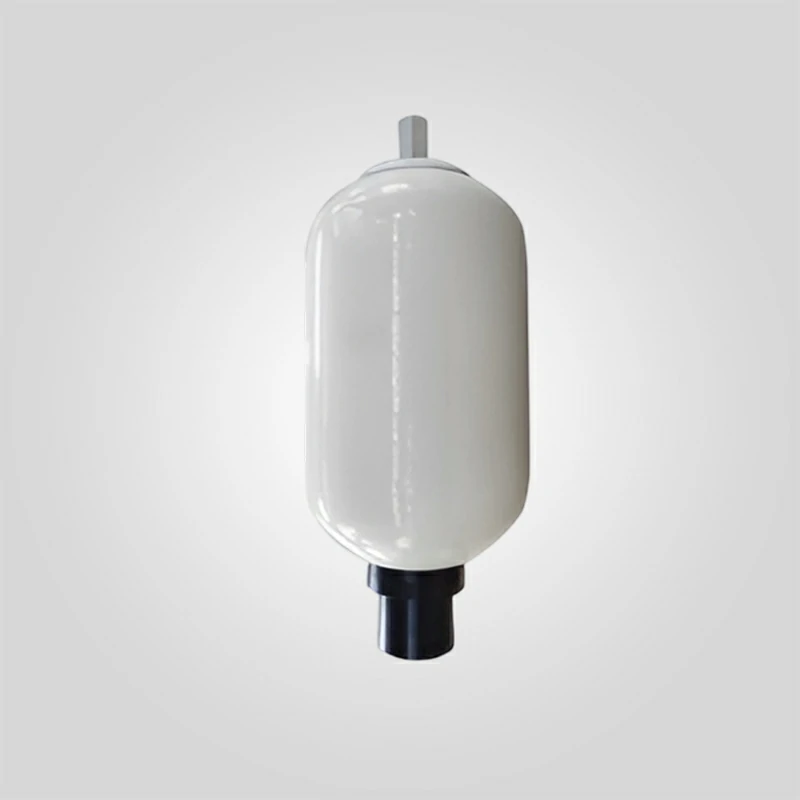
Cone Crusher Accumulator | Nitrogen Bladder Type | Hydraulic Spares
Type : Bladder Accumulator / Piston Accumulator (Customizable per application)
Shell Material :Carbon Steel (ASTM A516 Gr.70) / Stainless Steel (ASTM A240 Gr.304)
Bladder/Seal Material: Nitrile Rubber (NBR) / Polyurethane (PU) / PTFE (For High-Temp Applications)
Capacity: 5 – 50 Liters (Matched to crusher hydraulic system volume)
Working Pressure :200 – 350 Bar (Conforms to OEM specifications)
Temperature Range: -20°C to +80°C (Seals resist extreme mining/quarry environments)
库存 43 件
PRODUCT
Description
Cone Crusher Accumulator: Hydraulic Shock Absorption & Tramp Safety
The Nitrogen Bladder Accumulator is the kinetic buffer of your cone crusher’s hydraulic safety system.
Serving as a vital Cone Crusher Spare Part for Metso HP, Symons, and Sandvik CH series, this component stores pressurized hydraulic fluid to provide instant “Tramp Release” functionality.
Unlike simple storage tanks, our accumulators are engineered to absorb the massive pressure spikes (>300 Bar) generated when uncrushable objects enter the chamber, protecting the main frame, cylinders, and pumps from catastrophic fatigue failure.
For mining maintenance planners sourcing from crusher part suppliers, the certification of the pressure vessel is paramount.
Our accumulators are manufactured to ASME VIII Div. 1 or PED 2014/68/EU standards, ensuring they are safe for operation in high-vibration mining environments.
Core Engineering Advantages
- Rapid Response Bladder: We utilize premium NBR (Nitrile Butadiene Rubber) or Low-Temp Hydrin® bladders with an integrated anti-extrusion button. This design allows the bladder to compress and expand in milliseconds, allowing the Adjustment Ring to lift instantly during a tramp event.
- Seamless Shell Construction: The pressure vessel shell is forged from high-strength Chrome-Molybdenum steel (34CrMo4) without welds in the stress zones. This construction withstands cyclic pressure fatigue significantly better than welded-shell alternatives.
- Gas Retention: Equipped with heavy-duty gas valves (Schrader or Minimess style) that feature double-sealing caps to prevent Nitrogen permeation over time, reducing the frequency of maintenance recharge intervals.
Technical Specifications & Certification
Our accumulators are drop-in replacements for OEM units (Parker/Olaer/Hydac equivalents), matching the fluid port geometry and mounting brackets.
| Parameter | Specification | Standard/Notes |
|---|---|---|
| Component Type | Bladder Accumulator | Tramp Release / Hydroset |
| Shell Material | Forged Alloy Steel (34CrMo4) | ASME / PED Certified |
| Nominal Volume | 6L, 10L, 20L, 38L, 50L | Matches Crusher Size (e.g., HP300=10L) |
| Design Pressure | 330 Bar (4785 PSI) | Tested to 1.43x Design Pressure |
| Bladder Material | High-Nitride NBR (Standard) | -20°C to +80°C range |
| Net Weight | 25 kg – 120 kg | Corrected from Source |
| Fluid Port | SAE 2″ / BSPP / Flanged | High Flow Design |
Compatible Crusher Models
Engineered for hydraulic systems requiring rapid oil displacement and pressure stabilization:
| Brand Series | Application | Function |
|---|---|---|
| Metso Nordberg HP | HP100 – HP800 | Tramp Release System (Ring Lift) |
| Symons / Terex | 3ft – 7ft Hydraulic | Cavity Clearing & Tramp Protection |
| Sandvik CH/CS | CH430 – CH880 | Hydroset Pressure Dampening |
Performance & Diagnostics
A failed accumulator turns a safety system into a rigid lock, leading to structural damage.
Benefits of maintaining healthy accumulators include:
- Cylinder Protection: By absorbing shock waves, the accumulator prevents hydraulic hammer, which blows out the seals on Tramp Release Cylinders.
- Pump Longevity: It smooths out the flow pulsations from the hydraulic pump, reducing cavitation and noise levels in the HPU (Hydraulic Power Unit).
Field Diagnosis: Accumulator Health Check
Accumulators are often neglected until it’s too late. Check these indicators:
- “Dead” System Response: If the crusher adjustment ring slams down hard after a tramp event instead of settling gently, the nitrogen bladder is likely empty or ruptured.
- Oil in Gas Valve: Remove the protective cap on the top gas valve and depress the core slightly. If hydraulic oil spurts out, the bladder has ruptured. Replace immediately.
- Rapid Pressure Drop: If the system pressure drops instantly when the pump turns off (with no holding time), the accumulator has lost its pre-charge.
Expert Engineer’s Note: Nitrogen Pre-Charge
Critical Maintenance Advice: An accumulator is useless without the correct Nitrogen Pre-Charge ($P_0$).
A common mistake is charging it to the system working pressure ($P_1$).
Do not do this. The pre-charge should typically be set to 90% of the minimum system working pressure for tramp release applications, or 60-70% for pulsation dampening.
Refer to your specific crusher manual (e.g., Metso HP manual usually specifies around 6-8 MPa for tramp circuits depending on the model).
Check the pre-charge every 2,000 hours using a dedicated charging kit.
Never use Oxygen or Air—this will cause an explosion. Use Dry Nitrogen only.
“Authoritative Engineering Data: All critical metallurgical specifications and dimensional tolerances (e.g., ±0.05mm) are strictly governed by the master English documentation. While localized versions are provided for operational reference, the English original remains the sole binding authority for quality inspection and technical compliance.”



 English
 French
 German
 Spanish
 Russian
 Arabic
 Portuguese
 Turkish